An interview with designer Guillaume Verdier
by Vendee Globe on 1 Jan 2010
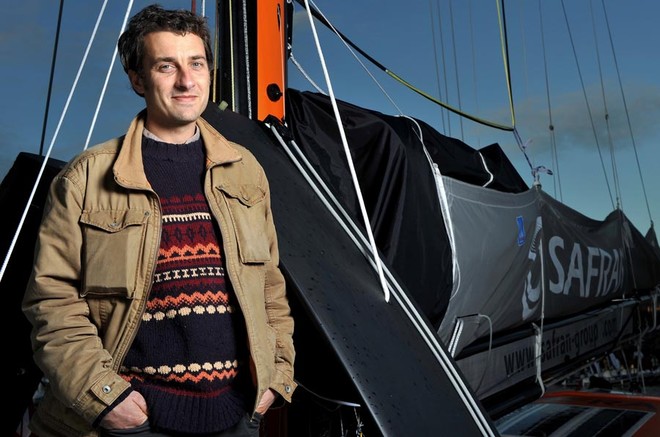
Guillaume Verdier/VPLP Vincent Curutchet / DPPI / Vendée Globe
Safran and Groupe Bel, both designed by Guillaume Verdier/VPLP, finished first and second in the highly competitive field of IMOCA Open 60’s in the recent Transat Jacques Vabre. Both were lighter, narrower, easier-driven boats departing from the normal pattern of designs in the last Vendée Globe.
Both Jean-Pierre Dick and Vincent Riou both have new IMOCA Open 60’s from the VPLP/Verdier team. JP Dick’s new Paprec-Virbac is well advanced at Cookson’s in New Zealand, while Riou’s new PRB is being completed at CDK in Port La Foret. Jean Le Cam is reported to have said he would like a new IMOCA Open 60 from the partnership and Michel Desjoyeaux is believed to be in regular discussion with them. It seemed like the ideal moment to talk to Guillaume Verdier about these developments.
Guillaume, you appear to be on the crest of a wave at the moment?
'When Safran was second in the 2007 Transat Jacques Vabre, I thought this would never happen again for me in my career and now it happens again, almost better with Safran and Groupe Bel. So of course it is a great turn for me. But you know I see my job as like the sea with waves, and so it has to go down from here! I am a bit scared that I have a few Open 60’s to design.
How do you evaluate the successes, the 1-2 for Safran and Bel?
'It is important to say that it is not because of the boat. The sailors did a fantastic route. When I saw before the start that it would be very dodgy to go west, and Michel Desjoyeaux took his option... Anyway they took the decision to go full west, I was amazed how straight they went. They did not make much of a descent at all. I think it was the first time I have seen such a direct route, and they did share the work so well beween Caudrelier and Guillemot, in a very nice way.'
The two, Safran and Bel, are very similar but what differences can you see?
' There is not much difference between the two boats. They do not behave exactly the same as Bel with a wing mast is a little better in terms of aerodynamic performances, but probably it is compensated for because Safran is a little bit lighter.'
What is your greater passion, maths and science or sailing? And you had the designer Juan K at college with you at the same time?
'I studied mathematics a lot, but sailing was always my passion. I was not so passionate in maths, but more so in Physics. When I finished in Southampton in 1993 there was so little work and I went to do the Masters and then on to study for a PhD in Copenhagen (which he has not yet completed and his place is still open), at the time it was necessary to carry on, really to avoid going out into the market. Juan K was either one or two years after me, but I did not go into the job market until after him. My opinion at the time was that I needed to be very specialised. It is not good to be a just a good draughtsman or something, so I worked a lot in structures and structural calculations. I had some doors opened that way and started in structural calculations with Finot and was there for five and half years. When I started it was with Group 4 for Mike Golding, I was in charge of the design of the boat at Finots. I did Mike’s first keel, which hit the ground in Cape Reinga, the keel was OK, but the boat was not (laughs!).
And what did you learn most of all at Groupe Finot where most of the winning Open 60’s were coming from?
' It was a very small company when I was there. We had to do everything and so I learned there that a boat has to be redundant in the structure. Really they taught me everything about my job at Finot. I had the tools when I arrived, but they taught me the job. They left me the opportunity to develop my own tools, and I have gone on doing that whether that is in hydrodynamics, in structures.'
Why did you team up with VPLP?
'I had a quite a bit of experience with Open 60’s and Vincent (Lauriot Prévost) had no experience in monohulls. He did not know the IMOCA rule, the rule system, the hull shape behaviour. He did not have the culture. But he had everything else. He had the organisation, the culture of very light boats and the culture of very organised systems to design boats. And we were great friends. Once we said ‘why not design an Open 60 together?’ For me I could never have touched a sponsor with the size of my company. I was not known enough. Vincent needed the knowledge of monohulls. For both of us it was an opportunity situation. I was presented to Safran together with VPLP and Marc Guillemot. It made best use of our respective strength to be presented as a unit. It was a nice story. But we are still competitors as well on other projects. On the trimaran side I did Actual, which was not so lucky, and Vincent will do a Class 40.'
And how does it work between the two groups?
'We are not exactly married! He does the organisational planning and puts pressure on me, saying we need the structural plans for this, or the design for this. I work some times in their office, or they come to my office. Vincent does the project management, the deck plan, sail plan the appendage configuration. I do the appendage design – the structure and the shape, but not the position. I do the hull shape, even so I show them and explain why we are doing this or that. The boats are the product of so many exchanges.
How are the developments and trends for the next generation, the newer boats?
'We try to make a boat which is polyvalent. We try to make boats which are fast without having too much water inside, which are really capable of sailing with the nose trimmed up, out of the water. I try to find some hull shapes which are better in that way. It is a combination overall of hull shape design, ballast, ballast design, keel design and position of daggerboards. On the rig side we have kept on developing step by step with a sailmaker. They are all small evolutions, it is always small steps. The change of the rule matches really well to Safran. We are lucky in a way. It makes it more complicated now to have a rule which is tighter.'
Would you say that Safran is a boat which requires less work from the sailor?
'Our thought with Safran was that the human scale is much more important than the machine scale. If you look the power of the boat is not so much of a problem. The problem with monohulls is you have the spinnakers, and because it goes quite slow, you always have to match the maximum speeds. If you are a very, very strong guy you can change more often than someone who is weaker. But it is a real, real pain changing the foresails. On an Open 60 there is less apparent wind than on a multihull and so you have to work like crazy. If you make a boat which is so powerful that you need to change the sails every five minutes to maximise that power, to match the wind then the guys are destroyed. So with Safran with first parameter we tried to fix was how much kilograms you can move. That made the mast height, and from there that decides the platform underneath. We worked the opposite way from others. It is like looking at a mountain range. You can choose many different peaks. You are not obliged to choose the same route. The crest you choose is in discussion with the sailor. If you have a sailor who is determined to be very physical and is determined all the time to match exactly the VPP you do a boat which is more powerful with more sail area.'
And how many boats do you expect, or would you like to have in the next Vendée Globe?
'At least four: Safran, Groupe Bel, PRB and Paprec Virbac and then perhaps if we are lucky we have another one or two…but I don’t know. You see for us that a boat is not finished when it races. It is always very, very stressful. I keep my phone in my pocket and every time the phone rings, I have to check who it is. I have many phone calls in the night. I ask the sailors to call me very often so that they don’t call me only when it breaks
ww.vendeeglobe.org
If you want to link to this article then please use this URL: www.sail-world.com/64997