The Rise and Rise of the Olympic Dinghy
by Gerald New on 19 Aug 2007
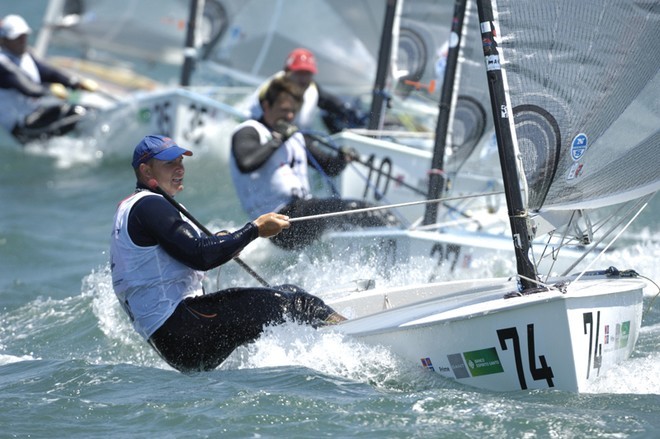
Finn ISAF Worlds 2007 Steve Arkley
http://www.sailshots.co.uk
With the future of keelboat events at the Olympic Games poised on a knife edge it is interesting to look at the changes that have taken place in the composition of the sailing events in the modern Games.
Yachting has changed and nowhere is this demonstrated more obviously than in Olympic sailing events. In 1900 yachting in the Olympic games comprised of nine events involving yachts from 1/2 ton to 20 ton. In 1936, the last Games before WWII, the classes consisted of three keelboats; the Star class, the 6 metre and the 8 metre classes and one dinghy, the Olympic Monotype (like an early Finn).
In the first Games after the end of the war, held in Britain at Torbay in 1948, the classes used were still just the one dinghy, the Firefly for the single hander event and four keelboat classes; the Star, Swallow, Dragon and 6 metre class. The Firefly event was a first appearance and a first Gold for the great dinghy sailor Paul Elvstrom from Denmark.
In 1952 there was still only one dinghy class, the Finn, and four keelboat classes; the Star, Dragon, 5.5 and 6 metre classes. Britains only medal was a Silver in the Finn class.
But, outside of the Olympics a revolution was taking place in sailing. The few racing dinghies, which in Britain had been only a handful of classes such as the International 14, and National 12, had been a complicated construction of steamed ribs, fixings and various forms of planking. These building methods were being replaced by the introduction of plywood and waterproof glues allowing simpler construction and eventually amateur construction.
In Britain designers such as Jack Holt and Ian Procter produced a series of one designs that sold by the thousands and feed a boom in recreational dinghy sailing and racing.
While this moved the expensive, mystical class era of yachting on at the grass routes level, it had little immediate effect at the international level. The forerunner of the ISAF, the IYRU, was still heavily big boat influenced having been set up to oversee the International meter rule and a set of racing rules. It met annually and was really under the control of the Britain’s YRA (forerunner of the RYA), both the Chairman and the Secretary being from the YRA.
1956 saw the first increase in the dinghy selection. The Games were held in Australia and as well as the return of the Finn single-hander, a two man dinghy was chosen, the Sharpie 12m2. Not exactly a lightweight flyer, but it did double the dinghy participation in the Olympics and one of the keelboat classes was dropped - the 6 metre.
In 1960 at the Rome Olympics the Flying Dutchman class replaced the gunter rigged Sharpie, introducing the trapeze for the crew and a spinnaker to the dinghy events. The Finn was retained along with the same three keelboat classes. Paul Elvstrom took a third Gold medal in the single-hander event but this Games was a low-point for Britain, not a single medal.
The classes remained the same for the 1964 and '68 Games with a first Gold for Britain's Rodney Pattison in the Flying Dutchman two-man event in '68.
In 1972 there were several changes with the addition of the Tempest, a lightweight twoman keelboat with trapeze and the replacement of the 5.5 metre class with the Soling threeman keelboat added to the Dragon and Star keelboats. This made the Olympic classes all one designs for the first time.
Upheaval in the classes for the 1976 Games in Montreal, when a major reorganisation of the events designated two classes for men only, the newly introduced 470 dinghy as the two-man and the Finn retained for the single-hander. With the removal of the Dragon and Star keelboats and the addition of the Tornado catamaran, dinghies now outnumbered the keelboats for the first time.
At the 1980 Games the Star returned to replace the Tempest, the split was now four dinghies, the Finn, 470, Tornado and FD, and two keelboats the Star and the Soling.
1984 and this Games in Los Angeles, USA introduced the Sailboard which as the Windsurfer had been a huge world-wide hit and although more used as a recreational surfboard it quickly became popular as a racing event, particularly in countries without a yacht racing background.
Despite Britain's much trumpeted recent success in the dinghy classes at the Olympic Games, in 1984 they only managed one medal, a Bronze in the FD. The USA won seven medals including three Gold.
1988 and the sailing events became eight with the addition of a separate women's event using the 470 trapeze dinghy. This meant there were now six dinghy events counting the sailboard and catamaran events, and two keelboat events.
The Games in 1992 were held in Spain at Barcelona and the sailing events expanded again, to ten, with seperate women's events on the Sailboard and a new single-handed, the Europe added to the existing 470 women's events. The additions brought the dinghy classes to eight to the keelboats two.
1996 at the Atlanta Games, saw the introduction of the Laser as a lightweight men's single-hander and the dropping of the FD. The two keelboats were retained so the split versus the dinghy classes remained the same. The main thrust of change since '88 had been the introduction of separate women's events, now formalised at three - a board, a single-hander and a two-person dinghy. And with the introduction of the 470, Sailboards and the Laser, driving down of the entry-level cost, to continue to widen the number of countries that could afford to compete.
The return of the Games to America may be considered the turning point for the composition of the sailing events and the first glimmering of a revival in Britain's performance at the Olympics. 1996 saw two Silver medals for Britain, hardly a great revival but they involved names that have come to symbolize the modern Olympic success of what is now known as TeamGBR - Ben Ainslie in the Laser and John Merricks and Ian Walker in the 470.
The Atlanta Games also saw 22 countries winning a sailing medal, compared with nine in 1948 and only twelve as recently as 1992.
The next Games in 2000 went back to Australia, Sydney this time and here at the home of skiff racing the 49er, an asymmetric, two-man trapeze dinghy was added, a replacement for the FD dropped in 1994, and the number of sailing events reached eleven, with the two keelboat classes retained - the Star and the Soling.
Britain made the break through in Sydney - three Gold medals, the Finn, Laser and Europe and two Silver, the 49er and the Star - TeamGBR were on their way.
2004 and the Games at the home of the Olympics, Athens, Greece. Once again the classes changed, but this time with the addition of a keelboat class, the Yngling as a women's keelboat event. The Soling was dropped so retaining the dinghy to keelboat split at nine to two but the sailing events were now firmly split along male/female lines, with four events for each and three so called Mixed events, although these were in reality men's events.
For Britain the medal total was five again; two Gold, the Finn and Yngling and a Silver in the 470 and two Bronze, the Sailboard and the 49er.
So where now for the dinghy in Olympic sailing? The once all Keelboat Olympics have become a dinghy dominated event, with the rise of the dinghy only halted by the participation limits placed on the sailing events. Allied to the changes in the make-up of the sailing events has been the drive by the ISAF to formalise the Olympic classes as a professional race circuit (ISAF will develop an elite competition structure and schedule). This will reach is next stage with the introduction of the World Cup of ISAF grade one events - MOCR, Melbourne, Hyeres, Princess Sophia, Holland and Kiel - in 2008.
In the up-coming Games in China at Qingdao, the event will consist of four clas
If you want to link to this article then please use this URL: www.sail-world.com/36795