Brindabella gets a new IRC friendly keel
by Helen Hopcroft on 7 Jun 2007
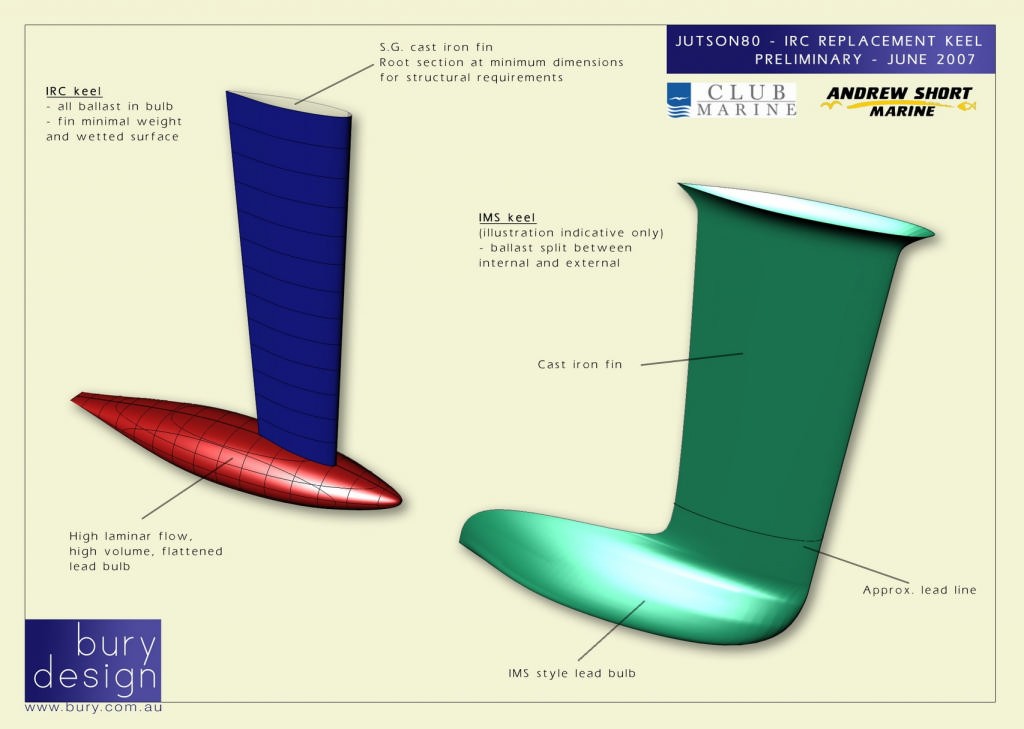
Possible design of Brindabella’s new keel Andrew Short Marine
www.andrewshortmarine.com.au
The famous racing yacht Brindabella was recently purchased by award winning Sea Ray distributor Andrew Short. She will undergo extensive modifications, including a reshaped keel, to make her IRC friendly. With Andrew Short reportedly in the final stages of negotiation with a major sponsor, expect to see Brindabella screaming past you on the water soon.
Andrew Short said that he was thrilled to have been able to purchase a piece of Australian racing history from previous owner George Snow. Brindabella still holds the race records for the Sydney Mooloolaba, Sydney Gold Coast, Sydney Wollongong, Sydney Newcastle and the Bird Island races.
‘I’m really looking forward to it. I’ve done a lot of racing against Brindabella in my last boat- the Volvo 60 Andrew Short Marine and watched it slowly disappear off on the horizon…I am looking forward to being further up the front end of the fleet.’
Paul Bury, of Bury design, has been charged with remodelling Brindabella so that she rates well under the IRC rule. He is working closely with Andrew Short to ensure that every single change they make to the boat significantly improves her handicap.
‘I’ve been commissioned by Andrew to take a look at optimisation of the boat under the new rule…A typical IMS to IRC conversion issue is that IMS favoured heavier displacement, lower stability boats while IRC essentially doesn’t directly rate stability. So there’s a fundamental difference in the two rules in that sense.’
‘We’ll be focussing more on increasing stability and then adding the horsepower through modifications to the sail plan.’
Brindabella’s original keel was replaced about six years ago with a ‘relatively light weight keel’ in order to rate well under IMS. Bury plans to remove Brindabella’s sixteen hundred kilos of internal ballast and to move all of this weight onto her keel bulb. Although the draft will stay the same:
‘…the lead will be concentrated lower and there’ll be more of it.’
He plans to reduce the weight and surface area of the keel fin in order to reduce drag and thus increase efficiency. The majority of the ballast will be located in the bulb not the keel fin, and the new bulb will be a slightly flattened, sleek torpedo shape.
‘IMS had certain limitations on the bulb shape, but we’re not constrained by that anymore.’
Brindabella’s total weight will probably remain more or less the same; it will just be redistributed with the goal of creating a boat that is faster on all points of sail.
‘You can’t really reduce the overall displacement of the boat significantly because they’ve already attempted to do that as much as possible from her original configuration. If you do that you end up with a boat that floats too high out of the water and doesn’t sit on her lines well.’
Bury noted that the IRC rule was a much simpler than the old IMS system, and he explained the key differences between the two systems.
‘IMS was a velocity prediction program or VPP based rule - it took into account quite a detailed list of geometries and weights and information concerning a yacht; this included an extensive measurement and a full digitalization of the hull, keel and the rudder as well as an inclination experiment to determine stability.’
‘The VPP then predicted the performance of the boat at various points of sail. It was a complicated system …and the underlying velocity prediction programme was constantly under development.’
‘When Brindabella’s new keel was done, about six years ago, the stage of development of the IMS velocity prediction programme was that it overrated the effects of stability…so essentially if you had a very stable boat the IMS would predict that you were going to go faster than you actually did. As a result lower stability racing boats became popular due to their handicap advantage. ’
‘The new rule, the IRC rule, is a single number rule which means that the measurements of your yacht are sent away to an organisation and they determine, through the use of a hidden rule, your yachts handicap number or TCC …It’s one number that applies to all yacht racing that you do with that boat in that configuration.’
‘It’s based upon the Royal Ocean Racing Club’s formulations which are secret and which are reviewed once a year. The measurement procedure that you go through is much simpler than under IMS and there’s no velocity prediction program that’s been used, or that is being known to be used.’
‘They take into account the draft of the boat and the type of keel configuration, so it’s a fair way forward in the optimisation of an IMS boat to increase the righting moment generated by the keel.’
Grunt above the waterline will be generated by new spinnakers and headsail configurations. ‘We’re probably going to focus our attentions on the reaching sails’ said Bury, noting that Brindabella’s hull shape has ‘somewhat of a reaching orientation in her design.’ They have decided to leave the dimensions of the mainsail as is, but a fixed bowsprit will probably be added so an asymmetrical spinnaker can be flown. There is also talk of a new code zero headsail.
Paul Bury has a long history of involvement with Brindabella. After graduating from RMIT’s Aerospace Engineering department twelve years ago, he started work with Brindabella’s designer Scott Jutson, and actually worked on some post launch aspects of her design. He was a racing crew member on the boat for about three years, and then moved to Europe to take up a job with Wally Yachts.
Two years ago he started his own design office and hasn’t looked back. He says that he is looking forward to working on Brindabella again, and is hoping that the changes to the keel and sail configuration will keep her at the front of the fleet.
‘The task at this stage is to work out the actual performance benefits the boat will see through the modifications using our in-house VPP and to compare these with the subsequent handicap effects. The aim is to have a boat that is fast and fun to sail and also rates well under IRC by making these changes.’
Contact details;
Andrew Short Marine
1 Box Road
Taren Point, NSW 2229
Telephone (02) 9524 2699 or (02) 9524 2280
www.andrewshortmarine.com.au
sales@andrewshortmarine.com.au
Bury Design
www.bury.com.au
info@bury.com.au
PO Box 17 Metung VIC 3904
Telephone (03) 5156 3089
Mobile 409 865 535
If you want to link to this article then please use this URL: www.sail-world.com/34424