The AC Finalist's Arms Race, who has the edge?
by Brett Bakewell-White on 1 Jun 2007
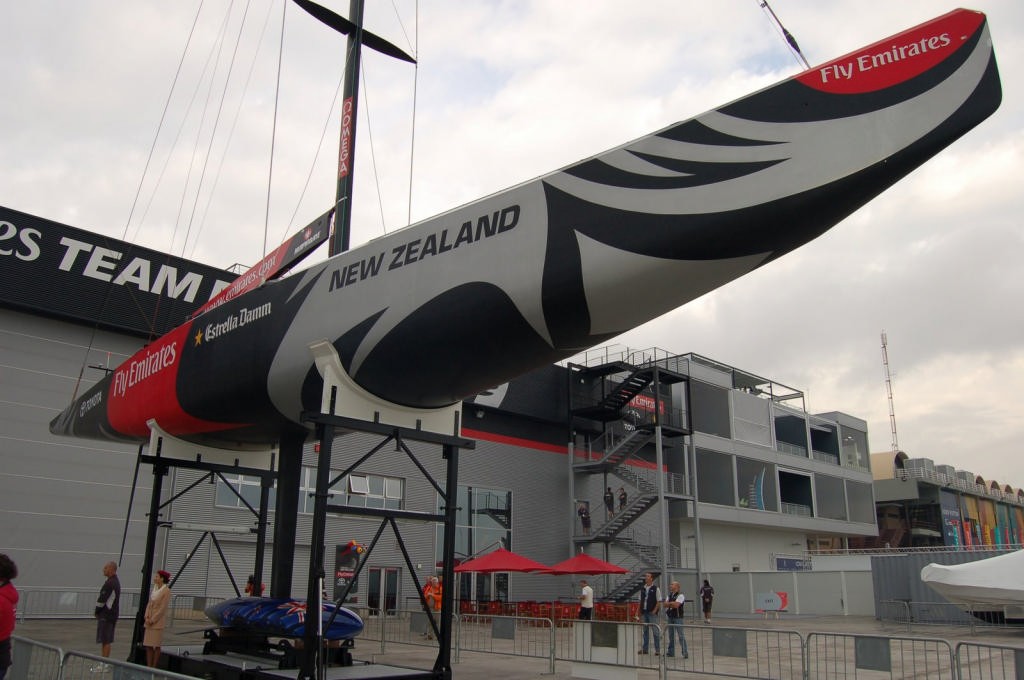
NZL-92 AC Unveiling 2007. "ETNZ is almost knuckle shaped in the forward waterlines - almost scow like - and this probably accounts for the noticeably more messy bow wave." Valenciasailing.com
http://www.valenciasailing.com
Looking at the three remaining contenders for the 32nd Americas Cup, who has the technological edge when it comes to the boats?
The reality is that the evolution of the IACC boats has almost reached its zenith. There have now been 100 of these boats built over the eighteen year life of the class – more than the 12 Metre class that competed for the Americas Cup for the 40+ years following World War Two. This rapid evolution is due largely to the use of computers and the large numbers of challengers in modern times.
All of the contenders are in the same corner of the rule ‘box’ and so the difference is in the detail – a sure sign of this is when the boats get ugly. Hard corners, lumps, and extremes are a sure sign that there are no major breakthroughs left in terms of fundamental concept and so the designers have begun to explore how hard they can push the rule to gain those last little fractions.
All three of the remaining contenders are remarkably similar but at the same time distinctly different. In general the hull profiles are similar, the sheerline is straight and level with a ‘ramp’ at the bow to meet the freeboard requirements of the rule – ETNZ are the most extreme here. The aft run of the boats is controlled by the rule and so all of the boats have a similar stern profile that extends well aft of the static waterline in order to gain as much unmeasured sailing length as possible. The bows all sport the Davidson double knuckle profile to maximize waterline below the measurement point.
The profile of the midsections do however differ, with both Alinghi and Luna Rossa very flat fore and aft, whereas ETNZ has a more conventional rocker profile. This possibly indicates that ETNZ may be more maneuverable as a result.
Each of the design teams has pushed substantial amounts of volume forward to increase the prismatic coefficient of the canoebody, making the midsection smaller, and increasing the speed potential of the boat. They have however all taken a slightly different route to achieve this goal.
Alinghi has produced a deep ‘chesty’ forefoot containing volume but keeping the cross section through this area fairly ‘U’ shaped and soft by comparison with Luna Rossa who have carried their very square box-shaped sections right forward to the bow knuckle.
ETNZs sections are softer but they appear to have pushed the volume out more sideways so that not only do they have the knuckle bow in profile, but are almost knuckle shaped in the forward waterlines as well – almost scow like, and this probably accounts for the noticeably more messy bow wave.
The transverse mid sections perhaps shows the most dramatic differences. Luna Rossa are the most extreme in their search for stability in a narrow hull – the section shapes are very box-like with vertical topsides and the boat dead flat across the bottom from stern to bow knuckle.
This shape suffers from increased wetted area but maximizes form stability. This may indicate that Luna Rossa are targeting a higher wind range. ETNZ have similar midsections although they still have a fair degree of ‘round’ or shape across the mid bottom and this continues forward creating a softer shape than Luna Rossa. ETNZ are chasing stability but not to the same degree as the Italians.
Alinghi is the more moderate of the boats and has perhaps departed least from the previous iteration of the class. The sections are more conventional and softer in form giving less wetted surface and resistance, but also less form stability. Perhaps Alinghi are so confident in the rest of their package that they do not consider that they have to push so hard with their hull design?
The appendage packages seem to compliment the respective canoebodies. Alinghi has relatively long bulbs that have more wetted surface but get the centre of gravity lower, complimenting the less form stable but slippery hull. Luna Rossa have fairly moderate length bulbs, giving away some stability in order to reduce the drag from the bulb.
ETNZ have a bet both ways with one long bulb and one rather short fat bulb – to date they have used the shorter bulb suggesting that they have been moded more towards lighter winds to date.
The rudders are all relatively small when you consider the size of the boat and the associated sail area, however the rudders on ETNZ are significantly larger than the others, further emphasizing the importance they seem to be putting on maneuverability.
The difficulty with drawing conclusions regarding appendages is that they are easy and quick to change and they may not remain the same for the entire regatta, or series of races.
Perhaps the area that is most difficult to assess and maybe the area of biggest difference is rig and sails. ETNZ are the only team using a four spreader rigging configuration. The performance edge here can change daily and a good example of this was ETNZ looking decidedly average in a breeze against Desafio when they chose the wrong mainsail, and yet a few days later with a different sail and even more wind ETNZ hammered the Spanish.
So who has the best weapon of choice? Well it seems that nobody at this stage is turning up to the gun fight with a knife. The boats are all reasonably close at a conceptual level but there are differences that will provide some strengths and weaknesses. It will be up to the competitors to figure how to make best use of these minor differences.
This is perhaps the difference in this 32nd Americas Cup. The winner is going to be decided by the people rather than purely the technology. The weather teams and the sailors appear to be the biggest single factor in who wins and who loses. This may be a sailors Cup rather than a designers Cup.
About the author: Brett Bakewell-White has had an interest in the Americas Cup since childhood and first became involved professionally as part of the design team for New Zealands 87 campaign in Fremantle.
Following this he worked with Laurie Davidson for nine years assisting with several 12 Metre designs and some early IACC work for an American syndicate before Laurie went on to work with Team New Zealands successful campaigns.
Now with a successful design practice of his own,Bakewell-White Yacht Design's latest design projects have been the highly successfil 52fters, 'Wired' and 'Braveheart' and they are also top offshore racing powerboat designers. More recently Brett has offered technical advice for TVNZ's Cup coverage and has been in discussions with fledgling Italian and Australian Challenges.
Brett Bakewell-White, B.Arch., ARINA., SNAME.
Design Principal.
Ph +64 9 357 0606 Fax +64 9 357 0603
PO Box 34-569 Birkenhead, Auckland 0746.
New Zealand.
www.bakewell-white.com
If you want to link to this article then please use this URL: www.sail-world.com/34184