Maritimo - Summa Cum Lauda (Pt.I)
by John Curnow on 6 Jul 2017
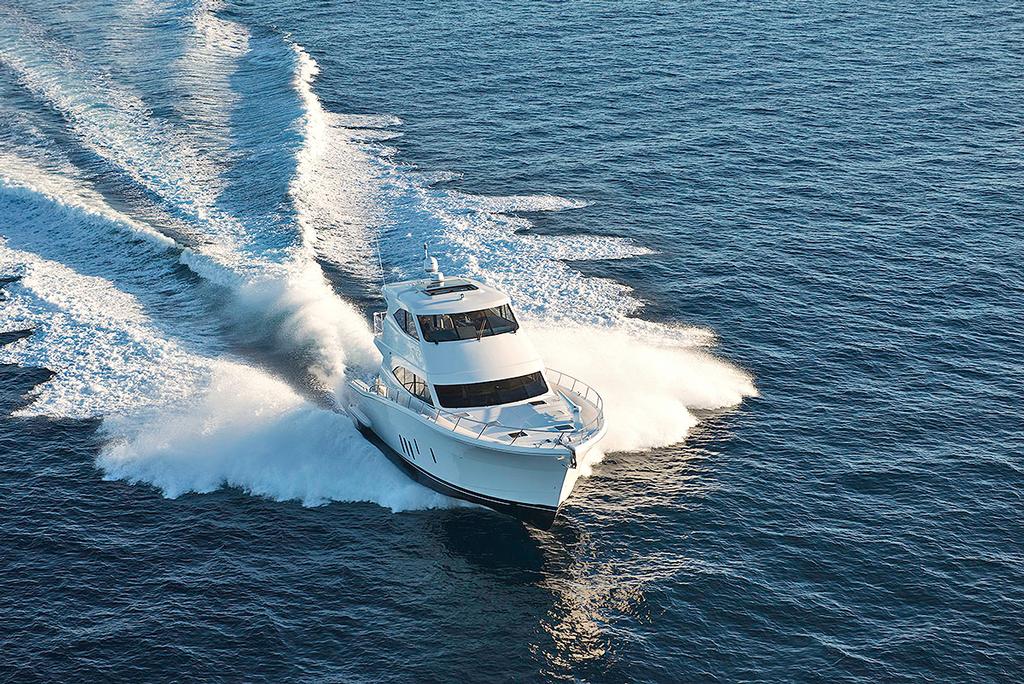
Underway with Maritimo's M64 Maritimo .
http://www.maritimo.com.au
There is no spelling mistake there. Using Lauda, not Laude, is absolutely intended. Also, the meaning is identical to the Latin, with the greatest honour. However, our specific reference is to the Austrian F1 Ace, Niki Lauda, and pays homage to the former World Champion’s complete dedication to engineering prowess, and the ability to then back that up on the racetrack. This was a distinction shared only with the likes of the late and great Sir Jack Brabham.
In nautical terms, it is something Maritimo is absolutely and justifiably very proud of. They too have drivers who bring back real world intel into the very boats they build not only for the race team but also for all their customers worldwide. They are Tom Barry-Cotter (Maritimo Designer) and Ross Willaton (Marine Engineer), and the engineering in terms of motors, drives, surface piercing props, hull forms, propeller shapes and rudders is totally carried throughout the team that races and subsequently integrated in to the Maritimo motor yachts that are hand crafted at their Coomera production facility on Australia’s Gold Coast.
Maritimo’s strapline is Oceans Apart, and it could well be all that passion that they are referring to, for it comes out strongly in their work practices. Maritimo have a dedicated R&D facility near the main factory, and it is there that they bring new models to life from ideas, designs and direct customer interface. It also means that they can bring new models on inside a couple of years. It’s important to note at this juncture that every model in the present line up is less than three years of age!
To understand how it all works I spoke at length with Phil Candler, Maritimo’s GM of Operations, whilst reviewing the factory and the work they are undertaking. “The entire lamination process is hand laid. Our hulls are a mixture of balsa core topsides with hand-laid biaxial mat, and then solid fibreglass laminate below the waterline. The deck is also hand-laid using chop strand, biaxials, and quad mats.”
“We have extensive plug and mould development for the internal liners, the engine liners, and the construction of the overall boat, with a focus on manufacturing with quality and minimal weight taking in to consideration exactly what we have to put in to a boat. So the process, using a 50-foot boat as an example, is two weeks in lamination, eight days in engineering and another eight days in what we call Fitout One where all the major components are put together. Then it’s twelve days in Fitout Two where all the timberwork is installed in to the boat. After all that there’s another ten days of sea trial and commissioning, as well as a final quality control process.”
“So in total it is around ten to twelve weeks for a 50-foot boat, and then up to 18 to 20 weeks for a 70 foot boat. Across the range there are cycle times of between two, three and four weeks, and whatever that cycle time is in the lamination sector, that cycle time is replicated in every other area of production. In all it means that we are talking about three or four months from vacant air to boat in the water, depending on the model.”
It is an impressive feat considering that all the woodwork, whether it’s ply for formwork or veneers for cabinetry, is all done in-house. For that matter all the bright work is as well, and the propellers and engineering, which brings us straight back to acknowledging the race team. They are out there racing, and then coming back and working on propeller design, shaft angle and the overall engineering of the boats. There is a lot of hand finishing done at present, but just like any business, the need to have consistent quality and set turnaround times means that the next phase of capital investment is in machine finishing of wood and so forth for use in the fit out.
“So the CNC router, edge banders and typical cabinet making tools that we use are continually developing. Every bit of wood that goes in to the construction of the boat is either cut by CNC, or on a bench saw, but our CNC routers would cut over 80%, and that stems from the beginning of design. When we design it in 2D or 3D, we can pass the information on to the CNC Router to create that for the manufacturing of the boat.”
Indicating just how closely Maritimo work with their customer, Candler explains, “Our focus groups are such a significant part of what we do to get the right information for the right product, and that ensures that when we build the product it hits the market and it sells well. We’ve done that extensively over the last four or five years particularly, and the success is evident in the boats that we’ve produced.”
Expanding on Maritmo’s own Skunkworks, as it were, which is located nearby at Hope Island, Candler comments, “The R&D facility has a number of staff involved in both design and making mock ups for people to go and review. We have two phases of design. The first is conceptual, stemming from two particular designers. One is Tom Barry-Cotter, the son of Maritimo founder, Bill Barry-Cotter and the other is Neil McCabe, and it is here that our customer focus groups see things in both 2D and 3D.”
“We also review all of the last few years of production with our engineering focus groups to see what can we do to improve how we develop a new model. This is then all rolled together and it’s then that we start a development program. So at any given time we will be working on four or five different new boats that are not yet in production. Some of our focus group participants may well place an order by the time they’ve completed their focus group session.”
Interestingly, many customers apparently do actually say, “I’ll buy a boat if you develop that.” Maritimo’s design process is probably eighteen months to two years long from the start to when they get into physically doing the development, plug work and final R&D work. As mentioned, typically there is anything between four and five projects on the go at one time, and they have just launched their S59, S70 and M54 models.
Candler added, “We are currently focusing on an X60, which is a 60-foot Maritimo. The concept of that came through all those focus groups. Tom Barry-Cotter is driving that particular design, and we’ve already sold three off the plan!”
Now it’s also important to work out that there might be eighteen months in original sketches, focus group, approval from the board and then going through with a new model. However, once that has occurred there’s also at least twelve months in the set up to develop the moulds Maritimo use in production. “Some of the work is concurrent, so once we go from concept and get into basic parameters we then start the hull fairly quickly. Once we get the core shape of the hull we move into engineering and design fairly early in the process, which means they’re somewhat overlapping. What that means is a brand new model takes at least a couple of years from development to when she hits the water.”
One of the other aspects to look at here, which is no longer the elephant in the room, is fuel efficiency. On the production floor we had just been looking at some of the Scanias that Maritimo are deploying into more and more of their customers’ vessels. Fuel efficiency always comes down to two key areas in the end, gross tonnage and fluid dynamics.
During our tour we talked briefly about not trying to put too much weight into the boats and yet these boats are beautifully fitted out and, to a certain degree, bespoke vessels. I also saw first-hand that there is a lot of engineering prowess that comes out of the race team and that goes into shaft angles, screw development, and I dare say even rudder placement.
”It is a significant focus for everything that we do. It’s to do with hull shape, shaft angle, power to weight of the motors, the weight of the boat, the power needed to drive it, and then the propellers. We are always fine-tuning and developing the combination of those things to get the best outcome.”
“There’s a lot of weight here on the engine companies, as some engine companies have significantly greater fuel efficiency than others within the same power bracket. We definitely focus on what we can do to improve efficiency, what engine package can be offered to us for a specific model, and what criteria is required to improve efficiency. We’ve proven with exact models that a shaft driven boat at cruise speed will outperform any pod boat.”
This is an important point. Volvo is one of Maritimo’s engine suppliers and of course Volvo are heavily pushing the pod scenario. To determine what is Maritimo’s take on it, I ask what are the key aspects that Maritimo focus on in terms of finding that correct engine package for the delivery. Is it kilowatt per kilogram? Is it 80% of torque from 1200RPM or is max power from 2000 and then hold that through to 2500 or 2700RPM?
“Absolutely, but we focus on multiple things, because take the example of a larger boat, where you might add another two or three thousand kilos of fuel because the owner wants a longer range, say to go to New Zealand. So it’s very broad, but also very specific, for the engine package must suit the exact boat that we’re going to build. On a 70-foot boat the base engines are 900 horsepower, and the boat performs fine. But we will go up to 1500 horsepower in the same hull depending on the speed you want to travel and the fuel efficiency you are after.”
“So in effect we choose the engine packages to suit the customer’s expectation on range, and then also the engine itself, in terms of its own total performance and its torque, but I wouldn’t put it down to a particular kilo per horsepower or exact torque curve. What we do is look at how to take each engine’s unique characteristics and turn that into speed.”
Payload is a very important aspect, especially if you are looking to take an extra three tonnes of fuel. Naturally you’ve got to locate that fuel somewhere which changes the dynamics yet again, and then you’ve also got to deliver the grunt to get the boat up on the plane.
“The reality is that with our boats and the fuel that we carry as standard, you already have significant range against most of our competitors around the globe. It is a focus of ours for you to have adequate fuel capacity, but we do offer additional tanks allowing our customers to get the extra range they want. It’s 1,200nm to New Zealand and that’s probably the limit for our bigger boats in the 64 to 70 feet range at 11.8 knots. Under that size it is less.”
Please standby for Part Two of Maritimo – Summa Cum Lauda, which will be along presently. In the meantime, should you want to stand oceans apart, simply go to www.maritimo.com.au
If you want to link to this article then please use this URL: www.sail-world.com/155265