Foils, the Olympics and the Cup—Sailing news from the U.S. and beyond
by David Schmidt, Sail-World USA Editor on 19 Nov 2015
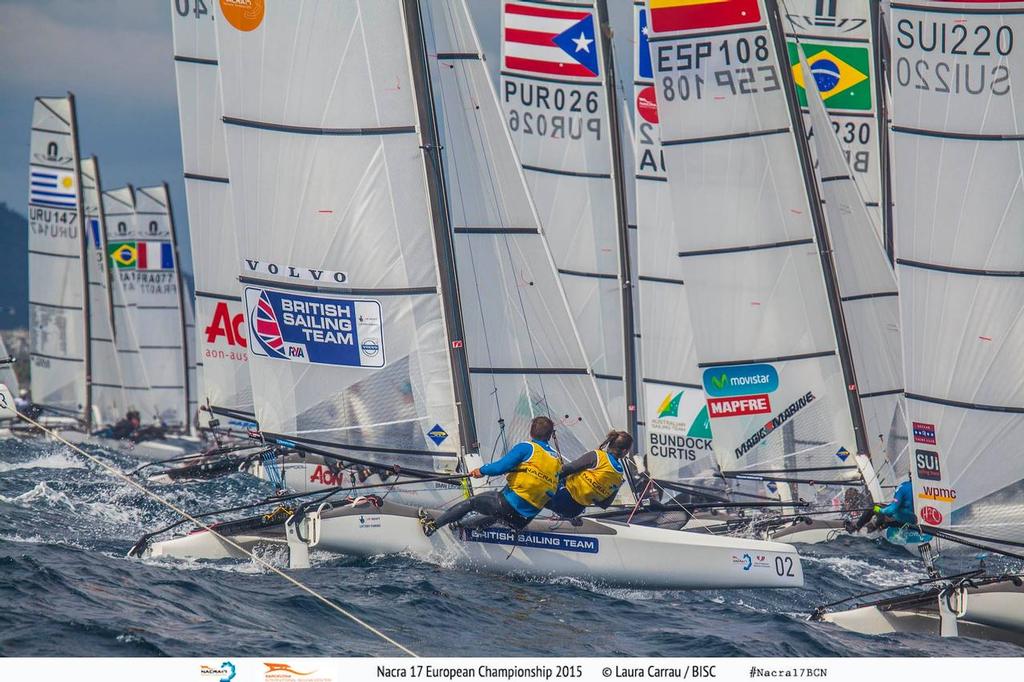
12002508 10153226431501819 7777530877297461859 o - 2015 Nacra 17 Europeans Barcelona International Sailing Center
Regardless of your thoughts on the state of the America’s Cup, (almost) all sailors can agree that the transition from displacement-mode sailing to foiling was the biggest breakthrough in sailboat-racing technology since the invention of the Marconi rig. Not surprisingly, plenty of non-Cup racing sailors saw this leap in performance and became interested in foiling on a more Corinthian level. As a result, we’re now seeing new generations of raceboats that are adopting foils in order to free themselves from the speed-confining drag of displacement-mode sailing, and while it’s easy to chalk this up as a trickle-down effect—given the state of the Cup (ahem…) and one of the classes that’s looking to take flight—one has to wonder if this is instead a rare “trickle-up” effect?
At the recent ISAF Conference (November 7-14), which just wrapped up in Sanya, China, the conversation turned to the Tokyo 2020 Olympics and foiling. The Equipment Committee presented their recommendation to transition the high-performance Olympic multihull, the Nacra 17, into a foiling platform in time for the 2020 Summer Games. The Events Committee endorsed the Equipment Committee’s recommendation, and a bold new era of Olympic sailing appears to be hoving into view.
Some backstory on the Nacra 17: The boat was designed in late 2011 by the design firm of Morrelli & Melvin for the new Mixed Multihull Event (which will debut at the Rio 2016 Olympics) and included constant-curvature daggerboards (C-foils), which the class currently uses. But, given Morrelli & Melvin’s work with high-performance sailing, they were careful to create hull forms that would work well with now-generation foil shapes-a design element that will no doubt help to make the Nacra 17 a fast and capable foiling platform.
So is this a case of a trickle-up effect? Given the fact that most successful America’s Cup sailors come from a strong Olympic-sailing background, coupled with the fact that plenty of Cup winners-including Oracle Team USA’s Tom Slingsby-view an Olympic Gold medal to be on par with (or possibly above) winning the Auld Mug, this largely depends on one’s allegiances.
At the minimum, bringing foils to an Olympic class represents a direct matriculation of technology and sailing skills. However,if you haven’t been impressed with some of the sweeping changes that are defining the 35th America’s Cup (AC35), it’s also easy to look at the purely level, One Design nature of the Olympics as a Ph.D.-level study in sailing, while Cup racing is more akin to a Ph.D. graduate taking their newfound knowledge and applying it to a job in private industry.
Put another way, if you hold the Olympics as the highest level of international sporting competition (which can sometimes be a slippery slope, given the reports of doping and performance-enhancing drug use that has forced some shamed athletes to return their medals), there’s no question that foiling is about to trickle up a notch.
Which then brings up another question, namely, how will a foiling Olympic class influence tomorrow’s Cups? The past few Defenses have seen America’s Cup teams hiring top-gun skippers from high-performance classes such as foiling Moths, A-Cats and the 49er skiff, but this could all change if suddenly there’s a new crop of Olympic-level sailors with high-performance foiling skills and experience in top-level international competition, provided, of course, that future Protocols call for wingsail-powered foiling catamarans.
If all of these variables hold constant, it will be fascinating to see if the advent of foiling ends up having a circular trickle effect, where AC-level foiling technology and skills transition to the Olympics, before returning to the Cup in the form of even more refined and skillful sailors, who are used to contending with busy mark roundings at full foiling pace, and who possibly have as little experience sailing displacement boats as some of the AC34 skippers had aboard foiling platforms, prior to 2012.
Much like the Marconi rig dramatically reduced demand for ketch or yawl-rigged ocean racers, odds are excellent that foils will be driving the high-performance sailing game for the foreseeable future. As of this writing, foilers have now been used to win the America’s Cup, to cross oceans (L’Hydroptere and the “production” Gunboat G4), and to win World Championships (Moths). Additionally, events like the Extreme Sailing Series (which will be using the foiling GC32 platform) will be flying on foils come 2016, so it’s only natural that foiling trickles up to the Olympics.
One can only expect that foiling will be second nature to Cup-level crews come AC36 (possibly AC37, depending on racing schedules), and that we will be treated to some of the most refined displays of foiling imaginable…provided, of course, that foiling first takes off at the Tokyo 2020 Olympics.
May the four winds blow you safely home,
If you want to link to this article then please use this URL: www.sail-world.com/140172