Coral reefs threatened by a combination of changing ocean conditions
by Woods Hole Oceanographic Institution on 12 Jan 2015
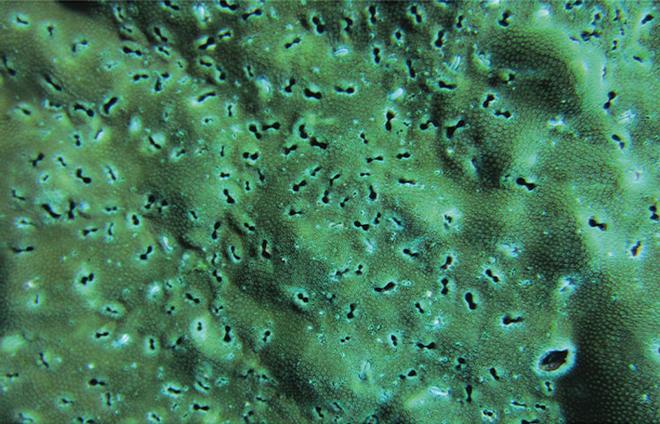
This coral off the coast of Panama shows holes bored into its skeleton by bioeroders. Hannah Barkley, WHOI
The lowering of the ocean’s pH is making it harder for corals to grow their skeletons and easier for bioeroding organisms to tear them down. Erosion rates increase tenfold in areas where corals are also exposed to high levels of nutrients, according to a study published January 2015 in the journal Geology. As sea level rises, these reefs may have a harder time growing toward the ocean surface, where they get sunlight they need to survive.
The study, led by scientists at Woods Hole Oceanographic Institution (WHOI), highlights the multiple threats to coral reef ecosystems, which provide critical buffers to shoreline erosion, sustain fisheries that feed hundreds of millions of people, and harbor 25 percent of all marine species. And it points to a key management strategy that could slow reef decline: reducing the input of nutrient pollution to the coastal ocean from human activity such as runoff from sewers, septic tanks, roads, and fertilizers.
Corals make their skeletons out of calcium and carbonate ions from seawater, constructing massive colonies as large as cars and small houses. As the ocean absorbs excess carbon dioxide from fossil-fuel burning, it spurs chemical reactions that lower the pH of seawater, a process known as ocean acidification. The process removes carbonate ions, making them less available for corals to build skeletons.
'A healthy coral reef ecosystem exists in a constant and often overlooked tug-of-war. As corals build their skeletons up toward the sea surface, other organisms—mollusks, worms, and sponges—bore into and erode the skeletons to create shelters,' said lead author Thomas DeCarlo, a graduate student in the WHOI-MIT Joint Program in Oceanography, working in Anne Cohen’s lab at WHOI.
This process, called bioerosion, reduces skeletons to rubble, which is transported offshore during fierce storms or gradually dissolved in the sediments. On healthy reefs today, calcium carbonate production barely exceeds the loss by erosion, dissolution, and offshore transport. As a result of this delicate balance, coral reefs grow very slowly, if at all, when sea level is stable.
The new study shows that additional nutrients provide a dramatic boost for bioeroders that, combined with lower pH conditions, will tip this balance in favor of erosion. The bioeroders are filter feeders, sifting particles of food out of seawater. Nutrients spur the growth of plankton, supplying food for large populations of bioeroders that burrow into coral skeletons.
When corals and bioeroders are in balance, the former grow just fast enough to stay near the sea surface, while the latter are busily sculpting the coral skeletons into an intricate, three-dimensional habitat full of nooks and hiding places for fish, urchins, and other marine life.
In waters with fewer carbonate ions and more nutrients, corals may not be able to build new skeleton fast enough to keep pace with bioeroders cutting down the reef. The result would be 'flatter' coral reefs with less of the three-dimensional structure responsible for the rich biodiversity found on coral reefs.
To conduct the study, the research team investigated coral reefs spanning the Pacific Ocean, from the west coast of Panama to Palau. The reefs also spanned a range of different naturally occurring pH and nutrient conditions in the ocean, including several reefs in seawater with pH levels today that are as low as those expected for much of the tropical ocean by 2100. That allowed the scientists to examine how bioeroders are affected by the isolated and combined influences of pH and nutrient conditions.
The scientists used underwater drills to collect cores of coral skeletons. They put the cores through the CAT scanner at the Computerized Scanning and Imaging Facility at WHOI to get 3-D images of tunnels and borings made by bioeroders with a resolution of about the width of a human hair. That allowed them to calculate precisely how much skeleton the bioeroders had removed.
The researchers found that relatively acidic (lower-pH) reefs were more heavily bio-eroded than their higher-pH counterparts. But their most striking finding was that in waters with a combination of high nutrient levels and lower-pH, bio-erosion is ten times higher than in lower-pH waters without high nutrient levels.
'The ocean will certainly absorb more CO2 over the next century, and ocean acidification is a global phenomenon that reefs cannot escape,' DeCarlo said. 'But the encouraging news in our findings is that people can take action to protect their local reefs. If people can limit runoff from septic tanks, sewers, roads, farm fertilizers, and others sources of nutrient pollution to the coastal ocean, the bioeroders will not have such an upper hand, and the balance will tip much more slowly toward erosion and dissolution of coral reefs.'
Along with DeCarlo and Cohen, the team included Hannah Barkley (WHOI), Kathryn Shamberger (WHOI, now at Texas A&M University), Quinn Cobban (Falmouth Academy), Charles Young and Russell Brainard (NOAA), and Yimnang Golbuu (Palau International Coral Reef Center). The research was funded by the National Science Foundation, the Nature Conservancy, and the National Oceanic and Atmospheric Administration’s Coral Reef Conservation Program.
If you want to link to this article then please use this URL: www.sail-world.com/130660