America's Cup- Jury to decide as Oracle sails with rudder elevators
by Richard Gladwell on 27 Jun 2013
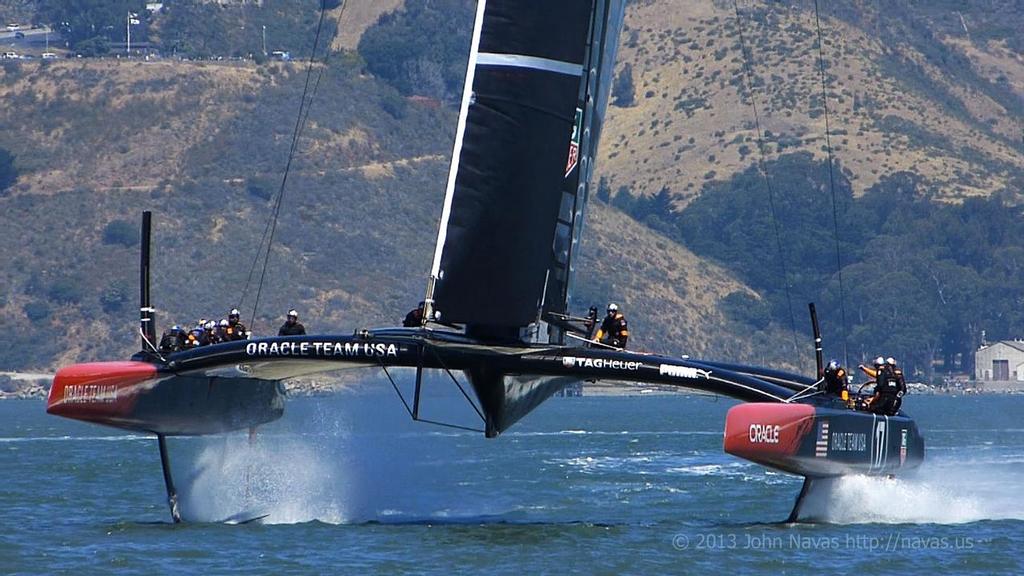
Many will ask why the legalisation of once-banned T-foil rudders should not be extended to T-foil daggerboards as well - with elevators on each to obviate nose diving? John Navas
Oracle Team USA is in the process of fitting and sailing with the new winglets specified by America's Cup Regatta Director, Iain Murray and made public just over four weeks ago.
Long time America's Cup correspondent, Bernie Wilson, writing for Associated Press reported that:
Russell Coutts, the CEO of Oracle Team USA, said the syndicate has started following safety recommendations made after Simpson's death.
Among them were installing new rudder wings on both boats to give them more stability, particularly when they foil, Wilson explained to his readers. Foiling is a recent advancement in which the hulls of the 7-ton boats skim across the top of the waves supported only by the two rudders and a daggerboard in the leeward hull. Foiling reduces the drag on the boat and increases the speed dramatically, he concluded.
Wilson was present dockside when Oracle Team USA sailed Tuesday, with both their AC72's, but the session was foreshortened when their second boat suffered forestay damage.
One of the 37 Recommendations drafted by Regatta Director, Iain Murray was for new elevators to be fitted to the winglets on the lower end of the rudders on the AC72 class, replacing those which have been used for the past 12 months.
The use of adjustable elevators (moved via the rudder stock adjustment) that can be adjusted while racing are specifically prohibited under current AC72 Class rules. The rules were developed to try and prevent the wingsailed catamarans fully foiling – which is normally done using adjustable elevator flaps on the end of foiling struts or rudders.
Emirates Team New Zealand was able to work out how to fully foil using a single adjustable angle daggerboard and fixed angle winglets on their rudder. The innovation was street-legal within the AC72 Class rules.
Murray also wrote a draft rule that would allow the winglets to extend beyond the maximum beam of the AC72 catamarans – currently prohibited under the AC72 class rule.
In producing the contentious rudder elevator rules, Murray set in place a process that is intended to unilaterally change two AC72 class rules, and over turn an interpretation by the Measurement Committee for the event.
(AC72 Class Rule 8.6 says: Rudders shall not have components such as trim tabs or moveable winglets, that can be adjusted while racing.)
An AC72 Class Rule change is required to make the rudder elevators legal for racing in the America's Cup Regatta, which gets under way on in nine days time. If the Protocol governing the event is followed, that change must be agreed by all four teams.
Currently Emirates Team NZ and Luna Rossa are emphatically against the change.
Organisers are still determined to make the Class rule changes part of a Coast Guard Permit for the Event, meaning if the Teams do not accept the conditions of the Permit, there can be no racing and no Event.
All that is required is for OTUSA is to make their current elevators larger and to be optimized under the Recommendation.
Sources in San Francisco told Sail-World today that Oracle has already been sailing with winglets which extend beyond the maximum beam.
Elevator time-line
The time line for development of the winglets by Oracle is interesting in that they were developed three months ahead of the announcement of their inclusion as one of the Recommendations.
Without the Artemis capsize it is difficult to see how the devices could have been legalized - given that they are supported by only half of the teams, and on that basis would not pass under the provisions of the Protocol.
While the devices are ostensibly for safety, the Recommendation is that they cannot be adjusted after the Warning Signal (five minutes before the start), and without being adjustable when in a bear away situation to raise the bows of the AC72's.
Many believe that to be effective and do the job intended by Murray - a yacht designer of considerable repute - that the elevtaors must be fully adjustable while racing.
Last August, the Measurement Committee responded negatively to a question as to whether the single piece rudder winglet could be rotated to apply a downward force.
The uncompromising line of Luna Rossa and Emirates Team NZ in opposing the Recommendation, is that the Parties to the Protocol must adhere to its dictates, and properly discharge their obligations under the Neutral Management provisions of the Protocol.
Probably more serious is the design implications of the rudder elevator rule, which if it were available to reduce the chances of pitchpoling, then Emirates Team New Zealand and Luna Rossa's AC72 could have been designed with bows and forward sections that had less volume and therefore less drag - making a substantial impact on speed against apparent windspeeds of 50-60kts which are not unusual in the AC72's.
There is no certainty that larger rudder elevators would have averted either AC72 incident. Oracle's capsize in October was due to operator error, after the leeward hull did initially lift clear on her hydrofoils before nosediving. Artemis broke up in moderate winds - rudder elevators will not prevent structural failure.
Oracle Team USA is widely conceded as having a lower aero footprint, meaning less drag and faster speed. But the tradeoff is the lower volume bows increasing the risk of pitchpoling if the daggerboard foils do not load up and lift the hull clear of the water.
Currently both the New Zealand and Italian teams have got around the pitchpoling issue by building more seaworthy boats with bigger bows designed to lift clear in the bear away maneuver - which was the demise of both Oracle Team USA and Artemis Racing - the only two AC72's to have capsized.
The spike in the dispute lies in the intention of the organisers to push through the changes using a standard clause in the Protocol requiring all competitors to 'comply with all applicable laws and regulations of any city, state, national or other governmental authority having jurisdiction over the Event'.
Organisers have stretched that to cover the authority of the US Coast Guard, which is yet to issue a Permit for the Regatta due to start in eight days time.
While the four days of Mediation which were unsuccessful in resolving all issues organisers do not seem to have wavered from the line expressed by Golden Gate Yacht Club Vice-Commodore, Tom Ehman in an interview with Sail-World on May 24.
'As far as whether there has got to be votes and Class Rule Amendments and Protocol Amendments – No, these (Recommendations) will become Rules', Ehman said.
When questioned on the safety aspects of the Rudder Elevators, Ehman said that while he could not speak for the Committee, 'it will make the boat easier to control. What we are hearing is that when the boat nose-dives and goes bow-down, if the rudder length and the rudder wings are not correct, then that situation can lead to trauma. It is a boat control issue as I understand it', he added.
Responding to the point that under the recommendation drafted by Iain Murray, the rudder elevators could not be adjusted after the warning signal, and the way the rule is drafted, there is not the opportunity to change the angle to give most effect in the difficult bear away maneuver. 'That is a good question. I know some teams thought you should be able to adjust them throughout the race, but he (Iain Murray) determined that you could only adjust them before the warning signal.'
'Iain has told us that he adopted them to assist with the control issue during the bear away,' Ehman added.
The safety reasoning, of course, completely ignores the fact that if the rudder elevator control button was inadvertently flicked the wrong way, then the so-called safety device could actually trigger a nose-dive. Typically the daggerboard controls on an AC72 are controlled with a 360 degree of movement button, similar to that found on gaming consoles. Rudder elevator controls would be done through a similar device, which is why the AC72 Class Rule talks about the current rudder elevators not being permitted to be adjusted while racing, ie if you have a control that could be used when racing, then it is illegal, as the rule stands.
With the change to allow the elevators to be altered up to the warning signal five minutes before the race start, the Recommendation drafted by Murray unilaterally changed a third facet of the existing AC72 Class rudder rule.
Off to the Jury
Before the end of the week, one of the parties is expected to refer the matter to the International Jury for a binding resolution. The intention by Luna Rossa to take the matter straight to the New York Supreme Court is believed to be on the backburner for the moment. It is understood the Court does not treat cases kindly which have not exhausted their prescribed opportunities for arbitration process.
That being the case, the Jury are not expected to be able to fly in and meet before July 3 - which is just two days before the start of the America's Cup Regatta. In short, the matter will probably not be properly resolved before the start of the America’s Cup regatta.
While claimed to be a safety device the Wing Elevators will not be in use by the Challengers before the start of the Regatta, bringing into further question the merit of their introduction on safety grounds. Of course that also raises the issue that if the Rudder Elevators are included in the Coast Guard permit whether all boats will be required to fit them before being allowed to race.
If the Challengers are allowed to sail races without the devices, then it makes a complete mockery of the safety claims for their introduction. And with just a week left before the start of the America's Cup Regatta, and the certain knowledge that the Rule Change will be strongly contested before the AC Jury and maybe New York Supreme Court, it is difficult to see why a team would suffer the distraction of compliance, at this late stage of the Regatta.
Two of the Challengers are having to move into race mode for the regatta that starts tomorrow week, and will stay that way until September. The opportunities for fitting the new rudder elevators are limited, and may not even happen.
Meanwhile, with a three month jump on the proposed rule, Defenders, Oracle Team USA are the main beneficiaries. Clearly the rudder elevators can be used to control the foiling performance of AC72's - an area where Oracle Team USA has been making improvement since March. It is impossible to determine how much this is due to the introduction the still illegal rudder elevators and how much is due to other changes in the AC72’s.
The bottom line on all this is that the Class rule 8.6 was written (and agreed by the Challenger of Record and Defender) to prevent the use of T-foils in the AC72 class. The contentious Recommendation changes this fundamental of the AC72 class. A similar Class rule 9.6 contains the identical worlds to 8.6 (above) except that the word Daggerboard is substituted for Rudder.
The same comment would also apply to rudder elevators, unless one team was already a long way down the track with the devices. As it stands, even if they were ruled legal only Oracle Team USA and maybe the tardy Challenger of Record, Artemis Racing would fit the devices.
The issue was dismissed by Oracle Team USA's CEO, Russell Coutts as 'rules minutiae' in a statement from the team today.
Sail-World.com will continue to update on developments.
If you want to link to this article then please use this URL: www.sail-world.com/111255