America's Cup update with Oracle helm James Spithill (part 1)
by Rob Kothe on 12 Mar 2013
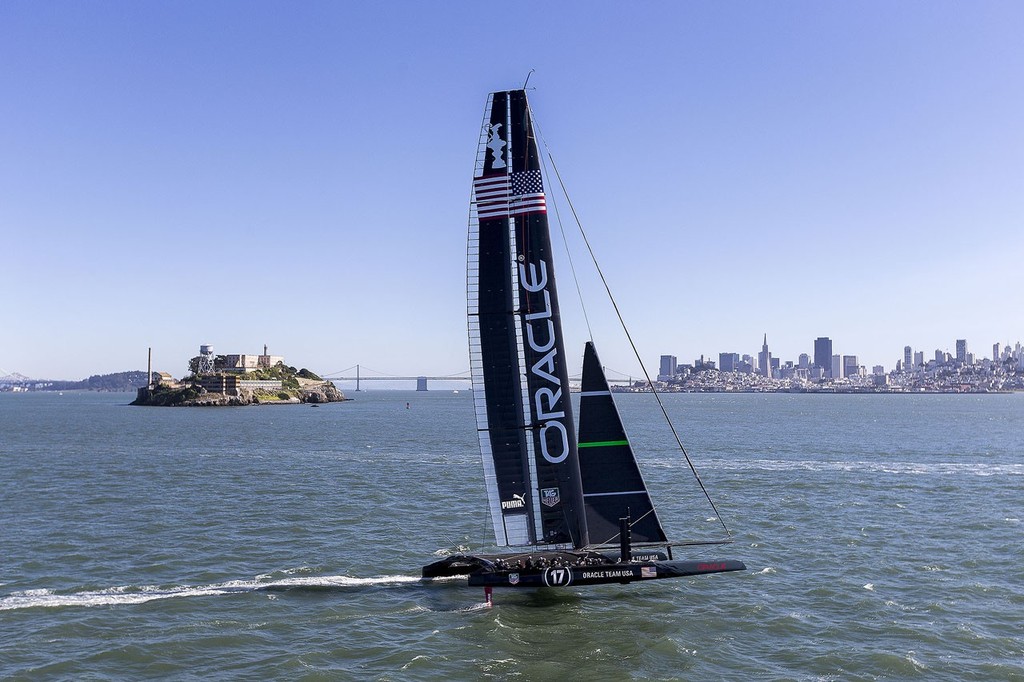
ORACLE TEAM USA / San Francisco (USA) Guilain Grenier Oracle Team USA
http://www.oracleteamusamedia.com/
The 2013 America's Cup is now just six months and the pressure is mounting on all the teams...
Oracle skipper and helm, James (Jimmy) Spithill is a straight talking Australian. In 2010, aboard BMW Oracle Racing, Spithill became the youngest ever winner of the America's Cup. Sail-world interviewed him at length last week. Some of his observations were predictable and diplomatic but others less so and there is obviously some needle between Oracle USA and the Team New Zealand already.
SW. In September on San Francisco Bay, in past years we have seen wind comes in at 20 to 22 knots straight from the bridge about 14:30.
For the America's Cup you are going to start at 13:00 so it is going to be 15 knots and building and a little variable. Is that what you are training for?
JS. Typically in the summer you can get anywhere from 10 to 20 knots usually. Round September a little bit more, there is a small percentage chance we can get less than 10 knots for a race and another small percent chance we can get a lot of wind, like 30. Otherwise San Francisco is a good 15 to 20 knots.
That’s the beauty of San Francisco as a venue for television and on time starts... It is just the ultimate venue in that the wind is so reliable.
Last year we had the two World Series events here. One in September and one on October.
You can pretty much set your watch to the wind. Either way with these boats, as we have shown even with the 45s, they can sail in pretty much all conditions. That’s what makes them good and that is important to TV. You cannot have delays.
By contrast, it has been a pretty tough winter for Artemis, wind-wise. Speaking to some of those guys they were saying the sailing hours were few and far between.
Certainly since we have started sailing in February it has just been 10 to 20 knots and even up to 25
SW. What did you learn from the capsize?
JS. A lot. It was a huge learning experience. I reckon the biggest thing to take from that is seeing how people react to a tough situation in basically the aftermath. Psychologically, as a group. It was a big test and it was pretty rewarding to see how our shore team, our boat building team the engineers how they dealt with it. It has been really impressive to see the team reacted.
From that point of view we have been tested more than any other team. No other team has been through what we have been through and to get through that and to be able to come back out there we have put a better, faster boat on the water than what we had and safer. It is a big statement for our competitors out there.
SW. Tiller to wheel steering – what benefits for you as the driver?
JS. If we weren’t foiling I think the tiller would be the way to go. I think all the boats like all the 60s have tillers, the MOD70s have tillers. Even with TP52s the tiller is the go and I think you can do a better job.
But once you start foiling it does seem better, a bit more locked in with the wheel. You can plant your feet when you are foiling and doing those speeds. It does seem a little bit better.
We decided to have a wheel and I guess it is our attitude in the team that we are always improving the boat. We are always looking at little ways here and there that may give us a little gain in the boat.
If you look at the boat now from when it was launched it is quite a lot different. That process is what the Cup is all about. The constant R&D and small improvements. It will happen the whole way up to the Cup. These refinements and changes.
I think we have made a big step with the boat. I think it is a big improvement on a lot of parts. Before we capsized we had a long list of modifications that we were planning over the winter.
Obviously we had to start a little bit earlier than we expected. We had a lot we wanted to change and in some ways we had to look hard at a few others following what happened.
We are all pretty happy with the boat as it is but on that point we are not just going to stop. We are going to keep on with improvements.
The boat is much faster than when we started. It’s such a new class there are a lot of refinements. To do those refinements you have to come into the shed and let the engineers and the boat builders get some time on it.
Just because of the scale of the boat and the loads it sees it does take a bit of time to produce components. Most of the stuff when you are making a change isn’t just an overnight job.
SW. Other key changes?
JS. The other big change is the foils shapes. That’s obviously big. Teams are going to spend a lot of time and energy trying to figure out how do we gybe and keep it on the foils.
SW. Yes, Look at the early days of the Moths – top mark, was a stop, turn, then come back up on the foils – now they zoom around, so there is a lot to learn?
JS. Boat handling is a big part of Moth sailing. The guys who can tack and gybe without the thing coming off the foils or stopping too much they take massive gains at the turning marks as well and so it will be with the AC72´s.
But you can’t just focus on one area. You really need to make sure you don’t have any weak links. Obviously foiling is very important. You can’t also disregard the sails or the wing. All the crew work. It all adds up.
SW. How is progress going with the second boat?
JS. The boat is going well. It’s on its pathway. Nothing really changed when we had the capsize. We were planning on bringing boat one in. Boat two has been on its path and the guys have done a fantastic job just working away. It is just a lot of man hours to build these boats and there components.
SW. How many days on the water with this one before you get boat number two?
JS. Not sure. It depends how it goes. We have had hiccups and we have made changes. The fact is that boat one is proving pretty reliable. The other week I think we sailed four days a week, last week, which is almost unheard of and it just highlights the amount of effort the shore guys are putting in to running it.
It depends on the build program going forward. We are expecting to have quite a bit more sailing in boat one, put it that way.
SW. How much time are you expecting to have with two boats sailing together?
JS. We have been setting up for two boats sailing. That’s where we have gone out and we have acquired a lot of depth in our sailing team, for two boat sailing...
What will be interesting is how many days we can actually sail during the week. It is quite a logistical operation to launch two boats, to sail two boats but … we just have to gear up.
SW. Artemis learned a lot by briefly sailing against you. What did you learn?
JS. We learned heaps as well. You sail around on your own. One boat testing is inherently very difficult for performance …. But we learned a lot and … Just seeing another boat and seeing how it reacts and what the other guys are doing. It was a fantastic experience for both teams.
SW: Looking forward to Emirates TNZ and Luna Rossa getting there as soon as they can?
JS. It would be great. They have been doing a lot of sailing down in New Zealand. They would be getting big benefits by training against each other.
SW. From afar it does look like team NZ is pretty well sorted. They have got more time in the water than anybody and also more time in the second boat. Don’t you wish you were in the same situation?
JS. Trust me I don’t wish I was a New Zealander. That would never ever happen. Team New Zealand has had more sailing time and they have been making a big deal about it.
But, at the end of the day this is also yacht race and I can tell you one thing that Team New Zealand struggled on is the racing part, in the AC45's.
When the pressure came on in Newport in the final World Series they dropped the ball there. The last two events in San Francisco they didn’t perform that well either. That’s with one design of course.
Obviously the America’s Cup is a lot of that as well but it is a combination this time.
The other thing is that it is not a day count competition. There is no trophy for the team that sails the most.
Maybe now they have been making big deal about it but at the end of the day the trophy won’t be awarded if you do more sailing days than other teams.
I have been on campaigns where we have done more sailing days than the other teams and it didn’t matter. It is about using them smartly. It is about getting the concept right.
At the end of the day the guys than win the races during the match they are going to get given the trophy and ultimately that’s it.
In Part 2 Jimmy tells us more about the two boat program and what he REALLY thinks about the Kiwi's.
If you want to link to this article then please use this URL: www.sail-world.com/107367