Lightning at sea- Myth and Reality
by Des Ryan on 22 Oct 2012
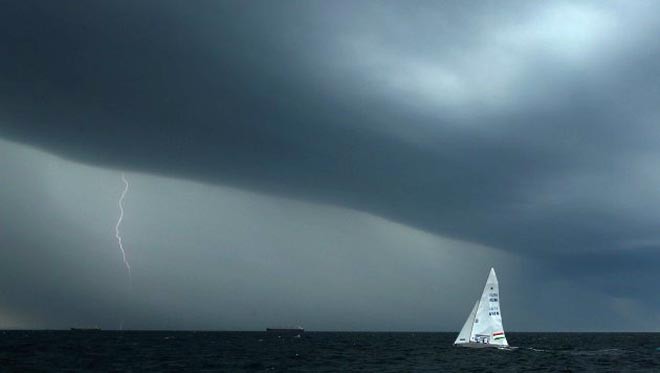
Lightning - unavoidable if you are already at sea SW
Lightning strikes, like collisions with whales or floating containers, cannot be planned against if you are already at sea, and thunderstorms are among the most violent forces of nature. Here Des Ryan separates fact from fiction.
At sea, it is possible to encounter squall line thunderstorms that have developed over land. Thunderstorms that form at sea occur most often in the early morning around dawn. However, tropical thunderstorms can occur at any time, often daily because of intense heating over land and an unlimited supply of moist tropical air from the ocean.
Thunder is the result of a lightning bolt. Lightning is a large current for a short period of time (milliseconds). This is a danger on an unprotected boat. Lightning can vaporize antennas, destroy electrical power, navigation systems, blow a hole in the hull or start a fire.
Cruising friends who have experienced a lightning strike aboard their boat have agreed on one thing - the strike was so severe that no normal lightning protection would have worked, as the electricity was so powerful that it jumped through the air to reach metal objects, sometimes as far as 20 cm.
However, this is anecdotal evidence, and who knows how much worse the strike would have been had these boats not had lightning protection. To equip your boat with lightning protection, the following system needs to be installed: A sharp pointed rod (lightning rod) at the top of the highest point of the boat has to be connected with a good conductor of electricity. On sailboats, the mast can be used if it is made of metal. From the rod or mast, run a heavy copper wire (#8AWG) to a metal keel. This wire should be run straight, without sharp bends. All connections need to be mechanically strong. The metal keel plate needs to be through-hull bolted and in good electrical contact with the water.
The theory is that the properly grounded mast (lightning rod) will provide a cone of protection. The point of the rod should extend at least 6 inches above everything it is to protect. The cone then makes roughly a 60-degree angle with the vertical, and the circle of protection at waterline has a radius of 1.5 to 2 times the height of the lightning rod. If all of the boat is within this cone, you are protected at least 99 percent of the possible strike. Within 45 degrees, the protection is 99.9 percent.
However, if you are caught in a thunderstorm, have everyone stay in the center of the boat. If you have a hand-held VHF or GPS, put it in a microwave if you have one. If not, separate it by a wide distance from anything metallic. Don’t let anyone go into the water. Stop fishing. Do not touch or go near anything metallic.
Here are some of the common myths attached to lightning:
Myth 1: Lightning does not strike the same spot twice:
It is a myth that lightning does not strike the same spot twice. In a typical lightning flash, several strokes may hit the same spot in rapid succession. This is proven by the fact that tall structures are sometimes hit many times a year.
Myth 2: There is no danger of being hit by lightning if it is not raining:
It is a myth that if it is not raining there is no danger of being struck by lightning. Lightning bolts can and often do strike as much as ten miles outside of the rain area of the main storm. Recent research on lightning deaths finds that most fatalities occur in the period when the storm appears to be ending.
During the height of most thunderstorms, sailors are below anyway, seeking protection from the rain. For the ten or more minute period after the rain ends, and even after the sun comes out, lightning is still a threat. Lightning can be a threat as the storm approaches as well. The storm may be a good distance away and may have blue sky overhead. A lightning strike would still be possible.
Myth 3: If you touch a lightning victim, you’ll be electrocuted:
The truth is that the human body does not store electricity. Therefore, it is safe to touch a lightning victim and give them first aid.
Myth 4: If you are on shore and lightning is about to strike, lie flat on the ground:
The best thing to do in that scenario is to crouch down, ie, put your feet together, squat low, and tuck your head. Lightning induces electric currents along the top of the ground that can spread out and be deadly over 100 feet away. While lying flat does get you low, your chances of getting hit by ground currents are increased. You want to be as low as possible but also touch as little ground area as possible. Obviously, getting inside to proper shelter would be even
better.
For a worthwhile technical description of the interaction between lightning and sailing boats by the University of Adelaide, http://l-36.com/read_html.php?file=lightning/LightningAndSailboats&title=Lightning%20And%20Sailboats!click_here.
If you want to link to this article then please use this URL: www.sail-world.com/103074