Skipper Bouwe Bekking on Telefonica Blue's predicament
by Bouwe Bekking media on 11 Mar 2009
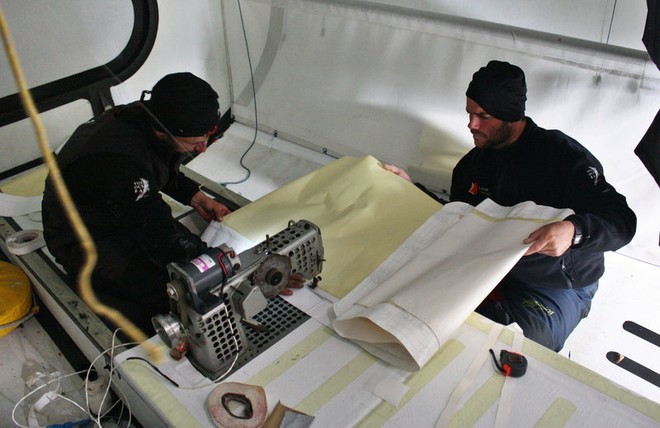
Jordi Calafat and Pablo Arrarte prepare a patch for the mainsail, on leg 5 of the Volvo Ocean Race, from Qingdao to Rio de Janeiro Gabriele Olivo/Telefonica Blue/Volvo Ocean Race
http://www.volvooceanrace.org
If it was not hard enough starting the longest leg in the Volvo Ocean Race with a 19-hour deficit, quite what is going through the minds of Bouwe Bekking and his Telefonica Blue team right now is all but impossible to contemplate.
Having fought themselves back into contention and, indeed, the lead by the halfway point, Bekking and his comrades now find themselves faced with sailing the second half of the race - including the potentially brutal Cape Horn - with a broken forestay, a crack in the mast and a mainsail that might prove more useful in the galley should anything need a sieve. Is there any good news?
'We've got plenty of food on board - enough to eat properly for at least fifty days. This is important because whatever happens it is probably going to take us more than forty days,' says Bouwe, who adds, 'at least we are still racing. It may only be with a limited amount of sail - so it feels like we're cruising - but we moving in the right direction.'
Bekking's current tale of misfortune began with the mainsail that started to delaminate before the scoring gate off New Zealand. 'We had to sail with a reduced main, which certainly hampered our efforts to go fast and impacted on the tactical decisions at the time.' Having answered that problem with glue, sheets of Kevlar cloth and a permanent reef, the headstay (which supports the mast longitudinally) promptly snapped at the top. 'It looks like a material failure. We were sailing well within the safe working loads which have, theoretically, a huge margin built in before breaking strain is reached.'
COMPROMISED PERFORMANCE
Quick reactions from the crew on deck, particularly the helm, saved Telefonica Blue from losing the mast, the ultimate in rig catastrophes. With a jury (temporary) stay in place, comprising strops and halyards, the worst seemed to be over - albeit with some further serious limitations placed on performance, as Bekking describes: 'upwind and any reaching closer than an angle of 120 degrees from behind we are truly compromised. Down wind we should be all right, as you don't need a headstay. The difference is huge though, upwind 2 - 3 knots slower and when reaching up to 6 knots slower.' With 6,000 nautical miles to go, this is a mighty ball and chain to overcome, made all the more frustrating since to replace a headstay ashore is only a two-hour operation.
With the discovery yesterday of the crack in the mast, the salt has been well and truly rubbed into the wounded Telefonica Blue. And, whilst Bekking believes they have managed to get this latest issue under some semblance of control, they are doing their best to avoid any unnecessary risks. 'We have had to stop again to rearrange our jury rig as we have discovered a small crack in the mast. It was not an easy job, and above all, it was time consuming. We had to adjust the lengths of strops from which our so-called forestay hangs several times in order to create the right bend in the mast again. The stretch in the rope is difficult to judge and I want to have it perfect. The crack is a concern, but not an overriding worry. With the action we've taken, the mast is better secured. Obviously, we are keeping an eye on it.'
ON A POSSIBLE STOP
At the moment there are no plans to stop en route, 'of course, pulling in Ushuaia to sort out the breakages is an option, but we have to look at a lot of factors. It is a long way up to Ushuaia, then a 12 hour minimum stop and then a long way out of the strait. You could easily lose 400-800 miles depending on the prevailing weather, so we might be better off just heading straight to Rio.'
Things could be worse. 'We almost hit a whale this morning,' quips Bekking, who in his daily reports from the boat, reinforces that moral remains high in spite of the problems and a sense of perspective is being kept. Despite the considerable mental strain, no one is being shot at.
Added to the physical ailments, Telefonica Blue is suffering from a tactical decision that initially paid dividends, but now is exacting a high level of interest. The Blue boat continued south as the rest of the fleet has headed north and since that point has been steadily bleeding miles at a rate not wholly due to her problems. Bekking is philosophical, 'it was a good feeling to lead the fleet and to be going faster than the boats around us. Unfortunately, we were too late anticipating the need to change course to the north for which we are paying. And, even without the damage, we would have lost some miles.'
www.bouwebekking.com
If you want to link to this article then please use this URL: www.sail-world.com/54706