Lake Ontario 300 Challenge - Introduction to stability screening
by Guy Perrin on 5 Mar 2012
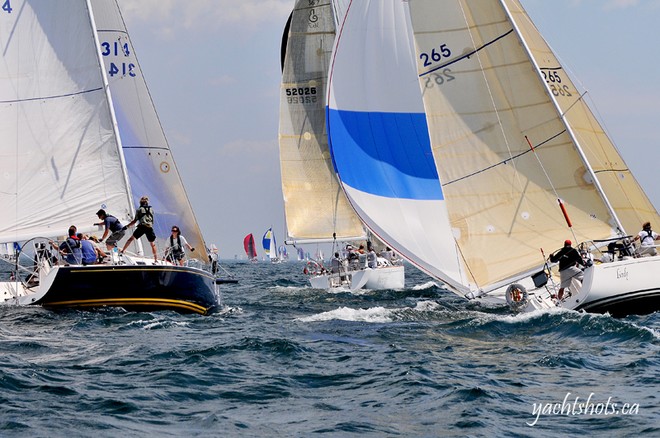
Mark Ashworth and crew are underway aboard Black Magic at the start of the Lake Ontario 300 Jeff Chalmers
Lake Ontario 300 Challenge (LO300) - One of the primary areas of concern for the Lake Ontario Offshore Racing Group is racers safety. Our improvement efforts in this respect are two-fold for 2012; we have standardized the published Minimum Equipment Requirements across all events and we are introducing the racing community to Minimum Stability Requirements for monohull yachts.
During this introductory year, the Organizing Committee will review entries for all races, determine a yacht’s Stability Index value based on sistership data and communicate with the owners of yachts that appear to fall below internationally accepted stability requirements for offshore events. A minimum Stability Index is not a requirement in the Notices of Race but will help race organizers and boat owners assess a yacht’s ability to resist capsize.
Whereas formal stability screening has been used in oceanic races for years, the screening used for freshwater offshore races has tended to be less rigorous. A significant hurdle is the lack of Stability Index value for boats in the types and size range in our fleet; high performance rating systems such as IRC, ORR and ORC already assign a Stability Index on the boat’s rating certificate, all other entries will be assigned a Stability, Safety and Screening Numeral (SSSN) calculated by an engineer.
There are many types of races ranging from trans-oceanic races beyond the reach of any outside rescue facility to inshore races of short duration where rescue boats are available along the entire race course.
ISAF, the sailing sport authority, has divided offshore races into seven categories; in the Offshore Special Regulations they strongly recommend that for Categories 0 through four races the race organizer should require compliance with a minimum stability/buoyancy index.
Crafted as a yacht manufacturing design tool, the International Standards Organization (ISO) created the ISO 12217-2 standard for sailboats longer than 6m, with design categories (A to D) for different types of sailing conditions as they relate to wind and waves. These are used as a general guide to suitability for meeting the OSR categories as per the following table:
Summary of Maximum Design Category Conditions under ISO 12217-2
|
ISO Category
|
A
|
B
|
C
|
|
ISAF OSR Category
|
1 and 2
|
3
|
4
|
|
Significant wave height*
|
7
|
4
|
2
|
|
Wind in knots
|
55
|
40
|
27
|
* Height in metres. Some waves will be double this height.
The preferred systems for stability/buoyancy screening are:
ISO
Any boat, no matter where she was built, sold in the European Economic Area (EEA) since June 15, 1998 is required to have undergone a certification process involving many ISO standards. The standard germane to this discussion is ISO 12217 Part 2. These boats will carry an ISO Category label.
STIX
Boats independently verified as meeting the minimum sailing weight, STability IndeX (STIX) and Angle of Vanishing Stability (AVS) under ISO 12217-2 and meeting the other standards are assigned an ISO category as summarized in the table below. A STIX value is typically obtained via the IRC Rating Office or a naval architect.
Since this is the most recent and arguably most sophisticated screening tool available to date it is the preferred method.
IMS, ORC and ORR
In addition to using hull shape to determine the yacht’s rating, the International Measurement System (IMS) based rules such as the Offshore Racing
Council Congress (ORC) and the Offshore Racing Rule (ORR) offices calculate a STaBility IndeX (STBIX) that appears on the yacht’s rating certificate.
Stability, Safety and Screening Numeral
The Stability, Safety and Screening Numeral (SSSN) is an older system developed by the RORC in the early eighties; the same input parameters as required for a PHRF certificate can be used to calculate a stability value, thus for almost any sailboat.
Unlike the STIX and STBIX values, SSSN estimates stability from rather basic parameters as compared to the more rigorous and detailed process used by the other systems. SSSN is not intended, nor should be used, for unconventional boats including those with moveable ballast, wings or excessive flare.
Corresponding ISO 12217-2 Minimum Values:
|
ISAF OSR Category
|
0
|
1
|
2
|
3
|
4
|
|
ISO Category
|
-
|
A
|
A
|
B
|
C
|
|
STIX
|
-
|
32
|
32
|
23
|
14
|
|
AVS
|
-
|
130-0.002m
but always ≥100°
|
130-0.002m
but always ≥100°
|
130-0.005m
but always ≥95°
|
90°
|
|
STBIX
|
120
|
115
|
110
|
-
|
-
|
|
SSSN
|
|
35
|
28
|
15
|
10
|
|
Minimum Sailing Weight (m)
|
-
|
3,000 kg
|
3,000 kg
|
1,500 kg
|
-
|
As a best practice, the Lake Ontario Offshore Racing Group has adopted a minimum stability values associated with OSR Category 3 events for all overnight events (Lake Ontario 300 Challenge, Susan Hood trophy Race and LOSHRS 100-miler) and a minimum stability values associated with OSR Category 4 events for all LOSHRS daytime races. Note that the Minimum Safety Requirements for all races remain the same and are based on OSR Category 3.
Required values will be in the following order of preference for OSR Category 3:
• minimum ISO Category B
• minimum sailing weight of 1500 kg
• minimum IRC STIX of 23 and minimum AVS of 130-0.005m but always ?95°
• minimum ORC or ORR STBIX of 103
• minimum SSSN of 15 except for boats with moveable ballast , wings or excessive flare.
Required values will be in the following order of preference for OSR Category 4:
• minimum ISO Category C
• no minimum sailing weight
• minimum IRC STIX of 14 and minimum AVS of 90°
• minimum SSSN of 10 except for boats with moveable ballast , wings or excessive flare.
Note that compliance with any of the screening systems mentioned herein does not guarantee total safety or total freedom of risk from capsize or sinking.
With special thanks to Richard Hinterhoeller for his efforts at researching the various screening
Lake Ontario 300 Challenge website
If you want to link to this article then please use this URL: www.sail-world.com/98678