Jean-Louis Etienne - 'I am in Sakha in the middle of nowhere'
by Mer et Media on 10 Apr 2010
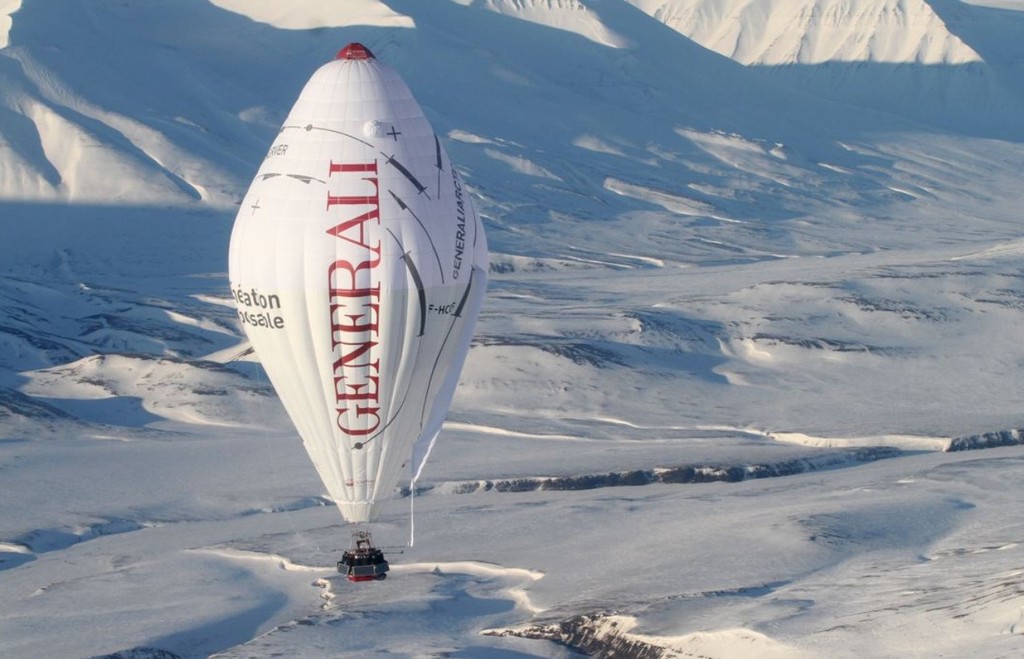
Jean-Louis Etienne setting out on Monday 5th April 2010. Armelle Quéré
Touching down this morning in Siberia at 0540 hrs (GMT) after a flight lasting 121 hours and 30 minutes and having covered 3130 km (1956 miles) since leaving Spitsbergen, Jean-Louis Etienne landed his Generali Arctic Observer balloon in the tundra in Sakha. He was contacted by phone late this morning. Here are some extracts from his press conference;
Etienne: 'I feel very satisfied and relieved. There were after all, some tricky moments during this flight. I was beginning to feel the effects of not sleeping enough. It was time to bring it to an end to savor this flight, which was long and difficult, but so thrilling.'
The final hours of the flight
'This morning I flew over the wide open spaces of Siberia. They are huge. You realize just how much of the Earth is empty. It’s gigantic. I was flying over winding frozen rivers at an altitude of 2000 meters. There’s nothing down there. In a desert, when you stop, there are always two or three people around you. I’ve been down here now for two hours and there’s no one. But I can’t imagine where they could suddenly appear from. It’s a vast wilderness of snow, ice, forest and nothing else.'
The landing
'Landing is always a fall back to Earth. Everything went well though. I had intended to go much further, but I found myself faced with a huge, thick wall of mist. I didn’t want to go back up again to cross to the other side without knowing where I was going. On top of that I was tired. I therefore decided to touch down as soon as possible before being surrounded by fog. I came straight down. It went well. I was expecting worse. I’m now on a rather rocky plateau, which is partly covered by snow.'
A successful first Arctic crossing
'The idea of an achievement is something personal. Looking at what I have accomplished, I feel like I have done a lot. When I went to the North Pole alone, I thought I had had gone far. I realize that you don’t push back the limits, but discover them. When you are determined, you can really do remarkable things that you thought could not be done. I surprised myself, as it’s true that I had a few difficult moments in the balloon. From the start I had to fly at a very low altitude over Spitsbergen and I almost hit a couple of hills. Then, there were some foggy periods. It was quite scary at times. After that, there was the struggle for fifteen hours to get as close to the Pole as possible in some surprising weather with some ascending and descending winds, which stopped 100-150 meters above the ice. It was amazing and what surprised me was that I took it all calmly in my stride.'
What about the scientific measurements?
'There were two things. On the one hand, the automatic measurements, the CO2 readings in the atmosphere and the Earth’s magnetic field. I’ll be passing on this data to researchers. There was also the photometer for the French Space Institute (the CNES) which measured the particles in the atmosphere. I must admit I only took one reading yesterday, because I rarely saw the sun. I spent a long time out of the sunshine. So I wasn’t able to do much about that. But the other tests were carried out automatically by the various devices on board.'
Is there a danger of coming across wolves where you are, as there are a lot of them around there?
'No, I think wolves probably would be afraid in such a godforsaken place, where they are at home, if they saw a balloon standing there. They are probably more surprised than anything else. In fact, I’d rather like to have some visitors; maybe see some wolves or reindeer.'
Favorite moments?
'Crossing Spitsbergen on the first day was magnificent; seeing the summits and the huge glaciers. These really were exceptional conditions. There was not the slightest sound, no noise at all. I was out on a fabulous balcony overlooking the natural world. Another moment that really left its mark was when I got a little bit too close to one of the final hills in Spitsbergen and then just beyond it, I was surprised to hear cracking sounds coming from the sea, although I wasn’t able to see anything through the clouds. The noise of blocks of ice rubbing against each other as they drifted along the coast; you only get to hear that if you are in a balloon. That was a magical moment that I’ll never forget.'
What are you doing while you wait?
'Firstly, I’m going to tidy up! When I came down vertically, all of the ice around the neck of the balloon fell on me. Everything is full of snow. Eastern Siberia is one of the coldest parts of the planet. This morning it was -27°C! I’ve got a little bit of food left. I’ve got water, heating and I’m going to sleep and then get some more sleep. That’s really what I’m lacking at the moment.'
Reaction of Christophe Houver, flight coordinator: 'We really must underline what has been achieved. He flew for more than 120 hours, covering more than 3100 km (1937 miles) on a straight line and in fact flew more than 3600 km (2250 miles) in all. This flight has been a great success. It is a long way to go to cross the Arctic Ocean, which was what the expedition set out to do. It was a very demanding flight that he accomplished perfectly. In these complicated conditions, living for five days in a two square meter space, he really showed what a great man he is, as he has shown great determination under the circumstances.'
Luc Trullemans, weather expert and router: 'Flying at a very low altitude, as he has just done is very difficult. You have to keep one eye on the altimeter, and the other on your bearing and speed. This was a very dangerous flight and required skilful piloting. This he managed to do. I think he’s the only pilot on Earth to have flown so low at such high speeds for so long, in spite of some appalling visibility. Not everyone can rise up from 300 to 50000 meters then come back down again a few hours later. He was really tested in this difficult weather.'
Marie-Christine Lanne, Head of Communications for Generali: 'In the name of the Generali Group, on behalf of President Claude Tendil and our 10,000 staff and agents, I would like to pay homage to Jean-Louis Etienne after this achievement, as he has shown remarkable determination and courage. I would also like to thank the team at flight headquarters and congratulate them on the work they have done in our offices. Thanks to Luc Trullemans, Christophe Houver, Benoît Pelard and Jacques Llopis, who offered us their precious advice and reassured us throughout this crossing.'
If you want to link to this article then please use this URL: www.sail-world.com/68414