Is it a stick? Is it a tree? No it’s Supercat! (Pt. I)
by John Curnow on 14 Oct 2012
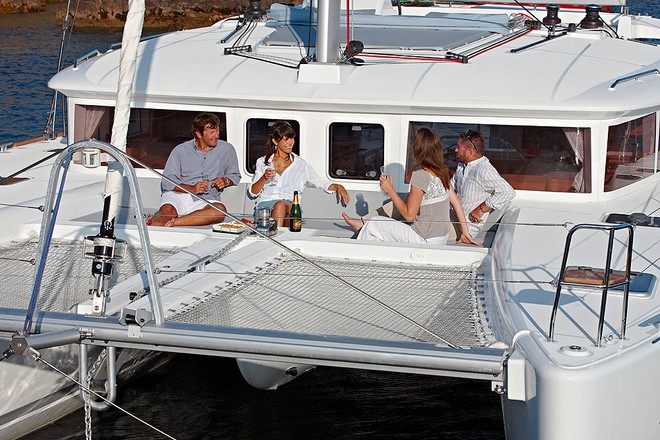
The mosh pit. I can taste the caipirinhas from here! Nicolas Claris
Just like most of the Ssang Yong’s out there, you won’t have to venture too far to find someone who believes a few of the Lagoon catamarans have been whacked once or twice by the Ugly Stick.
Rather, for some they may even feel that they have indeed had a brush in with the whole tree.
However, to call them visually challenged is probably more than a tad unfair. If you take the Destroyer-esque style windows for instance, the benefits to cabin volume, virtually non-existent water penetration and lower glare are both truly significant and also quite noteworthy.
The behemoth Lagoon 620, resplendent with many a feature, including its very own 100’ stick with which to ward off any unwarranted commentary, impressed me greatly and its prodigious proportions were not only aesthetically pleasing, but the spaces they afforded were vast, sumptuous and definitely appealing, too.
Perhaps it was the gargantuan flying bridge that not only added yet more space to the whole equation, but then took the cockpit’s purpose to purely entertainment and relaxation, and in the process, gave a sense of command and control that both matched and balanced in very harmoniously with the aforementioned warship inspired windows. Now, just like the entire Lagoon range, you can see all four corners clearly from the pilot’s seat and it is exactly from here, on its version of the truly widespread flying bridge, that you get to appreciate what a comprehensive, expansive and congenial vessel the Lagoon 450 is.
There is size, volume and mass to just about everything on board the 450, whether it is her imposing freeboard, hefty shrouds or 15 metric tonne bulk. In themselves, they both tell an individual story and also go towards the collective, which may have a different iteration all together.
One thing is for sure, though, and this is that the sum is definitely greater than that of her parts. Case in point. Her hulls are virtually like little monohulls in themselves. There are many benefits to this, but the one I wanted to point out here, is that this allows the rudders to be in front of the legs attached to the two Diesels, which sit right aft, something can only be achieved as a result of symmetrical hulls and the inherent volume and buoyancy they afford.
Combined with the fact that they are true hulls, when you are helming, there is greater response from the small foils and unlike other cats, the vessel does not tramline along the surface, like a car with really wide tires. One of the ways this is evidenced is by how little the autohelm has to keep adjusting when you have it in charge of your navigation. Alas, all of that is a really fancy way of saying that the water runs down both sides of both hulls at exactly the same speed.
So that pretty much covers the fact that this is not an AC72 riding along in the air on its L foils, but you then ask just exactly what is it? Come to think of it, in addition to that, who does buy one of these and how does it sail?
OK. So the French, yes Lagoon is part of the great Beneteau family, have a huge reputation with multihulls.
L'hydroptère comes to mind, pretty quickly indeed (Boom, boom).
This particularly Franco passion is certainly in the blood of the naval architects, Messrs Marc Van Peteghem and Vincent Lauriot Prévost, who have a racing catalogue filled with as many hits as there are in iTunes. They are the men responsible for each and every Lagoon shape and along with other parts of the Lagoon ethos that demand strength and durability, such as the resin-infused structures and the centre nacelle for dispersing water and air under the ‘trampoline’, is where you find the real DNA of a Lagoon.
Qu’est–ce que c’est? Quite simply, it is that these are Category Zero or transoceanic ready, right out of the box.
Even if you do not want to do that sort of sailing, this allows for things like the large portholes in the hulls and will lower your maintenance duties over time and quite probably help with resale, too. Of course, if it does go a little sideways on you, this is a pretty handy card to still have up your sleeve!
Now here’s the but. It is not a racing cat. It is, if you will, an apartment on water, with all that that requires and is somewhat de rigueur these days. Wide, open spaces that can be completely separate or interact, as and when required. Take for instance the galley at deck level and not locked down in one of the hulls, so that it is part of the scene at the cockpit dining table.
Incidentally, the latter can be stowed in a special compartment in the deckhead above the lazyboy lounge on the starboard side. In the pics you will also notice the vent above the table, which not only helps with ambience and connectivity, but ensures you get that all-four-corners commanding view, which adds another element to the safety first mandate that is Lagoon. Other spaces like the huge sunbed in front of the bridge and the cocktail lounge or mosh pit, directly in front of the mast, are just more clever ways to get the most from your experiences on board a Lagoon.
So we are really thrashing the French words around at the moment and here comes another. Citroën. Lagoon owners are a little like their Citroën counterparts. A touch quirky, with an ever-so-appealing eccentricity… I was lucky enough to spend a month in Europe with a CX25Turbo in the 80’s. Yes it had hydropneumatic suspension and non-self cancelling blinkers, but it also had the best seats around and copious amounts of room in the boot for four full suitcases and ancillary items.
French, yellow headlights along with that sloping, chiselled and oh-so-unique design are as vivid in my mind now, as then, as too the countryside we saw along the way. Now, you know the parallels with a Lagoon are quite distinct.
Here is a vessel of unique design and amazing travelling capabilities that will put you in places you can only dream about. A certain, Je ne se quoi, if you like. You certainly notice a Lagoon and when you get to experience one up close and personal, you too will get it.
That seems like a segue to a break, if ever I heard one. Accordingly, when we come back with Part II, it will be all about taking the Lagoon 450 for sail and what else the French may be about ready to launch.
If you want to link to this article then please use this URL: www.sail-world.com/102861