Gladwell's Line- Showing the America's Cup Story
by Richard Gladwell, Sail-World.com on 28 Jul 2010
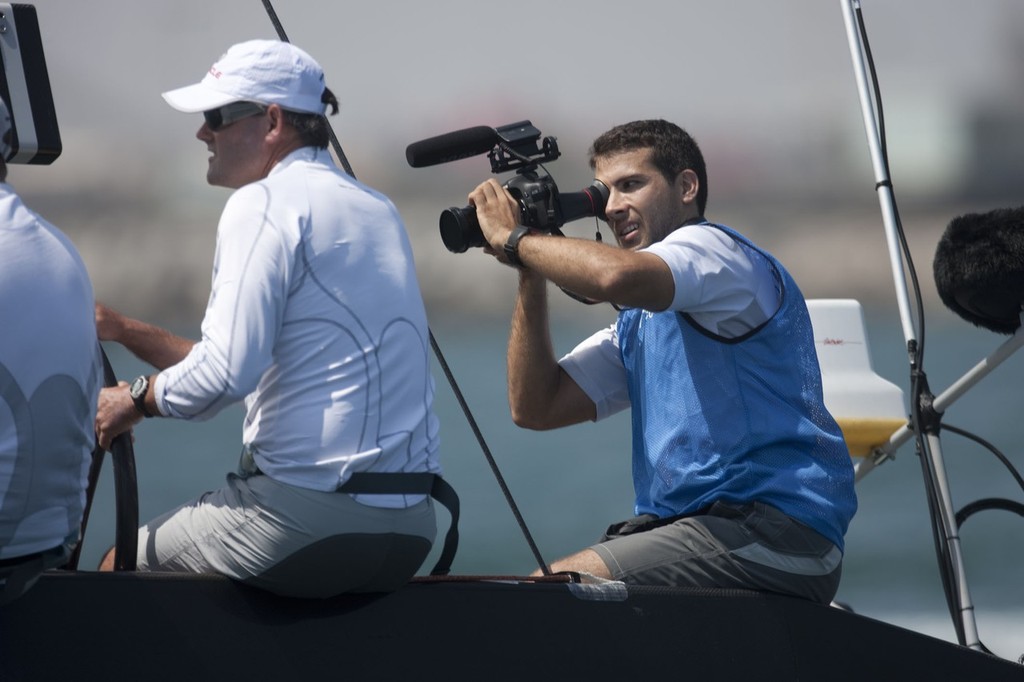
34th America’s Cup - TV Trials Gilles Martin-Raget
http://www.martin-raget.com/
A lot of time and effort is being spent over the past few and coming weeks on what makes for good sailing television.
The exercise is underway for both the Olympic sailing regatta and America’s Cup.
Others in the World Match Racing, Audi MedCup and similar circuits have been in steady, sometimes stellar, improvement mode for months and even years.
Currently there is a large amount of sailing video being broadcast and replayed. A small portion of it is very good. Most of it is average to dreadful. Technology seems to have overridden the basics.
What does make for good sailing television?
We turned to Paul France, one of the fathers of live televised sailing. A former national dinghy champion sailor himself, he has sailed boats – mono and lately multihulls – all his life.
France produced the live NZ television coverage of the Fremantle America's Cup 1986/87. Peter Montgomery handled the on the water commentary and Jane Dent the shoreside theatrics, of which there was plenty. The Louis Vuitton Cup, in particular, was an event that captivated the nation.
France undertook a similar role with the Big Boat challenge in San Diego in 1988, but the two race, Coma off Pt Loma, just wasn’t the same.
Then as General Manager, Production in 1991 France vacated the director’s chair and did the initial set up for the coverage for 1992 America’s Cup. That role included driving the development of the first real-time 3D graphics system commissioned by Television New Zealand in conjunction with Animation Research Ltd. He then moved offshore as President CNBC Asia (a financial news channel), before returning to live in the Bay of Islands.
'There is a certain amount you can do for yachting to make good television. The graphics was a huge step forward. Setting up the field of play with lines on it meant then that people could understand what was happening.
'That is perfectly achievable in a match race, but I have seen nothing in a fleet race that will show that information to the viewer.
'In fleet racing, you have to be able to show when a boat has taken a flyer, picked up a shift and how much they have gained.
'You need to have commentators who can say 'look how so and so has taken off to the left and look what has happened.'
'I discount the frequently espoused view that we have to get sailing on TV because it is good for the sport. That is just naïve.
'If you look at the sport that is successful on TV, they are sports that were successful before the advent of TV, and they have since just been adapted for TV. But originally, before the advent of television, the sport was a major fan puller. So you have Rugby, League, Motor Racing, Cricket, Baseball and so on. But sailing was never part of that scene.
'So when people say that yachting has to be on television to succeed in the world, then I think that is a simplistic statement. But if you say that there is a substantial body of an industry which is now supported by various professional yachting circuits which people think would be enhanced as a commercial product by being on television then that is a completely different statement.'
For Sponsors not Sailing
France believes that much of what is presented on television, as sailing packages, is really produced for sponsors not for sailing. He doesn’t have a problem with this.
'The question then has to be 'what do sponsors want?' Sponsors are very difficult to pick what they are about. But I would be very surprised if any sponsor seriously thought they were going to get mass television exposure through yachting.
'For the sponsors, it is a game of association not mass exposure.'
'For their marketing teams it is about very careful positioning.'
France does have a big issue with what he calls Vanity TV. He explains: 'If you look at many highlights productions, the story is all told in the voice-over about how someone won three races; and you see a few shots of boats going in various directions; and in the end you get an interview with the winner , who tells you why they went up the left hand side.
'It’s all about sponsors and sponsorship. It is Vanity TV. It serves no end, except to make someone in the sponsor’s marketing division feel better. Why bother?
'I’m pretty passionate about television and my belief that it is story telling.
'I used to say to people who worked for me 'look the best thing you can do is to imagine that you are taking the viewer by the hand and saying 'come with me and I will show you what happened'.
'Any story on television has to be shown, not told. You don’t need television to tell the story. Just write me a letter if you want to tell the story,' he says with a smile on his face – but you’ve seen that look before, and know he is deadly serious.
'You have to have an illustrated story,' he adds. 'And the pictures have to relate to the story.'
Capturing the Drama
While much of the current focus is on applying new technology to sailing television, those who have been in the epicentre of an event such as the America’s Cup, know that clever images are not really the cornerstone of sustainable regatta coverage.
France puts his finger on it, when he talks about 'The Conflict'.
One of the features of an America’s Cup and its preliminary series are that no two days are ever the same.
On the water there is always some moment that sets the day aside from every other, and that is the story of the day. But it’s off the water that The Conflict really lights up. Who can forget the momentous media conferences with the characters of the 1987 America’s Cup? Young Chris Dickson needling the uncomfortable master, Dennis Conner. Tom Blackaller played all to perfection, and Harold Cudmore was an able foil.
The Black Hatted New York Yacht Club got eliminated early, with their laconic skipper John Kolius making an art form out of his use of Gallows Humour, when reluctant exit became more and more inevitable. Then of course there was the play of the fibreglass boats, with Michael Fay conducting that particular orchestra.
In 1992 it was the bowsprit, the tandem keel, Paul Cayard and the Italians against the Kiwis. Remember the boats breaking and sinking? The betting scandal in Auckland? The needling from Butterworth in Valencia? It was there in 2010, in Valencia – when you had two billionaires who didn’t like each other finally having to sort it out on the water – all played out on television.
But even the race itself is theatre as much as it is sport – almost like a bullfight.
'Good sailing television does actually work, is because there is tremendous drama in sailing,' says France. 'It means that there is a whole series of segments about which the half knowledgeable viewer has some idea about what is going on. There’re pre-starts, and then the start, and then they’ll go off, and the viewer knows they can probably make a cup of tea at that point, because 10 minutes later they will go around a mark.
'A good commentator would say 'I wouldn’t have gone that far across..' and so on, and will very quickly pick up on the snafus etc. And, some commentators are very quick to pick up on that sort of detail', he adds.
'The things that I think are terribly important are to work out just what you are trying to achieve. If it is some way of enhancing the marketability of a professional sporting circuit then that is one answer. And that answer may be Vanity TV – which looks good for the sponsors; and the owners are happy with some good shots of their boats. That sort of thing is usually beautifully shot. The owners go away with a good DVD. And everyone is happy – that is all they want.
Quality images fundamental
With the advent of the New Media and Reality TV, France is scathing of the quality of some of video that is being passed off.
'The quality of video is still critical. A lot of the stuff you see, on YouTube for instance, is dreadful – even from professional companies. Their aim is not to provide coverage of the event, but just video that you might like to watch. There is no stabiliser in the camera at all, and it is just awful.
'It is fundamental that you have to have stabilised lenses and you have to have some way of getting a camera in the air - whether it is a helicopter, balloon or whatever. There isn’t any way around it'
'The camera is capable of taking you somewhere it is brilliant to illustrate what is going on, and to places where you would never be able to go if you were at the sportsground, for instance. The aerial shot tells you what is going on.'
While many of the old hands of television production are impressed with the quality and quantity of technology that is now available, too often the basics of direction are forgotten in the quest to use some new lens or shooting position.
'There is standard television grammar, a bit old school, these days but it still applies,' France explains. 'You have to stay on the same plane to keep the viewer properly orientated, while you illustrate the story you are trying to show.
'What seems to happen now is that someone says' I have a whole lot of footage of boats going every which way. I’ll write a story, you voice it and I will get the editor to do some pictures for it.
Audi MedCup Marseille - above with an unstabilised camera - and below a big quality lift with a stabilised camera
'The finished product has boats going in all directions, and no time sequence. The voice over is telling you what a great race it was, and that it was won right in the last few metres. The poor viewer is left wondering what the hell are they looking at. There is no story being told by the pictures.'
If I were an audience what I would want is a website where I could watch the race live if I wanted to, which is unlikely, because I am never going to hit the TV/PC at moment when they start the race.'
'I’d like to be able to see seven or eight minutes of each race, in an archive and clearly labelled; I would also have section where there would be various clips of video that has been acquired in the course of the day.
'There might be a free 40 second news coverage clip for instance which can be taken by broadcasters or given to a distributor; there would be a Vanity video for the sponsors.
'But you have to have the continuous coverage of the races which can be edited later into the packages, which is not difficult.'
Next we will look at Olympic television.
If you want to link to this article then please use this URL: www.sail-world.com/72623