Gladwell's Line- America's Cup Decision - Your call, Ernesto.
by Richard Gladwell, Sail-World.Com on 3 Apr 2009
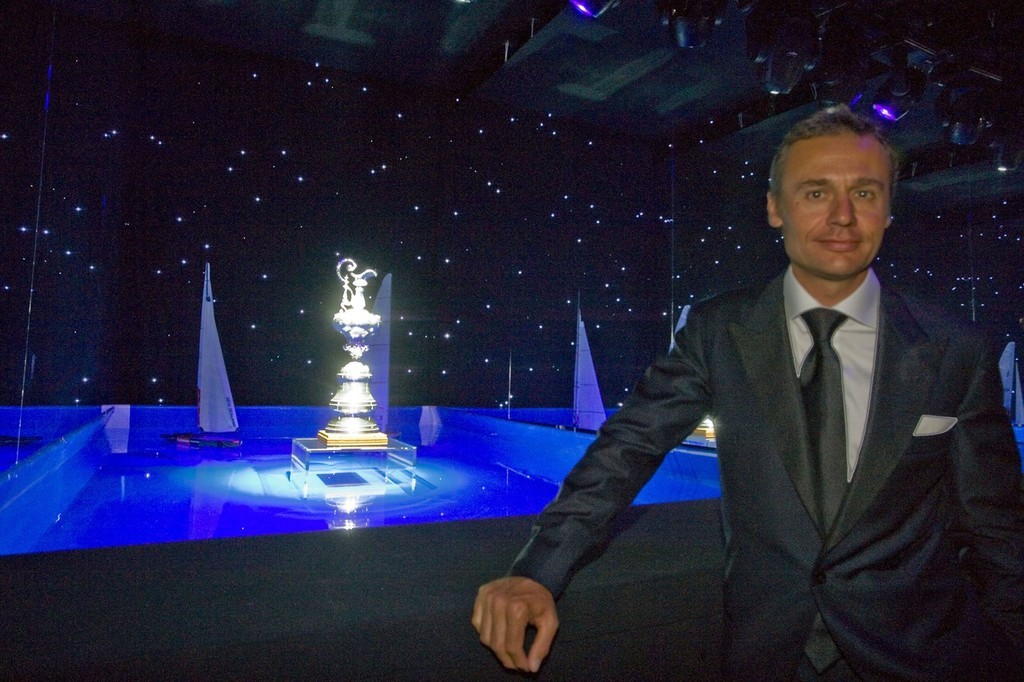
Ernesto Bertarelli, head of Team Alinghi, with the America’s Cup, after Alinghi’s first Defence ACM 2007/Carlo Borlenghi
The Appeal Court of New York State this morning ruled in favour of the Golden Gate Yacht Club on the legitimacy of Club Nautico Espanol de Vela (CNEV), as Challenger of Record for the 33rd America's Cup.
The simple answer was that CNEV did not satisfy the requirements of the Deed of Gift, and therefore was not a bona fide club from which the Defender Societe Nautique de Geneve (SNG) could accept a Challenge.
In what will be a landmark decision, from which there is no further Appeal the Court set back the America's Cup clock back to to July 2007 with their concluding paragraph:
'Since CNEV has failed to show that at the time it submitted its Notice of Challenge it was a 'club fulfilling all the conditions required by' the Deed of Gift, it does not qualify as the Challenger of Record for the 33rd America's Cup competition and Supreme Court was correct in declaring GGYC to be the valid Challenger of Record.'
As Sail-World, and other commentators pointed out early in the piece, the requirements of the Deed of Gift meant that a Club must have already had held an Annual Regatta, not for that to be some future event.
This whole case has been largely determined on the meaning of that simple word 'having' as used in the Deed of Gift when it requires:
'Any organized Yacht Club of a foreign country, incorporated, patented, or licensed by the legislature, admiralty, or other executive department, having for its annual regatta an ocean water course on the sea, or on an arm of the sea, or one which combines both, shall always be entitled to the right of sailing a match of this Cup, with a yacht or vessel propelled by sails only and constructed in the country to which the Challenging Club belongs, against any one yacht or vessel constructed in the country of the Club holding the Cup.'
The view put forward by Alinghi and SNG was that having was some future event and provided that a regatta was held before the commencement of the next match for the America's Cup, the condition would have been satisfied.
Golden Gate YC did not subscribe to that view, as it meant that a paper yacht club with few members, no infrastructure, and no record of sailing could be formed and then accepted as a Challenger for the America's Cup.
During the string of hearings that followed the acceptance of the Challenge in July 2007 the meaning of the word 'having' were argued at length.
The Appeal Court resolved the matter by applying the required test that they look at the plain English meaning of the word. And recognised that there was an issue between a future event and a past regatta.
To resolve that issue the Court then looked at other words around the tests of a Challenging Club specifically 'incorporated, patented, or licensed by the legislature' .
It decided that these were all past requirements, and so was the meaning of the word 'having'.
The Appeal Court began to address this issue on Page 8 of their 12 page decision:
'Thus, to comply with the eligibility requirements as outlined by the Deed, a challenger must be (1) an organized yacht club, (2) foreign, in that it is not of the same country as the trustee yacht club, (3) incorporated in its local jurisdiction or officially recognized either through a license or patent from its government, (4) and 'having for its annual regatta an ocean water
course on the sea or an arm of the sea or one which combines both.' It is the last requirement that divided the court in light of the fact that CNEV had not held an annual regatta on the sea prior to submitting its Notice of Challenge.'
'The Appellate Division majority deemed the phrase, 'having for its annual regatta,' ambiguous and therefore found it appropriate to glean the settlor's intention as to the meaning and purpose of this phrase by looking to extrinsic evidence. We disagree and find the phrase to be unambiguous. As we did in Mercury Bay, we must first examine the plain language of the Deed of Gift and determine, as a matter of law, whether the language can be construed as written and the settlor's intention determined solely from the unambiguous language of the instrument itself.
'In looking at the plain language of the Deed of Gift itself, as we must, we first note that the annual regatta requirement is only one of a list of eligibility requirements set forth in the Deed of Gift. The settlor clearly placed the requirements of 'organized' and 'incorporated, patented, or licensed' in the past and intended that a challenger would continue to meet these eligibility requirements in the present and future. For example, the term 'incorporated' refers both to a past event of incorporation and to a continuing status.
'We believe that the settlor intended the same to be true for the 'annual' regatta requirement. By using the word 'annual,' the settlor suggested an event that has already occurred at least once and will occur regularly in the future. Taken as a whole, the fact that CNEV has since held two ocean course regattas, one in November, 2007 and a second in November, 2008 is of no moment since none had been held in July, 2007 prior to CNEV submitting its Notice of Challenge to SNG.
'We conclude that the settlor intended to link the annual regatta requirement to the other eligibility requirements in that the challenging yacht club has in the past and will continue in the future 'having' an annual regatta on the sea. Any other interpretation would render the annual regatta requirement a nullity.
'The settlor clearly intended that for a challenging yacht club to be within the eligibility requirements, it must have held at least one qualifying annual regatta before it submits its Notice of Challenge to a Defender and demonstrate
that it will continue to have qualifying annual regattas on an ongoing basis.
'Thus, SNG is wrong in its claim that the regatta requirement can be satisfied by race time rather than at the time of challenge. We conclude there is no ambiguity as to the annual regatta clause at issue. When read in the context of the entire Deed of Gift, the challenger must demonstrate that its Notice of
Challenge 'fulfill[s] all the conditions required' (Deed of Gift, October 24, 1887,) at the time it submits its challenge.
'SNG and CNEV assert that the existing practice among Defenders and Challengers of Record to allow Mutual Consent Challengers to participate in the America's Cup, even without having held an open sea course regatta is evidence that the
settlor intended that a challenging yacht club is not required to have held a regatta on the open sea prior to issuing its Notice of Challenge. This assertion has no merit because the plain language of the Deed of Gift itself forecloses such an illogical conclusion.
'Even if the language of the Deed of Gift were ambiguous, evidence of these practices would not qualify as extrinsic evidence of the settlor's intent in 1887 as these practices emerged much later. Thus, the decision of the Defender and the Challenger of Record to waive the eligibility requirements for yacht clubs seeking to participate as Mutual Consent Challengers has no bearing on whether a yacht club seeking to establish itself as the Challenger of Record must meet the requirements imposed by the Deed of Gift itself.
'Since CNEV has failed to show that at the time it submitted its Notice of Challenge it was a 'club fulfilling all the conditions required by' the Deed of Gift, it does not qualify as the Challenger of Record for the 33rd America's Cup competition and Supreme Court was correct in declaring GGYC to be
the valid Challenger of Record.'
Where to from here?
The decision does NOT as some commentators have claimed, mean that a Deed of Gift Challenge sailed
If you want to link to this article then please use this URL: www.sail-world.com/55393