Emergency Locator Beacons - Make the Switch to 406
by . on 17 Jun 2009
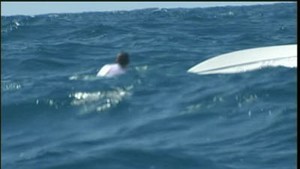
This sole survivor clung to an upturned boat for 46 hours - they had no EPIRB on board SW
Globally, all distress beacons were required to have changed to 406MHz from February 2009. Have you changed yours yet?
Earlier this week, in New Zealand's South Island a woman was saved solely, after a fall, because she had a personal locator beacon, http://tvnz.co.nz/national-news/mum-survives-200m-fall-2786760!click_here to read more. 'She attributes her survival to their locator beacon. It took just an hour and a half for the rescue helicopter to find them', says ONE News.
After 1 February 2009 the old 121.5MHz and 243MHz Emergency Position Indicating Radio Beacons (EPIRBs) won’t generate an alert or give your location. The satellite system that supports these old beacons ceased to operate from 1 February 2009.
This means if you need help in an emergency and try to use an old EPIRB to alert rescuers, the satellites will have no way of hearing you.
Time is/has running out – if you get into trouble and need help you’ll have to have a 406MHz EPIRB, registered and installed in your vessel by 1 February 2009.
The sooner you do this, the better. 1 February 2009 was the deadline, make sure you have your 406MHz life-line.
What kind of EPIRB do you already have?
If you don’t know what kind of EPIRB you have already, check it now. Somewhere on its body it will be marked with an operating frequency. If it doesn’t say 406MHz, it will more than likely need to be replaced. If in doubt, take it to an EPIRB supplier for verification. A list of these can be found at www.beacons.org.nz .
How will a 406MHz EPIRB help save your life?
- It works. Only 406MHz EPIRBs will be monitored by satellite from 1 February 2009.
- It’s faster. Once activated, the signal from a 406MHz EPIRB is picked up almost instantly by satellite. The satellites supporting the old 121.5MHz and 243MHz EPIRBs took several hours to determine your location - which could have been hours too late.
- It’s more Accurate. 406 MHz EPIRBs give rescuers a search area of approximately 20 square kilometres. However, we strongly recommend GPS equipped EPIRBs as they reduce the search area down to only a few square metres. This takes the ‘search’ out of search and rescue, and increases your chances of survival. Any 406MHz beacon is a huge improvement on the 121.5/243MHz system, which had a search area of more than 1260 square kilometres.
- It brings the right response. With 406MHz EPIRBs, alerts are cross-referenced against a database of registered owners. Having this information improves rescuers ability to help you in an emergency, and to respond appropriately. Being able to contact you or a person you nominate also saves time and resources from being wasted on false alerts – out of the 1300 121.5MHz activations in the last two years, only 9% were for a real emergency.
Maritime Rules
Pleasure Vessels. Offshore pleasure vessels heading overseas are already required to carry a 406MHz EPIRB. Yachts undertaking coastal races where Category 2 or 3 safety rules apply must carry a 406MHz EPIRB from 1 February 2009. For further advice, contact the recreational boating team at Maritime New Zealand recreationalboating@maritimenz.govt.nz
Commercial Vessels. For some classes of commercial vessels, it is already compulsory to carry registered 406MHz EPIRBs from 1 July 2008. To determine if that applies to you, please contact your nearest Maritime New Zealand office or check out the relevant rules on their website at www.maritimenz.govt.nz/rules/EPIRBAmendement.pdf. In basic terms, if you currently are required to carry an 121.5MHz EPIRB, then you must now carry a 406MHz EPIRB.
Buying your 406mhz EPIRB
What kind of 406MHz EPIRB do I need?
There is a wide range of beacons suitable for marine use. Some are activated manually while others will float free and activate automatically if the vessel sinks. In some cases a smaller, waterproof Personal Locator Beacon (PLB) may be suitable and can also be used for other purposes such as tramping, climbing, gliding and other outdoor activities. PLB’s are small enough to fit in your pocket and are activated manually but most do not float and have a shorter battery-life than EPIRBs. We strongly recommend you purchase a beacon with in-built GPS as this dramatically improves their accuracy.
Free 406MHz Registration
It is vital that 406MHz EPIRBs are registered with the Rescue Coordination Centre New Zealand (RCCNZ). This ensures a faster, more appropriate response in an emergency. Registration is free and you can register online or download the forms at www.beacons.org.nz. If you sell or buy a second hand 406MHz EPIRB or if your personal details change (such as phone numbers or address), please take the time to update the registration information with RCCNZ.
Disposing of your old EPIRB
It’s important to dispose of your old 121.5 or 243MHz EPIRB properly. If you don’t, it could still be accidentally activated, causing an unnecessary search and rescue operation. Old EPIRBs need to have their battery disconnected and then be disposed of in accordance with local regulation, as many contain hazardous materials. You can go to www.beacons.org.nz to see a list of suppliers who will help you dispose of your old beacons safely. Some of these suppliers may offer trade in deals.
Don’t buy a foreign 406!
Each 406MHz EPIRB has an individual hexadecimal code. These are allocated to different regions around the world. When you purchase a 406MHz EPIRB, make sure it’s coded for New Zealand. You can find a list of where to buy New Zealand coded 406MHz EPIRBs at www.beacons.org.nz.
FOR MORE INFORMATION AND WHERE TO BUY, VISIT WWW.BEACONS.ORG.NZ
For more information on all courses offered by www.cbes.org.nz!Coastguard_Boating_Education download http://www.sail-world.com/NZ/company_n.cfm?compid=978!Coastguard_Boating_Educations_brochure or visit their website www.cbes.org.nz
If you want to link to this article then please use this URL: www.sail-world.com/57962