America's Cup- Regatta Director Iain Murray reflects at Portside
by Richard Gladwell on 14 Nov 2010
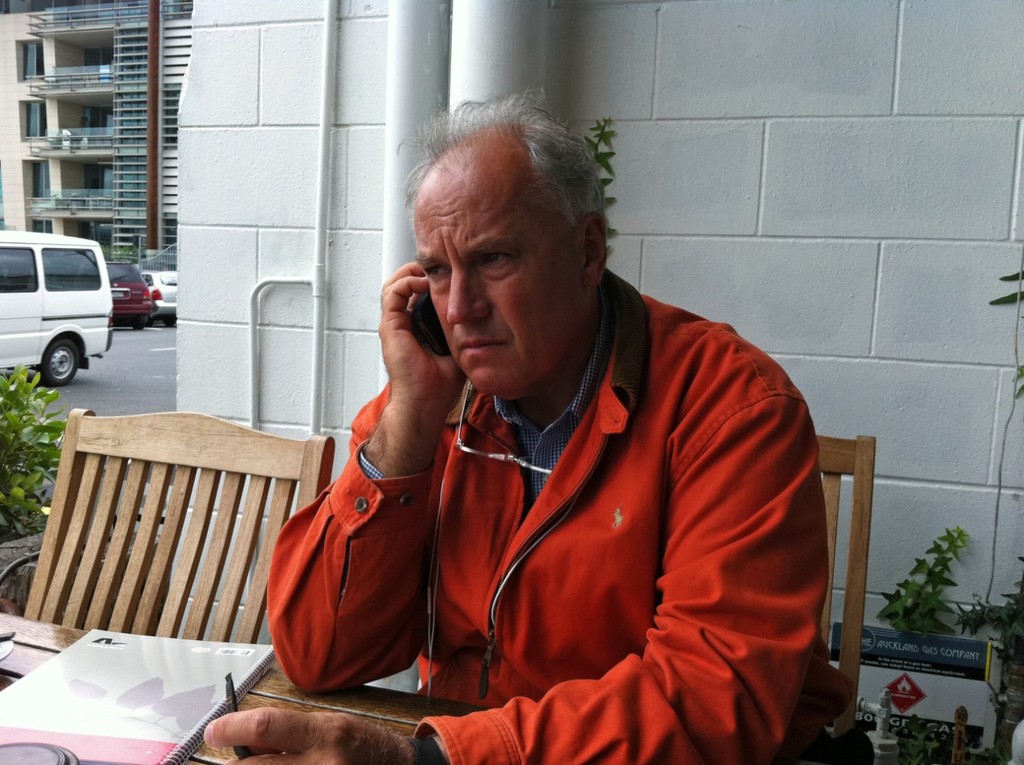
’’We move people around and run races,’’ Iain Murray, AC34 Regatta Director Richard Gladwell
www.photosport.co.nz
New Zealand once again seems to be the centre of the America’s Cup universe, and will be so for the next few months as the first of the new AC 45 class of catamarans are built and commissioned ahead of the America’s Cup World Series due to get underway in June 2011, from a European venue.
One of the icons of Australian sailing Iain Murray, in his new capacity as Regatta Director for the ACWS and America’s Cup events was in Auckland to check out progress on the first of the AC45’s in Warkworth about 40 minutes drive north of Auckland.
The new one design class which will feature a wingsail will be used by the America’s Cup teams in the opening stanzas of the ACWS before switching to their big sister, the AC72’s the boat of choice by the Defender for the 34th America’s Cup.
Murray, as Regatta Director works alongside the America’s Cup Event Authority. 'We move people around and run races,' is his simple explanation for the role of the America’s Cup Regatta Management. 'We are not selling the sponsorship and we are not selling the venues, or negotiating television and sponsorship – that’s all ACEA’s negotiations,' he says when we caught up at Portside, the watering hole so beloved by the sailing paparazzi.
It’s Murray’s second flying visit to Core Builders , builders for America’s Cup Defender, BMW Oracle Racing, to check out the construction of the first of what are expected to be ten AC45’s.
Murray is Core Builders’ major customer. 'They are just suffering me at the moment. We are very lucky, they have taken this project on, because I am not sure how it would have happened without them.
'I am pretty happy. It would have been much harder to manage it ourselves from startup. Essentially there is a commitment to six to ten boats - the materials have been bought for ten,' he adds.
'Cooksons are one sub-contractor for the hull construction, with Hall Spars doing the beams and centre spine, and the fins and rudders being done separately. There are a lot of parts being spread around, Auckland building firms. Which teams get the boats and in what order pretty much comes down to who has entered and ordered.'
The AC45’s are being onsold to the America’s Cup teams at 600,000 Euros each – some will have one, others two – for two boat testing as well as competing in the ACWS. This is the first time a junior boat has been used in the America’s Cup. The reason being to give crews a chance to learn about wingsail technology and catamaran sailing before stepping up to the much larger and more powerful AC72’s.
Murray’s first delivery will occur at Christmas, and the prototype will be retained as a test boat and spare for the ACWS, venues for which are still under negotiation and yet to be announced. ACRM Chief Operating Officer, Andy Hindley is handling the logistics associated with each potential venue.
Murray expects the first three to five venues to be in Europe in 2011. There will be 13 rounds of the ACWS before the start of the Challenger Selection Series in July 2013.
'The plan is for ACRM to have a charter ship, specifically for moving all of the syndicates’ containers from venue to venue. That may turn into two charter ships when there are AC72’s to freight, or we might go to one bigger ship.
'It is very expensive to transport these boats by airfreight, sure you can fly them around, but the cost isn’t sustainable for a fleet of AC45’s or AC72’s. We might have to fly wings to the first event, which are only very light, but quite bulky.
'For us to have a commercial ship travel from New Zealand to Europe for our first event, it would cost 35-40 days depending on stops. If we have a charter ship going direct it will take 23-25 days depending on steaming speed. When you multiply those gaps it adds up to a lot of time', Murray explains.
The use of a charter ship is not new, having being used for the Acts leading up to the 32nd America’s Cup in Valencia – and used for carrying competitors gear, boats, committee boats even the event tents. To some extent it means the teams, like in the Louis Vuitton Trophy, can just fly in before the regatta and be ready to race.
'What we are trying to do is provide good racing, with logistics and sailors – a small team in the first year, to allow them to get out on the water and sail these boats.
'We will pack up their containers, pack their boats. We will load them on the ships. We will take them to the next place and all they have to do is show up.
'The shared facilities will have all the construction materials for the AC45’s , we will have spare parts, spare wings, sail-making facilities, sewing machines etc. When we move to the AC72’a clearly the most cost effective way is to have those common facilities, but that will ultimately be decided in a competitors forum.
'That is quite different from what it has been in the past. Every syndicate has had its own big logistics operation. For the ACWS they won’t need to have had to have their own sail loft, boat building facility – ACRM will be supplying all that. They will have the boat delivered to the venue for them,' Murray adds.
The issues are well publicised, in the 33rd America’s Cup, surrounding the overnight care of USA-17 on a mooring and the antics with her wingsail in an overnight storm.
So how will ACRM cope with up to ten AC45’s and their wingsail issues after the day’s racing?
'Not all the venues are going to be the same, says Murray.' We can’t always get a two acre square downtown city block. It quite possibly will be that we will have to separate the boat park and the boat moorings.
'We will just have to work with the venues on where we set down our public areas, syndicate bases, our mobile sailofts and all the features that we are going to have.
'I would like to get the wing sails down at night, particularly on the 45s. We are trying to make it so we can lower the wing sail while in the water.
'What we all have to do is learn the ways of managing the boats from the AC45s.
'Whether they are on the water or off the water, we have to get on top of things with managing the wings. They are clearly aerodynamically efficient, and they are fragile. The last thing we want to do is to be banging them up and repairing them, just because they are difficult to handle.
The term 'Shared Bases' is an oxymoron in the Spy vs Spy world of the America’s Cup.
But in the ACWS World it is a practical way of reducing costs for teams on the circuit. Murray dismisses the espionage as more imagined than real.
'In the first year there is going to be a lot of learning how to sail and dealing with wings, and rotation and twist angles. They are all one design. How much spy stuff will go one? There is probably not a lot to spy on. There is nothing from stopping the teams from trialling new wings or foils, but they will have to race in one-design mode. The development work will take away from those spying eyes, I guess.
'The 45s are all one design and I would think that we could upscale them to work with the 72s. The teams all see what happens with the other guys anyway, so maybe the secrecy isn’t quite such a big deal. It is not like these boats are skirted and behind barbed wires. Similarly with the sail making, there are no secrets.
At the ultimate America’s Cup venue, the teams would shift to the more traditional secure bases for the Challenger and Defender Selection Series and the America’s Cup Match itself.
When asked about the format of the two series, Murray indicated this is something he will take up with the teams.
'It is not down on paper yet', says Murray. 'Once we have a Competitors’ Forum, we will be taking a number of options to them. We could even have fleet racing as part of the CSS. We will be sitting down and discussing all of that with the teams, we will not be making that decision on our own.'
'The courses going forward are going to be under an hour in duration. They are going to be tight, fast courses.'
'The windward leeward thing for the cats is probably not the best option, as we don’t want a situation where there is one tack or gybe to the mark. One of the most difficult parts with cat sailing is the beam reaching because they get so overpowered – so we will tailor the courses a little – they won’t be just straight up and down courses. We want to make the courses challenging.'
Once the venue for the 34th America's Cup, is announced in December, it is expected that there will be more detail on courses, dependent on the sailing water available, and base details.
Also expected is the announcement on the venues for the 2011, 2012 and 2013 America's Cup World Series, which will have a significant influence on team sponsorship opportunities.
If you want to link to this article then please use this URL: www.sail-world.com/76865