Robbie Doyle on the Bermuda Race 2014 - Strategy, sails and crew care
by Laurie Fullerton on 16 May 2014
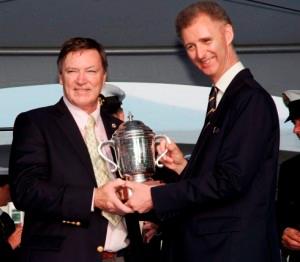
Bermuda Governor Mr. George Fergusson awards Robbie Doyle the George W. Mixter Trophy as winning navigator in the Gibbs Hill Lighthouse Division. (Barry Pickthall/PPL) Laurie Fullerton
2014 Newport Bermuda Race - Robbie Doyle will start his 12th Newport Bermuda Race when the fleet leaves Newport on June 20th. He is what he calls the 'stratitician' on board George Sakellaris’ Shockwave, 2012 winner of the Gibbs Hill Lighthouse Trophy and the North Rock Beacon Trophy as top IRC boat in the race. We caught up with Robbie at the Doyle sail loft in Salem, Mass.
Q. To get an edge on the competition, what should competitors, navigators, or tacticians be doing now to get prepared for the race in mid-June?
For all competitors, right now you should be reviewing the weather from past races and watching the Gulf Stream and surrounding eddies. Begin to get a feel for what to expect in terms of weather and determine how the Gulf Stream is setting up and moving. Don’t wait until two days before the race to do this. The Gulf Stream and accompanying meanders and eddies play a key role in the race so you need to know where all the key elements will be when you get there, not just at the start.
Q. As well as watching the Gulf Stream, how important are weather patterns and forecasts and why?
My first Newport Bermuda Race was 38 years ago and we relied on celestial navigation, and much of the weather was predicted by the navigator’s arthritis. The prevailing strategy was what emerged from past races. It was basically thought that you head 180 degrees until you get into the Gulf Stream, and then head for Bermuda. Along with everything else, weather forecasting has gotten a lot more accurate but you still cannot trust the forecast 100 percent.
On Shockwave we are preparing with the goal of winning it. So, currently, we are doing a study on weather data over the decades and we are basing our analysis on a number of factors. The reason the weather predictions are so important is that we will decide on our sail inventory from our analysis. If we choose wrongly, or if I advise wrongly, that does not give me a warm, fuzzy feeling. These decisions of what sails to bring and what sails to leave behind are a huge factor in preparing for the race and can determine a great deal. We need to submit our rating by May 27 so most key decisions must be made by then. We will make our macro inventory decisions then but exactly which sails come and go will be decided the day of the race. Despite all the technology we have, you never win the Newport Bermuda Race if you don’t make some big guesses and that is all part of what it takes to win the race.
Q. Are there some factors that many competitors could take greater notice of as they consider their competitive strategy?
Yes, and it is about sail inventory. Read the ORR rules again or talk to your local sailmaker. The rules have a clear effect on the sail inventory because with ORR rules you are rated with the spinnaker factored into your rating whether you choose to use one or not. You are rated based upon the minimum ORR area whether your actual spinnaker is that size or not. If your spinnaker is larger than the ORR area your rating goes up, but not vice versa. Some teams will have a spinnaker on the boat that may be well under what you are rated for. Similarly, you are charged for a minimum jib area and a cruising boat with a non-overlapping genoa is likely to be under that for jib area. It is very easy to miss these details and you should take time right now to figure out your sail inventory to your best advantage.
Q. What are some common pitfalls for competitors?
You want to make sure you establish your watch system immediately and stick to it from the start. I can’t emphasize enough how important it is to get into a rhythm and stay rested. People tend to want to stay engaged or participating in the decisions even when they are off watch -but it is better to preserve your energy. You will need it. Another pitfall is that you don’t rest on your laurels after you pass through the Gulf Stream. As a rule the sea state is calmer but people are tired and it is very easy to stop thinking strategically. There remain a lot of tricky currents and decisions made in the final 200 miles of the race where it can be won or lost.
Seen here after the 2012 Bermuda Race, the R/P 72 Shockwave recently was overall winner of the 2014 Caribbean 600. (John Rousmaniere).
Q. What else have you learned about the Bermuda Race?
The more I learn about the race and the more I know, the less confident I have become about winning it. The Newport Bermuda Race is one of the most challenging races of all time. You have the Gulf Stream, with hot and cold air meeting each other. It is an oceanographic and meteorological laboratory and we are the RATS! It is really, really tricky. It is always interesting, challenging, and rewarding to take part in.
If you want to link to this article then please use this URL: www.sail-world.com/122189