Seabrakes - a must have for offshore sailors?
by Rob Kothe on 23 Mar 2006
Time to slow down Ocean Images
When Captain John Abernathy grabbed a steel bucket and threw it overboard in a storm, he had no idea he was on his way to a great future invention for sailors - such a good invention that Sail-World asks, ‘So, why the bloody hell don't you have one?’
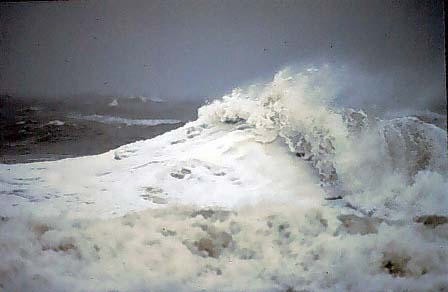
As a charter operator in Bass Strait taking tours out to the Lady Julia Persey seal colony, John found that if a sou’westerly blew up, the trip home became a nightmare, because of the nearness of the continental shelf. The winds could blow anything from 40 to 100 knots and caused lethal following seas.
John now recalls: ‘Conditions were so severe that day that the sea started breaking aboard - we broached, and then we got pooped. I had already tried a conventional sea anchor and the parachute style drogue in these conditions and nothing had worked.
‘As it happened I had an old stainless steel bucket on board that was rolling around the deck, hitting me on the shins. In desperation I hacked it with a tomahawk and made some holes to create less drag, put some rope through it and threw it over.
In an instant it went from a life and death situation to going back and putting on the kettle. The difference was so incredible, I immediately thought, ‘I am on to something here!’
So John went home and started to refine the idea, By 1982, he had developed a full blown two stage moulded plastic drogue.. He worked with the Australian Maritime College to develop his first model, which was used in the BOC Round the World Race. ‘It’s still a fantastic product today,’ he says, ‘a lifesaver, but it was a bit bulky.’
So John went back to the drawing board, using traditional canvas material with a stainless steel wire frame and finally producing today’s internationally successful ‘Seabrake’
This time it was approved as a SOLAS (Saving of Life at Sea) sea anchor, and the first alternative use came up, as Yachting Australia approved it, not as a sea anchor, but as emergency steering. Very successful!This meant that when you didn’t need to have restraint it provided an easy tracking device, conical in shape, but when the boat needed enormous drag, there is a bucket shaped base. The effect of the Seabrake is to keep the boat at a constant speed. This is excellent for going over a bar, when you want to maintain the boat at the same speed as the wave. As John says, ‘You’ve not going to get this surf, stall and then sit there waiting for the next wave to hit you. It is impossible to broach.’
I had to admit it sounded tricky to get it just at the right speed. John explained: ‘If you take the time to set up correctly and it is almost impossible to broach the boat. Once you get on the back of the wave you will stay with it. You can take your hands off the wheel if you like and you’ll run straight through.
‘This is one of the big features that people have used over the years, sailboat operators, people who have got to rely on running bars have bought it for that reason and that reason alone.
‘It will never go below the depth of the keel once you’re on a wave, and once you’re running at about 2 to 3 knots it will remain at about 7 feet.
‘That is actually where you want it - you don’t want it dragging along the bottom obviously. You usually run it about 3 boat lengths back as a rule of thumb. But if you’ve got short sharp seas you have to adjust it, 3 boat lengths might be wrong. I always say as a catchphrase 'if in doubt, let it out' the further out it is the safer you are.’
To prove his product to the Victorian Marine Board, he demonstrated it over Lake’s Entrance Bar, where the loss of life was higher than anywhere else in the State. The product, in fact, was so good, that people just didn’t believe him. He demonstrated it over Queensland’s once treacherous Southport Bar, and did bar tests and Coast Guard trials in America.
The Seabrake weighs 1.5-2kg for the smaller model. Being a stainless steel wire it folds into a figure eight for stowage. It is as flat as a pizza box and you can fold it in half and half again. The stainless steel springs it back up and holds the diameter so the water can flow in and flow out. These days the sleeve is polyester so that it doesn’t rot.
However, the usefulness of the Seabrake doesn’t stop at being ‘just’ a sea anchor and as emergency steering. As time went on, more and more applications were discovered, mostly, by owners.
As John recounts, ‘All of the other applications have literally come from people who have used it and said ‘oh by the way…..did you know…?’
‘An American sailor told me ‘We forgot to recover one of them after a hell of a gale and we left it hanging over the side. Later that evening in the anchorage it was pretty rolly, and we couldn’t work out how we could sit there and have dinner and a glass a wine when all the boats around us were rolling all over the place. Suddenly we realized that we hadn’t recovered the Seabrake and it was hanging out of the boat like a plumb bob or a flopper stopper.'
As a result of these later suggestions, the latest models of the Seabrake have a wide range of uses. They can be used as sea anchors, drift anchors, for emergency steering, for anti-surfing and anti-broaching. It can be used as an anti-roll device, and as a stabilizer up a wave and at anchor.
Coast guards and water police use it for towing purposes – it keeps the towed boat from accelerating in an uncontrolled fashion. It also has good use in combination with an autopilot – as it reduces the yaw, it stops the autopilot from having to work overtime, and this in turn saves power. (Australian Navy tests showed that it reduced roll by 50%, yaw by 70% and the helm by 70% plus.)
But John has the final say, ‘Just when we thought we had found every possible use for the Seabrake, someone came along and said, ‘Did you know that you can use it for a spare ‘man-overboard’ harness, as you can get inside it?’’
Today, Seabrake is experiencing an unprecedented success. Coming in sizes from 24 to 48 inches, the equipment is sold from Spain to New Zealand, from Africa to Asia.
Sail-World thinks the product is so good that one has to ask – ‘Should they be compulsory for certain races?’ The cruising sailor makes an individual decision about what gear is to be carried, and carries the consequences.
Racing boats sail with a certain responsibility being carried by the organising body. In the ill-famed 1998 Hobart Race, when boats were faced with giant breaking waves in Bass Strait, would compulsory Seabrakes have made the outcome for some of the boats different? An interesting question…..
The Seabrake is manufactured by Australia company Burke Marine.
Founded in 1971, Burke Marine makes a wide range of wet weather gear, personal flotation devices and other marine safety equipment under the Burke brand name. The group also distributes some of the world's best-known brands such as Henri-Lloyd, Sunbrella marine fabrics and Anchor Marine, a UK manufacturer of inflatable boat fenders.
www.burkemarine.com.au
If you would like to learn more about the product, click into the Seabrake website.
Burke's head office is located in Sydney, Australia.
www.sail-world.com/send_message.cfm!Click_Here!same to comment on this article
If you want to link to this article then please use this URL: www.sail-world.com/22274