A Q&A with John Craig about the Extreme Sailing Series San Diego event
by David Schmidt, Sail-World USA Editor on 16 Oct 2017
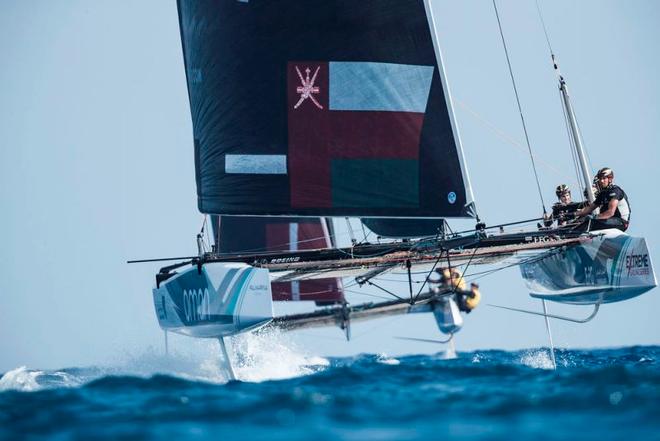
Oman Air’s victory in Act 4, Extreme Sailing Series Barcelona, saw it break its habit of finishing in third place Lloyd Images
http://lloydimagesgallery.photoshelter.com/
Years before the America’s Cup was the hotbed of high-speed multihull-racing and foiling innovation, the Extreme Sailing Series was ripping around international racecourses in 40-foot catamarans that defined extreme, circa 2007. Critically, the series brought a new kind of stadium-style sailing to international cities, allowing fully sponsored, professionally sailed teams to demonstrate high-end multihull maneuvers at speeds up to 30 knots in front of spectators whose previous ideas about multihulls likely involved Hobie 16s or some bloated charter-trade boat (read: a comfortable party platform).
While the event’s first-generation “Extreme 40” cats didn’t foil, they were one of the fastest boats afloat for their era, and they were also a capable platform for the often close-quarters racing that helped give the Extreme Sailing Series the reputation of being sailing’s answer to NASCAR (especially once America’s Cup teams started foiling in 2012 ahead of the 34th America’s Cup [2013, San Francisco] and assumed sailing’s F1-level multihull crown).
The Extreme Sailing Series celebrated its tenth birthday (2016) by swapping out their aging displacement-mode-only 40-footers for foiling GC32 catamarans that fly on a set of J-foils and are sailed by crews of five professional sailors at speeds up to 39 knots.
Now in its 11th season, the Extreme Sailing Series’s calendar features eight different Acts set in Muscat (March 8-11), Qingdao (April 28 – May 1), Madeira Islands (June 29 – July 2), Barcelona (July 20-23), Hamburg (August 10-13), Cardiff (August 25-28), San Diego (October 19-22) and Los Cabos (November 30 - December 3). I caught up with John Craig, Race Director of the Extreme Sailing Series, via email, ahead of the San Diego Act to learn more about this high-octane event.
San Diego is traditionally a light-air venue—how will this suite the boats and the crews?
San Diego is traditionally a light air venue but the GC32s are able to foil in 8-12 knots. We are optimistic that we’ll see at least those conditions while we’re there so we are looking forward to foiling in San Diego.
How has the Extreme Sailing Series’ recent transition to foiling GC32s changed your job? Have the new boats made it easier or harder?
I think the biggest change we’ve seen, which is not just with the GC32s in the Extreme Sailing Series but across the board, is that we now have foiling boats that are quicker and can create situations that raise safety concerns. Because of the greater speed of the boats we have upped the class requirements for safety equipment on the boats, for example each boat must now carry spare air, and as a result we’ve done training with the sailors in how to use that equipment.
We have also worked on fast boat rules that are designed to work better with boats at high speeds and do a better job of keeping the boats apart. These rules are applicable across the various tours that use fast boats, creating a situation for the professional sailors where the rules and interpretation of those rules are applicable across all the events. This is good news as it makes it easier for them to go from one event to the other and makes it fairer for everybody.
With the adoption of the GC32s and the boat speeds that they can reach there has been a need for us to find new venues and work within existing venues to increase the overall course length. Stadium Racing still remains at the core of the Extreme Sailing Series but now it is a balance between having stadium-style courses and making sure the legs are long enough so that the teams can stretch their legs. The reality is that you can still bring the racing close to shore to achieve that. San Diego is a perfect example of this.
We’ll be able to race up and down the shore close to the crowds and still have legs that are longer and provide the sailors with more opportunity to showcase what the boats can do. Other venues that lend themselves to this setup are Los Cabos, Muscat and Barcelona. We’re still going to have some venues that are slightly smaller but as we look at securing new venues we will continue to look to increase the racecourse footprint to provide the teams with more opportunity to demonstrate boat speed and leg strategy.
What shape courses are you envisioning for the San Diego event? Standard Windward-Leewards, or do you think the race committee will get creative?
In San Diego we will look to try and do reaching starts. The predominant wind direction will enable us to have reaching starts just off the Harbor Island VIP area, then we will send the fleet down towards the city and the leeward gate, and then on to a windward gate up at the top of Harbor Island.
Who do you see as the teams to beat in San Diego?
The current top four teams are the ones to watch; SAP Extreme Sailing Team, Oman Air, Alinghi and Red Bull Sailing Team. They will all be battling as usual and I think they are all in the running.
Given that the San Diego event is the second-to-last stop on the 2017, how much pressure will be on skippers and teams during this penultimate regatta?
There will be a lot of pressure on the sailors in San Diego because the teams are all very close on points right now, so what’s left on the table they’re going to need to get. SAP Extreme Sailing Team are a little safer after their victory in the previous Act in Cardiff, but the leaderboard is still pretty close.
A lot can be won or lost in San Diego ahead of the double-points finale in Los Cabos, Mexico.
Can you please tell me about any steps that the regatta has taken to reduce or lower its environmental footprint?
Earlier this season the Extreme Sailing Series was awarded Clean Regatta Gold certification by Sailors for the Sea, which was a great achievement. We will be working with Sailors for the Sea again in San Diego.
The event team is constantly taking steps to deliver a more sustainable event in many ways, from introducing more sustainable practices with the catering team, reducing the use of single-use plastic bottles by making re-fillable bottles mandatory for staff and working with staff and volunteers to eliminate litter from the event site, to working with the sailors to encourage more sustainable practices in the technical area and on the water.
I believe as a global regatta we have a responsibility to reduce our environmental footprint. We have seen what can be achieved if we all work towards being more sustainable. For example, in San Diego Bay and in San Francisco Bay, we have seen a growth in marine life in the bay following environmental projects, which is good news for all of us.
On a global scale, the oceans are our playground and we have to work to protect them. We need to make sure that we can continue to sail in them, so it is important to ensure that the footprint we leave at a venue is better than when we arrived there.
Anything else that you’d like to add, for the record?
We are very excited for the Extreme Sailing Series to make its debut in San Diego, and to return to the Americas for the first time since it visited Boston in 2011. I myself have been to San Diego many times and I am looking forward to returning.
San Diego has got a great history of international sailing and we are looking forward to working with the Port of San Diego, the San Diego Tourism Authority and all of our other local partners to make this event and future events a huge success.
If you want to link to this article then please use this URL: www.sail-world.com/157376