Rolex Sydney Hobart Race – Left field, handshakes and buckets Pt.III
by John Curnow on 24 Dec 2016
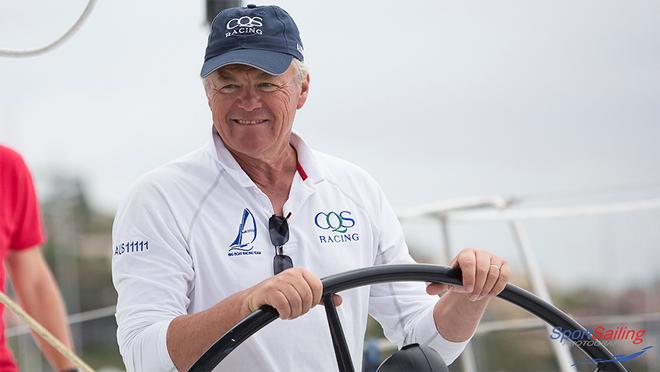
Ludde Ingvall at the helm of CQS - CQS Media Launch Beth Morley - Sport Sailing Photography
http://www.sportsailingphotography.com
Unobtainium keels, Einsteinium sails and Nobelium challenges ahead for the most radical supermaxi to ever start in the Rolex Sydney to Hobart Yacht Race. The 98-foot CQS started life as the 90-footer known as, Nicorette. She is being campaigned by dual Hobart winner Ludde Ingvall (one of which was with this very vessel in her former life, back in 2004), and his cousin, Sir Michael Hintze.
Part I and
Part II are available for you to go back to investigate all the notions from left field, the handshakes that sealed the deal and the ticks to the bucket list. Ingvall now wraps this three-part interview series for us today.
“Basically, the canting keel mechanism is the same as we have used on the 90-footer Nicorette, but we have gone from a dry box to a wet box, and we now have completely new keel and blade which is designed more to interact with the DSS, rather than purely for holding onto a bunch of lead. The bulb is made of Unobtainium.”
“How that happened is that our Kiwi designer, Brett Bakewell White, said ‘this is the type of keel that we would love to do. The problem is we can’t do it because the metal we need doesn’t exist. We have gone through all the metals we can find around the world, but we can’t find anything that is strong enough and hard enough.’ Then I said, I have got some contacts at Swedish Steel, which are big providers of high quality steel for the military industry, and also the Professor of Steel at Stockholm University. Tell me what you would need and we will see what they can come up with.”
“Brett Bakewell-White handed me a piece of paper the next day with the title, Unobtanium. I sent the spec to Stockholm, and within a week we got a reply that said ‘Unobtanium is now available in Sweden.’ They were yachties at the factory, and extremely keen, so they made us a billet of special steel that is just incredibly strong, and incredibly suitable for what we are doing. It was machined into the blade, and the result is that we now have a deeper keel with the same depth as Wild Oats XI.”
“Our keel weighs about 11 tonnes, plus then of course all the keel structures and the control systems, so we have got about 50% of the weight in the keel and its systems. Thus, we have a much bigger keel with a slightly larger bow, and a keel blade and a bow with less resistance, still with the dual ram as before.”
“Moving onto the race itself, I will be navigating, as I normally do. Scott Disley will be my wingman on that. Officially I am not navigator, I am skipper, but the two of us will manage navigation, and he’s been working on it full bore for a month, already”, said Ingvall.
“Tactics wise, it is hard to go past guys like Rodney Keenan, Chris Dickson and Chris Main. They will be running the start. I will be connected up with the media, and I will be calling down the time, which is pretty much what I do normally. Tactics throughout the race will be an interaction between the five of us; Chris Main, Chris Dickson, Rod, Scott and myself.”
“Also with there is the way I have set it up between the three watch captains. Chris Dickson is looking at how it would work and be tweaked to go as fast as we can. In the beginning a lot of it was seat of the pants type stuff, but Chris’ seat of the pants is hell of a lot better than anybody else’s that I know of. Chris Main is working on the control systems, and Rodney Keenan has done quite a lot of research in the yacht research unit at the University of Auckland on different settings. I think it was 76 computer simulations.”
“They were the first ones that said you must think multihull. Forget monohull, and forget about spinnakers, because every spinnaker we tested just performed worse than a combination of various headsails. So, on top of what Rodney is doing, he is now working on our sails set.”
“How many sails will we actually have? Well we have two sails at the end of the prodder - A1/A2. We have got two further sails half way down the bowsprit, so that’s four. Then we have a J2 that sits on the forestay on a furler, normally a J3 sits on the inner stay on a furler and then the J5. So, you are looking at a total of seven sails at the front, then the mainsail and all of them interact either as an upwind sail or as a staysail for a total of eight.”
“This is all new ground, so it’s purely a matter of going out and sailing. Every time we go out and come back we learn. We work out that we need to do this or that differently, and then the sail guys say we need to do this bit differently. So for example, we had originally thought we should have the normal forestay and just hoist on it.”
“We tried and then found that the bow is so narrow, because of that Dreadnought bow and chamfer, that it was too hard to work quickly and effectively. We lost too much time on manoeuvres, and the trick of course is that we really want to be able to change gears rather quickly. So we have all the forestays redone to furlers, along with the whole system in the front, and also atop the mast.”
“In terms of sailing fast it really doesn’t make that much of a difference, but from the point of view of being able to change gears quickly, it is just too long. So, we made the changes and that’s why we had to bring the mast down.”
“All in all, I am really excited. As you know, when I walked off the job and said that I do not need to do this anymore, it was with the arms race beginning when the handicap ceiling was removed. Up until then, Grant Warrington with Wild Thing, and Sean Langman and myself had a chance. We could be creative and hit that ceiling and we knew nobody could go past it, but when the rating was opened up, you also opened the arms race.”
“So now, and along with Sir Michael, I am back. After all, it seems to be my passion. It is what I have done since I was a kid. I used to put together little boats out of Scandinavian pine trees. I could see a big chunk of bark hanging off the tree in the middle of the forest, and I would go back sneakily with a little saw and cut it out and sit with a knife and make little boats out of it. So passion doesn’t disappear.”
“When you give up passion that’s when you get old, and I refuse to get old. I have lots of plans. That’s why we are here today, and now I have got a whole bunch of young talented yachties, both boys and girls training. They are just thrilled to be going sailing. It feels very cool.”
“A lot of people enjoying what we are doing, and learning a lot. If you can be 60 plus and find that you are learning a lot, then it is a pretty cool thing. I just can’t wait until the gun fires on Boxing Day”, said Ingvall in conclusion.
Current routing, which has to be viewed in light of the changes that can and do occur on the East coast of Australia, especially at this time of year, has the supermaxis at 1 day and 14 hours. This means they will have to work hard to be on record pace, which is 1:18 and some change up at the Battery Point finish line. Note that this timing puts you at the Iron Pot at/near sunrise, which is not ideal for getting up the River Derwent, but certainly better than in the dark. The maxis are at 1:19, the TPs 2:4, displacement 40-Somethings at 3 days even, older craft at 3:3 and small at 3:22.
We’ll have more on all of this as the super all-important weather window first gets a frame, then panes of glass, well before any paint gets applied, let alone any internal dressings, as the next few days unfold. For now, the nature of the Southerly change on the first night is still far from clear. Also, the remnants of the Tropical Cyclone currently over the top of Western Australia will appear in the Great Australian Bight at some point, but the blocking high-pressure system in the Tasman Sea will have influence over that. Time will tell, so keep your head out the companionway hatch… Warm temperatures on the South-East corner landmass of Australia mean one thing at this time of year. Change! And hopefully not bushfires!!!
Ultimately then if you are looking for smiles yourself, then do keep a weather eye here on Sail-World.com for all the latest intel on the great, inspiring, captivating and very historic, blue water classic… The Rolex Sydney Hobart Yacht Race.
If you want to link to this article then please use this URL: www.sail-world.com/150645