
D-1 to Francesca Clapcich's first Solo Transatlantic Route du Rhum-Destination Guadeloupe
by Team Francesca Clapcich 31 Oct 10:05 PDT
1 November 2026
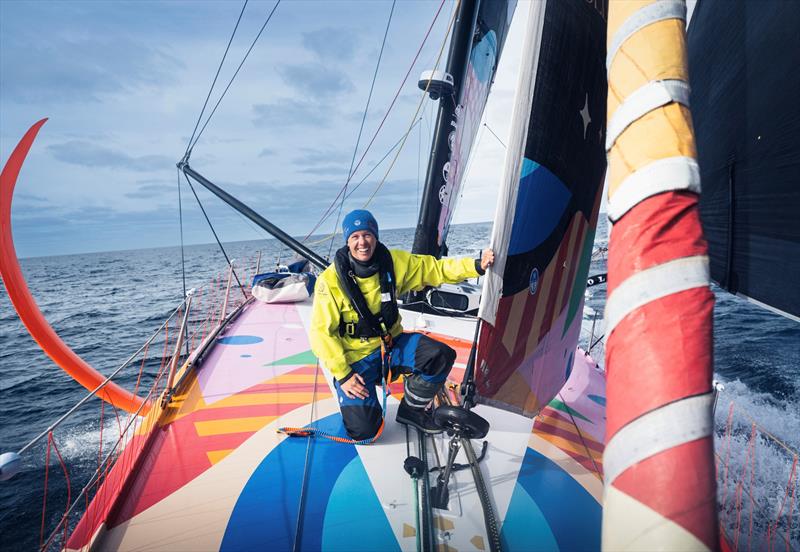
Team Francesca Clapcich Powered by 11th Hour Racing © Julien Champolion | polaRYSE | 11th Hour Racing
On Sunday, November 1, at 1302 CET (1202 UTC), I'll cross the start line of the Route du Rhum-Destination Guadeloupe. It's the final race of our 2026 season and my first solo Atlantic crossing onboard 11th Hour Racing, our foiling 60-foot IMOCA.
Ahead of me: 3,542 nautical miles (6,560 kilometers) to Pointe-à-Pitre, Guadeloupe. No one to share the watches, the maneuvers, or the decisions.
This race is a huge milestone. It's another step towards the Vendée Globe in 2028, but it's also a really important race in its own right. It's the objective of the season for our team, and we want to do well. We have to treat it as a major race, not just a box to tick.
In a straight line, the boat's performance is fairly similar whether you're crewed or alone. But solo, you have to think about every maneuver. How long it will take. How much a sail change will cost you in time and speed. You need to reach the finish not fresh, but with some brain power left. Rounding Guadeloupe isn't easy, and that's where you can make big mistakes.
I'll be honest: sailing alone offshore was never my dream. After two Olympic campaigns and winning The Ocean Race in 2023 as the first Italian to do so, I know how much I love sailing in a crew. I love having other people onboard with me. But this is something I want to prove to myself. That I can do it, and do it well. I find that motivating. Exciting, even.
Three races into the season, I'm leading the IMOCA Globe Series, the class's annual world championship, with 356 points. That's 76 clear of Sam Goodchild, currently second and last year's champion. A top-six finish in Guadeloupe would secure the 2026 title, and I would become the first woman ever to win it.
I don't feel much pressure right now. But I understand this is a big one. There's something magic about it. In the end, though, there's a start line and a finish line. Everything else is just noise.
Over the past ten days in Saint-Malo, we've opened our doors to more than 120 people from local community groups. Young people and job seekers exploring maritime careers. Families supported by local social services and NGOs. Women in remission from cancer. Young women from rural areas. We even ran a tour in sign language.
Throughout my life, I've been inspired by other people, especially women, and sailors who achieved amazing things with their own projects. Now it's my turn. I'm a pretty normal person. You might have nine doors closed in front of you, but you only need one to open to make something amazing happen.
On the eve of the Route du Rhum start, the weather picture is far from the classic route to Guadeloupe. Instead of a long dive south to the trade winds, the routing points the fleet towards the most direct route to the Carribean.
The opening is straightforward. From Saint-Malo, the boats head to a gate off Cap Fréhel, then come up around 30 degrees to clear the Breton coast before settling into a good downwind run. On start day, a huge high pressure system sits over the British Isles at 1041 hPa.
The first real test comes between November 3 and 4, with a large front to cross. "The wind does a full 180 degrees. You go from port to starboard," shared Francesca. Fast downwind sailing follows, with a few gybes to stay in the breeze.
After that, the forecast gets far less certain. The trade winds are weak, so most routes send the fleet north. "It's not really ca ommon scenario for a transatlantic race. It can make the crossing it pretty fast, because we're taking the most direct way to the Caribbean."
The catch is that the boats can't simply ride ahead of the lows, as they would on a west-to-east crossing. "We need to go through them, manage them and connect to the next weather system."