
On the right wavelength - the rise of Radio Sailing
by Mark Jardine 17 Mar 13:00 PDT
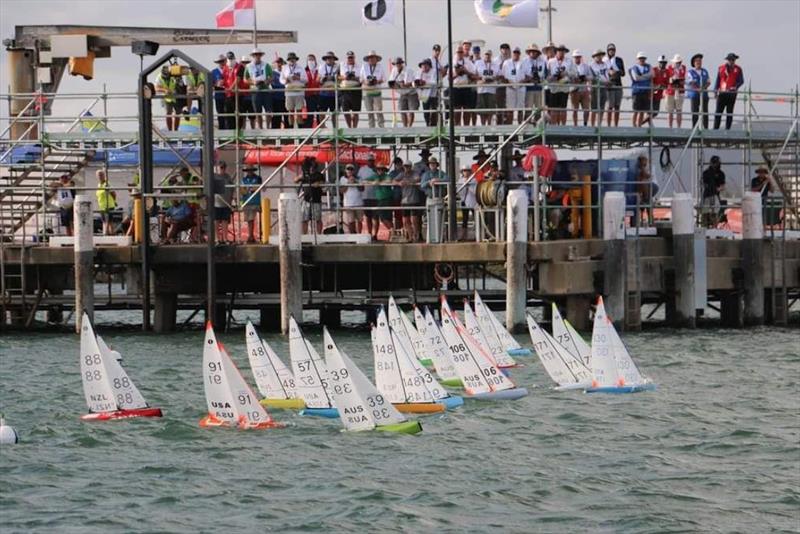
The starts were crowded - International One Metre World Championships 2024 © Nigel Barrow
While model yachting has been around for a very long time, dating back to the early 1800s with vane steering yachts raced in The Queen's Basin at Green Park in London, it has surged in popularity in this century.
Just like the larger equivalents which we go sailing in, radio controlled yachts come in a variety of shapes and sizes, and can suit pretty much any budget. Classes such as the DragonForce 65, DF95 and RC Laser have provided budget one-design racing, where everyone is using the same kit, while the pinnacle of model yachting is generally regarded to be the International One Metre (IOM) class, while allows strictly controlled hull, fin, rudder and sail development.
Sailors have turned to model yachting for various reasons, including age, costs, physical exertion, and storage, when they continue to crave the competition and tactical challenges which sailing provides, but want to do it in an easier way. Others continue with their own regular sailing, and use it as a winter or off-season hobby to keep their racecraft sharp.
One such sailor is Nigel Barrow, who won the Cadet UK Nationals and Worlds in 1973, and the UK Youth Nationals in 1974, before embarking on an Olympic campaign, coached by the legendary Jim Saltonstall, just missing out on a place in the 470 class at the 1976 Montreal Games, and continuing in the build-up to the boycotted 1980 Moscow Games.
It was in 1994 that Nigel gave up sailing and started golf due to time constraints, but the pandemic led him towards radio sailing, building a racing yacht, which is where his journey started and has since become something of an obsession. The appeal includes the technical aspects, such as hull, fin and bulb design, but also the camaraderie, as the sailors are all together in a controlled area to race.
Nigel now has a wealth of knowledge on model yachting, which he shares on his website, www.nigelbarrow.co.uk. He has this advice for those looking to give it a go:
"Read as much information as you can. Decide on your goals and objectives, and go and talk to your local radio sailing club - there will always be people there to help you.
"Find out what they sail and what the most popular fleets are. The two DF classes are extremely popular and a great entry point into the radio sailing world. You get a brand new boat for a low budget, and the identical nature of all the boats means there is no speed advantage or disadvantage, so you can develop your sailing skills with confidence.
"The Model Yachting Association supported classes are popular and offer more development opportunities. The most popular globally is the International One Metre, one of the nicest boats to sail and race, but unless you are extremely talented, there is a long learning curve. As well as radio sailing, there is also free sailing but you need to be at specialist clubs set up with walkways all round the course. Free sailing is the purest form of the sport and it is no surprise that most of the top skippers are involved in this aspect.
"As a radio sailor you have the opportunity to compete at club, open meetings, national ranking events, national championships, European and Worlds events."
Steve Cockerill needs little introduction. The founder of Rooster Sailing and multi-class champion has joined the ranks of radio sailors after his brother persuaded him to have a go, and he quickly found himself hooked:
"In a two hour session I had the full week's worth of championship emotions in eight races. And yes - I was pretty useless at working out which way to steer the boat when it was coming towards me and my lack of relative judgement was occasionally calamitous, but it all added to the sweet tapestry of learning a new game."
Steve now regularly sails on Slipper Mill Pond at Emsworth, on the South Coast of the UK, and has found he's in good company:
"Late last year we had a normal Thursday morning race at Emsworth Radio Sailing. Rod Carr's boat was out of action so he offered to be the Race Officer. He then announced that the field was pretty much the 470 Olympic trials fleet from 1974, with David Cambell-James, Eddie Warden-Owen and Nigel Barrow. None of us have to worry how much we weigh, whether our knees are crook, or if we are the right size for the boat. It's just great racing. And on top of that you can (with the right culture) have a lot of great banter whilst being shoulder to shoulder with the sailors you are racing."
You might think that taking up radio sailing showed Steve was slowing down, but that couldn't be further from the truth as he's also taken up wingfoiling:
"My Wingfoiling journey has been a long and hard one. In the early days we would be relieved to be back in a dinghy so we could make a manoeuvre without getting wet. The sport is as hard or easy as you make it. I am doing a lot of falling off at the moment, trying to make my tacks as reliable as my wife's. If I was not trying to match her prowess, I would be content to mow the lawn backwards and forwards - you get in a zen-like trance, no head space for any other thoughts apart from a tune in your head. It also works the muscles and joints in a way that is contrary to dinghy sailing so it's good for posture and injury protection. I can see myself winging when I am 85 if I make it that old."
Steve and Sarah continue to sail in the ILCA 6, Tasar and 4000 fleets, and have this advice for those starting out in the world of radio sailing:
"The DF65 and DF95 are relatively cheap boats and have excellent racing. The boat is easy to maintain, so it's a winning formula. If you are more practical minded, then the IOM is the boat that can take hours of preparation and maintenance but is lovely to sail; it is a little on the pricey side.
"Don't leave the radio sailing too late in life. It can be a little daunting getting to grips with the technology as we get older. Also don't take yourself too seriously at first. You will be making major errors very regularly. Some of my standard goals are: don't hit any marks, don't hit anyone else and don't be over the line. I rarely achieve all three in any series and sometimes even in a race."
The One Metre World Championship is coming to the UK in May, with the racing being held at Datchet Water Sailing Club. Sailors from over 30 nations will compete for the title and I'm very much looking forward to covering the event to find out more about the discipline and learn what attracts competitors to radio sailing.
Another sailor I've chatted with many times over the years is Australia's Brad Gibson. He is a multi-time radio sailing world champion, and also the man behind BG Sails & Design, which makes model yachts, intricate carbon fins and some of the fastest model yacht sails.
Brad started sailing in Flying Ants on Botany Bay to the south of Sydney, and has been active in Cherubs, International 14s and 18ft Skiffs, but it is mostly the International Moth I know him from. Brad shows that radio sailing and conventional sailing can be practiced side-by-side, and his constant tinkering in the Moths led to the wildly popular article 'Is it a Beiker? Is it a Rocket? No, it's an upside-down Bladerider!' article which I wrote with him during the UK Moth Championship 2021.
Both Steve and Brad prove that just because you've turned your hand to radio sailing doesn't preclude you from keeping a tiller or wheel out of bigger boats. The formats are very much complimentary to each other.
Radio sailing has seen a few foilers, but these are mainly made by hobbyists to see what they can do. Youtube videos show a trimaran hopping in and out of the water, going at great speed until it has to tack. There has been occasional racing in New Zealand and Australia, but nowhere near the scale of displacement model yachting.
Interestingly, at the very top end of the sport, the America's Cup is adopting more and more of the features of radio sailing. The AC40, and the latest generation of the AC75, both use battery power for trimming and foil movements, with the sailors using a steering wheel, push-button controls and AI algorithms to increase performance, with updates uploaded to the yacht daily, and sometimes between races. How long will it be until the crew themselves are ashore with a VR headset? Many already baulk at the direction the America's Cup has headed in, but there is no doubting that the technology is astounding.
Mark Jardine
Sail-World.com and YachtsandYachting.com Managing Editor