How dolphins handle 'the bends'
by Woods Hole Oceanographic Institution on 28 Oct 2011
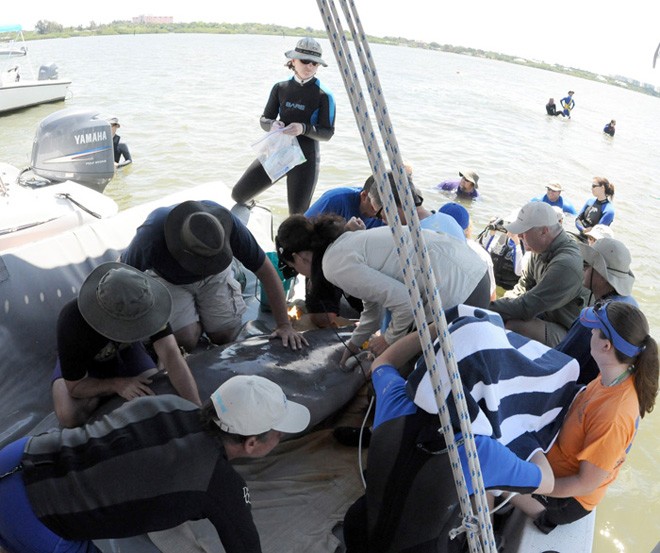
A common dolphin is examined by ultrasound after stranding alive on Cape Cod, Mass. (Image under NOAA Stranding Agreement with International Fund for Animal Welfare (IFAW) WHOI Graphic Services
Scientist are aware that the blood and tissue of some deceased beaked whales stranded in the vicinity of naval sonar exercises are riddled with bubbles. It is also well-known that human divers can suffer from bubble induced decompression sickness, more often referred to as the bends.
What researchers know comparatively little about is how living marine mammals handle the compression of lung gas as they dive deep and then resurface.
Now, in a study published online in the Proceedings of the Royal Society B, a team that includes researchers from the Woods Hole Oceanographic Institution (WHOI) has confirmed that bubbles do form in live, stranded dolphins. But in many cases, those animals are able to 'manage' those bubbles and can resume relatively normal lives of swimming and diving in the ocean.
'Evidence suggests that live dolphins that have been stranded have bubbles that appear not clinically significant,' said Michael Moore, a senior research specialist in biology and director of the WHOI Marine Mammal Center.
The multi-institutional research team, led by Sophie Dennison of the Marine Mammal Center in Sausalito Ca., along with collaborators from WHOI, the International Fund for Animal Welfare (IFAW), and the Chicago Zoological Society, performed ultrasound scans on 22 live stranded and capture-release dolphins. The researchers examined the liver, kidneys, eyes, and blubber-muscle interface.
They found gas in the kidneys of 21 of the live stranded dolphins and in some liver veins of two of the animals. Nine then died or were euthanized, and the presence of bubbles was corroborated by computer tomography and necropsy examinations. Of the remaining 13 that were released, 11 did not re-strand.
The researchers said that off-gassing of supersaturated blood and tissues was the most likely origin for the gas bubbles. 'In contrast to marine mammals repeatedly diving in the wild, stranded animals are unable to recompress by diving, and thus may form bubbles,' they report in their paper. 'Since the majority of beached dolphins released did not re-strand, it also suggests that minor bubble formation is tolerated and will not lead to clinically significant decompression sickness.'
The results, Moore said, 'suggest that dolphins are possibly managing bubbles routinely to avoid decompression sickness, also known as the bends. Humans likewise manage 'silent bubbles.’' Only a minority of human divers that get bubbles, he added, get the bends.
Moore said it was the observation of bubbles in deceased beaked whales that led to the current study. 'In routine decompression, the animal exhibits normal physiology and experiences few bubbles,' he said. 'But acoustic stressors, such as sonar, seem to change normal bubble management.'
'Beaked whales are stranding atypically when exposed to sonar,' Moore said. 'The beaked whale mortality events have led the current generation of marine mammal physiologists to revisit the question of how marine mammals manage the issue of lung gas being compressed as they dive deeper,' he said.
'Above the depth of alveolar collapse, a depth at which the gas-exchange surface of the lung is no longer inflated, increasing pressure with depth can cause gases to dissolve in the body; the gases then come back out of solution as they resurface. If this decompression is uncontrolled, bubbles can form. In humans such bubbles can cause joint pain that is relieved by 'bending' limb joints - hence the popular name. It was thought that marine mammals were immune to such problems, but the beaked whale cases reopened this assumption to fresh scrutiny.'
Moore said the study, which was funded by the U.S. Office of Naval Research and IFAW, is but one piece to the puzzle of possible effects of how human or environmentally induced changes to ocean conditions might affect the health and behavior of dolphins. Nevertheless, he said, 'We have shone a bit more light on bubbles in marine mammals.'
Woods Hole Oceanographic Institution http://www.whoi.edu/ WEBSITE
The Woods Hole Oceanographic Institution is a private, independent organization in Falmouth, Mass., dedicated to marine research, engineering, and higher education. Established in 1930 on a recommendation from the National Academy of Sciences, its primary mission is to understand the ocean and its interaction with the Earth as a whole, and to communicate a basic understanding of the ocean's role in the changing global environment.
If you want to link to this article then please use this URL: www.sail-world.com/90040