The Skipjack - Remnant of a Great Sailing Tradition
by Timothy B Wheeler, Baltimore Sun/Sail-World on 20 Jan 2009
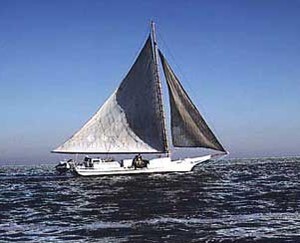
The boom is usually as long as the deck SW
In the Third World sailing boats are still a familiar sight, used for transport and fishing. Their delicate sails enliven the horizons of many a coastal waterway. In the Western World they have long been relegated to the field of pleasure and sport - except for a few hardy survivors, and the whimsically named Skipjack is one of them.
The gaff rigged Skipjack was specifically developed to dredge for oysters in US State Maryland's Chesapeake Bay. From a fleet of 1000, today there are just five plying the oyster waters of Maryland, kept in service because of restrictions against motors in the Maryland State Oyster Fishery.
...but now in Chesapeake Bay there's another Skipjack that's looking smarter every day, thanks to the efforts of a man who can't bear to see them go.
The deck of the Caleb W. Jones gleams with a fresh coat of white paint, as does the new cabin aft. Down below, though, the 55-year-old skipjack is showing its age - and even some daylight. You can poke three fingers through a hole in its rotted wooden hull.
Built in 1953, this remnant of the Chesapeake Bay's fading fleet of sail-powered oyster dredging boats is getting an extreme makeover at the Chesapeake Bay Maritime Museum. On dry ground for now, the Caleb's hull is being taken apart and put back together again, a timber and plank at a time.
'The boat was partially sunk when I got it,' explains Mike Vlahovich, a veteran boat builder and founder of the Coastal Heritage Alliance, a nonprofit that works to preserve the vessels and culture of fishing communities. 'It was pretty clear that no one really cared too much about it.'
With the help of apprentices and volunteers, Vlahovich spent more than a year rehabbing the topside of the 44-foot skipjack while it sat in the water, its leaks controlled by pumping. A few weeks ago, he had it hoisted out of the water with a crane at the museum so he and his helpers could restore the hull on land.
'It has to be done in careful fashion, and braced up, so we don't lose shape,' Vlahovich said. It's painstaking work, pulling the hull apart a bit at a time to replace the rotten wood. Like a jigsaw puzzle, no two pieces are exactly alike; each replacement piece must be carefully measured to fit the gap it must fill.
The restoration is being underwritten by the boat's owner, Michael Sullivan, a developer from Charles County. Sullivan, 53, grew up in Charles and has supported land-based historic preservation projects there. Though not a sailor himself, Sullivan said he was drawn to restore the Caleb W. Jones because his great-grandfather had worked on the water and had a skipjack.
'I just wanted to help preserve the heritage of Maryland,' he says. 'There are so few of them left.'
Indeed, there are only five still dredging the bay bottom for oysters - three based in Somerset County, one that sails from Tilghman Island and one from Baltimore. In the late 1800s, more than a thousand reportedly plied the bay.
Named for its original owner, a Smith Island waterman, it was built at a commercial boatyard in Reedville, Va. It's one of the last skipjacks ever built but, Vlahovich notes, 'like many of the newer ones, very cheaply built and just not made to last as long as they have.'
Skipjacks were developed in the 1890s. They were relatively inexpensive to build, and their shallow draft enabled them to dredge oysters closer in to shore. Watermen often built the craft themselves in their backyards.
The Caleb's fortunes mirror those of the bay's oyster industry. Harvests topped 2 million bushels a year when the old Smith Islander took his namesake out dredging. He sold it after about a decade to a man in Virginia who intended to convert it to a pleasure sailboat, according to a book about the Caleb by Doug Stephens of Sharptown. The skipjack returned to work after a few years, with Richard 'Dickie' Webster of Wenona, on Deal Island, as its captain.
Deal Island is one of the last bastions of oyster dredging, and still holds a skipjack race every Labor Day. Webster, whose family owned three skipjacks at one time, recalls boom times when they could catch 400 or 500 bushels a day. It was grueling work, though, sailing through all kinds of weather in fall and winter.
'I've caught some bad storms, but she took care of me,' Webster, 67, says of the Caleb. 'She brought me back.'
But oyster harvests plummeted in the late 1980s, as diseases devastated the bay's once-abundant shellfish. The statewide catch is a fraction of what it was before - just 83,000 bushels last season.
As oysters hit bottom, so did the Caleb W. Jones. It sank in 1992 - fortunately in just 10 feet of water near Smith Island. It was patched and towed to Baltimore for repairs. Students at what later became the Living Classrooms Foundation provided the labor. The overhaul lasted barely a decade, though.
'I couldn't make enough money to keep the boat up,' says Webster. 'It just needed a lot of things.'
So Webster sold the boat, and the new owner commissioned Vlahovich to restore it. A descendant of Croatian immigrants who fished Puget Sound, Vlahovich has been around fishermen and boats almost all his life. He started out salmon fishing, then shifted to building boats. For the past decade or so, he's worked on preserving fishing vessels, first on the West Coast and since the late 1990s here in Maryland, where he has focused on restoring the commercial skipjack fleet.
But keeping the old boats shipshape isn't really enough, he acknowledges.
'There's not enough money in dredging oysters to keep the boats alive. You need to find alternate sources of revenue. Ideally, there wouldn't need to be a Coastal Heritage Alliance. There would be sustainable fisheries.'
Until there are, Vlahovich says, skipjacks like the Caleb W. Jones must take on new roles, as vessels for experiencing the bay the way generations of watermen once did. The Caleb's owner wants to use it to offer educational cruises for groups of youngsters, taking them from Charles County down the Potomac River and over to Smith Island. A few of the old skipjacks are in similar service, owned by museums or nonprofit groups such as the Chesapeake Bay Foundation.
About the Skipjack:
The skipjack is sloop-rigged, with a sharply raked mast and extremely long boom (typically the same length as the deck of the boat). The mainsail is ordinarily triangular, though gaff rigged examples were built. The jib is self-tending and mounted on a bowsprit. This sail plan affords the power needed to pull the dredge, particularly in light winds, while at the same time minimizing the crew required to handle the boat.
The hull is wooden and V-shaped, with a hard chine and a square stern. In order to provide a stable platform when dredging, skipjacks have very low freeboard and a wide beam (averaging one third the length on deck). A centerboard is mounted in lieu of a keel. The mast is hewn from a single log, with two stays on either side, without spreaders; it is stepped towards the bow of the boat, with a small cabin. As typical in regional practice the bow features a curving longhead under the bowsprit, with carved and painted trailboards. A small figurehead is common. A typical skipjack is 40 to 50 feet in length. The boats use direct link Edson worm steering gear mounted immediately forward of the transom.
The dredge windlass and its motor are mounted amidships, between the mast and deckhouse. Rollers and bumpers are mounted on either side of the boat to guide the dredge line and protect the hull.
Due to Maryland state laws, the boat has no motor (other than for the windlass). Most skipjacks were eventually modified with ster
If you want to link to this article then please use this URL: www.sail-world.com/52983