Wot Rocket aiming to crack 50kts and Speed Record
by Rob Kothe on 23 Dec 2007
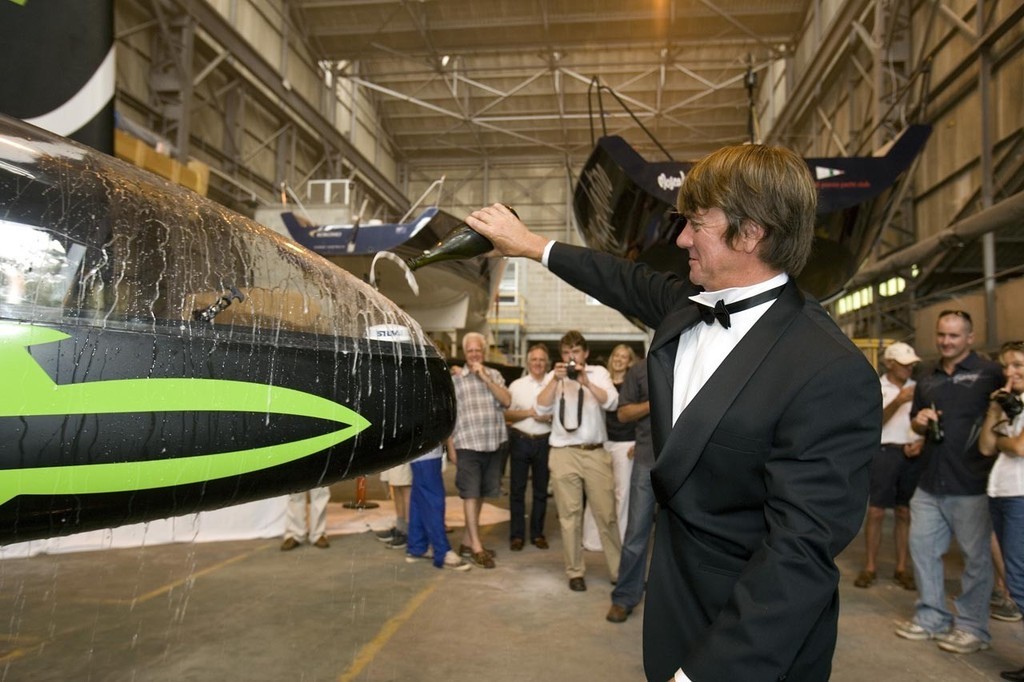
Sean Langman christens WotRocket Andrea Francolini Photography
http://www.afrancolini.com/
What might prove top be a sailing missile was launched in Australia today!
Built to break through the 50 knot barrier, the 9 metre, purpose built Atlantic proa style looks like a cross between Macquarie Yellow Pages, a foiling International Moth and a sailplane/glider.
There is an impressive team behind this project.
Sean Langman, the former 18 foot World Champion and who has raced the fastest ‘off the wind’ big boat in the southern hemisphere, Grungig/Xena built the Wot Rocket in his Noakes Shipyard.
Graeme Wood, the Internet entrepreneur who founded WotIf.com and will be racing to Hobart next week on his TP52 Wot Yot, has jointly funded the project with Sean Langman.
The Naval Architect is Andy Dovell from Murray Burns and Dovell. He has designed everything from America’s Cup boats to most of the surfboard foils on the top performance surfboards.
Martin ‘Tacka’ Thompson, who started sailing as a little 'tacka', was early on the Hobie scene enjoyed the extremes of the Worrell 1000 offshore racing multihulls and these days sails in Hobart races and races gliders/sailplanes, will be co-pilot with Langman.
The Wot Rocket is half sailboat and half sailplane; a nine metre long canoe style hull with two tiny foils, each about a sixth of the size of a Moth foil and a nine metre rigid sail, then a transverse beam out to an aerodynamic twin pod crew compartment.
The difference between this sailboat/sail plane and any that have come before it, is that it will be attempting to break through the water speed barrier using a technology as yet untried on any sailing craft - supercavitation.
The problem for all marine craft is that the drag in water is around 1,000 times greater than in air.
So in powerboat racing design or International Moth sail boats the aim is to have as little as possible of the craft in the water.
Supercavitation, according to the Wot Rocket team, could be the breakthrough for sailing boats. The most famous practical application is the Russian’s Shkval torpedo which has a maximum speed of 200+ kt (370 km/h).
This speed is a result of supercavitation. The torpedo is, in effect, flying in a gas bubble created by outward deflection of water by its specially shaped nose cone and the expansion of gases from its engine. By keeping water from contacting the surface of the body of the torpedo, this significantly reduces drag and allows extremely high speeds. In effect, the Shkval is an underwater missile.
However sailing boats don’t have engines to produce gas, but Andy Dovell thinks fin and foil design can deliver the same effect.
The current world sailing speed record is held by windsurfer Finian Maynard; it’s a record he set in April 2005 of 48.70 knots breaking his November 2004 record of 46.82 knots.
The World Sailing Speed Record is governed by a body of the International Sailing Federation (ISAF). Claiming a world record requires the sailing craft to average the highest speed over a 500 metre course.
Back in 1993 Simon McKeon and his Australian team with their yacht 'Yellow Pages Endeavour' set a record of 46.52 knots (86.52 km/h) in only 19 - 20 knots of wind.
After setting the World Record, the Yellow Pages team decided to continue to push, aiming for 50 knots. Their new craft, 'Macquarie Innovation' has reached 47 knots, but it requires the winds to be from a particular direction and a special location.
The British Sailrocket team lead by Australian Paul Larssen has been testing their design in Namibia in recent years. It too requires wind to come from a specific direction so the boat can sail in flat water.
The Australian Wot Rocket team believes the foils will deliver them the freedom to make their record attempts on water that is not at all smooth.
Sean Langman conceived the design four years ago. Today he told the story: 'Dreaming in the shower, I drew some lines on the shower screen, then reduced that to two circles and five lines on a sheet of A4 paper before taking that to Andy Dovell. (the Naval Architect who had worked with Langman or a range of projects).
'I've probably spent too long watching Discovery Channel really but I was always inspired by the notion of the Saturn V rocket; getting to the moon from a standing start.
‘The supercavitation questions I started asking from the beginning. Andy has been doing all the scientific work. On paper it works. Andy and I chipped away at it, but the project hit the brick wall because I was doing so much with Noakes Shipyacht growing and growing.
‘At the time I was not seeking sponsorship but Tacka (Martin Thompson) got wind of it. He was excited and pushed me to get it going again. He interested Graeme Wood in the project and he decided to take a half share. So the headline sponsors are Wot If and Noakes Boat Yard.
‘I had started the build with a shipwright in his workshop. When we restarted it we moved the project to Noakes Newcastle to finish it.
‘We have a series of other sponsors who have been fantastic; SP Systems - Gurit, Nexus, Garmin and Honeywell.’
Langman’s vision is a bold one. ‘We’ve built a modular boat. This first one, Mark I, will enable us to sort out the control system etc but this is a prototype. Mark I might touch 50 knots, but the Mark III will do 60 knots. The sailplane/sailboat is 9 metres long, 9 metres tall with the wing, 6.5 metres wide and weighs 450 kg. We’ve started work on a new nomex wing, it will be lighter.
‘The human side is actually the most important. We have spent a year of development on crew safety – the crew pod is monocoque carbon fibre with air canisters, to allow 10 minutes to get out in case of emergency. We will have a full body harness…a lot like an F1 offshore powerboat.
‘The transverse wing is like an aircraft, the foils have 15 degrees of movement each but only a few degrees will be used at speed. The front foil will provide lift, basically the height above the runway, just enough to keel the foil in the water, maybe 500mm, while the aft foil will provide pitch and steering.’
In a task split, similar to offshore powerboating, Thompson will be in the back controlling the pitch foils, Langman will be upfront steering and controlling the mainsheet and trimming the sail.
The concept behind the Wotrocket approach is to induce supercavitation at lower speeds where control can still be maintained and from there to push through to the top speeds. Andy Dovell indicates that they have an option to inject gas down the front of the foil to induce the cavitation 'but I don't think we'll need it, the foil design is such that we should be able work through a series of speed stages.'
Thompson comments, ‘We're prepared for a few incidents along the way, but we have all the moulds and it is a modular design so we can change foils, transfer beams and mast and sail elements. Once we can get the pod airborne, we will do it by the numbers.
‘Its not much like conventional sailing this is certainly no lead mine, this seems more like a racing glider.
'When I first approached Graeme Wood about the concept I realised it was something of an anti-sponsorship approach; there would be no opportunity to brand and promote the project before it was unveiled and he'd need to be prepared for us taking a few trips up the beach in the Ute to pick up bits of broken carbon.'
Graeme Wood commented ‘It’s an exciting project. Pretty crazy, but I like left field stuff.
‘The foils make the difference, so absolutely flat water is not a prerequisite; we will be able to sail it on Botany Bay..makes the logistics much easier and allows a spectacle for a large crowd. Botany Bay is a nice theatre.
‘The craft is almost finished. All the instrumentation and controls are in place an
If you want to link to this article then please use this URL: www.sail-world.com/40167