#Trim(mainLayout.Name)# Advertising Info Advertising Info

News Home Text Only News Marine Business News Powerboat-World World Cruising 2008-09 Volvo Race
 

Sail-World.com : History of Rolex Sydney Hobart 1945 - 2006
History of Rolex Sydney Hobart 1945 - 2006
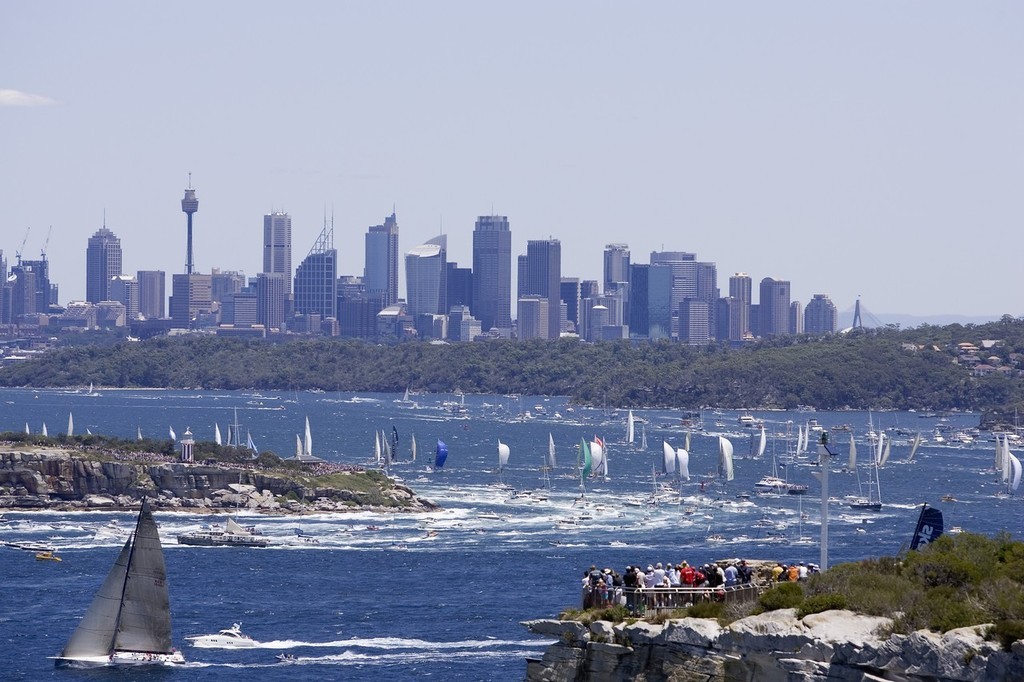
'The start of the Rolex Sydney Hobart Yacht Race 2006.'    Andrea Francolini ©    Click Here to view large photo

The Rolex Sydney Hobart ranks historically, along with the Rolex Fastnet Race in England and the Bermuda Race in the USA, as one of the three great ocean passage races of the world. The 2007 Rolex Sydney Hobart Yacht Race, starting from Sydney Harbour at 1.00pm on Boxing Day, December 26, will be the 63rd annual race conducted by the Cruising Yacht Club of Australia, the nation’s premier ocean racing club.

Over the past 62 years, the Rolex Sydney Hobart has become an icon of Australia’s summer sport, ranking in public interest with such national events as the Melbourne Cup horse race, the Australian Open tennis and the cricket tests between Australia and England.

It has been – and still is – a world leader in ocean yacht racing, in the professional race management and safety standards set by the CYCA, in the operations of its media communications centre and, of course, and in the standards set for yacht construction, rigging and stability of its fleet racing under the international rating rules (currently IRC). The CYCA has added even further to the stringent regulations of a Category 1 ocean race, particularly in regard to safety at sea training and the experience of the crew of each boat.

Perhaps most of all is the high standard of seamanship shown by these who skipper, navigate and crew these yachts south in the Tasman Sea to Hobart, largely amateur sailors who have successfully sailed, sometimes just survived, through some of the toughest ocean racing conditions in the world.

No yachting event in the world attracts such huge media coverage – except, of course, the America’s Cup and the Volvo Ocean Race around the world – than does the start on Sydney Harbour. And they only happen every four or five years; the Rolex Sydney Hobart is an annual event.

Ray White Koomooloo in better days at the start of 2005 Rolex Sydney Hobart -  © Rolex-Carlo Borlenghi  

The Sydney Hobart Yacht Race began in 1945 when a group of Sydney yachtsmen planned a post-World War II cruise to Hobart. A Royal Navy officer, Captain John Illingworth RN, who had been a keen racing yachtsman in Britain before the war, joined them. He was stationed in Sydney and bought the 39-foot Rani. Nine yachts started on Boxing Day, 1945 and several were 'lost' during the race, among them Rani which sailed through stormy weather to take line and handicap (corrected time) honours.

The Sydney Hobart has been held every year since, with the inaugural fleet growing to a record 371 starters in the 50th race in 1994 - the largest fleet in the world for a Category 1 ocean race. Among that remarkable fleet were two yachts that started in the inaugural race – Archina and Winston Churchill. Among the crews were two yachtsmen, Peter Luke and 'Boy' Messenger, by then in their mid to late 70s, who had sailed in 1945.

Of the fleet, 308 yachts finished and were packed gunwale to gunwale in Hobart’s historic Constitution Dock and Sullivan’s Cove.

The 628 nautical mile course starts from Sydney Harbour, a natural amphitheatre for spectators on the headlands, and takes the fleet down the East Coast of Australia, across the eastern edge of Bass Strait which divides the island State of Tasmania from the Australian mainland.

Then it’s then down the Tasmanian East Coast where, after rounding the towering perpendicular rock of Tasman Island, the fleet sails the final 30 nautical miles across Storm Bay and then 11 miles up the Derwent River to the finish off historic Battery Point in Hobart, Australia’s second oldest city.

The 'Hobart' is unique because it is one of the most challenging ocean races in the world, with uncertain weather that can range from a rollicking spinnaker run down the NSW South Coast before a 15-20 knot nor’easter to a howling southwesterly front bringing winds of up to 50-60 knots, sometimes more, and massive boat and body-breaking seas. Bass Strait is notorious for its short, steep seas due to its relative shallow depth and strong currents and the regular fronts bringing gales from the south and south-west.

There has never been a Sydney to Hobart without a significant change in the wind direction and strength, and there have been some turbulent years that have battered boats and bodies into submission.

Love and War off Merimbula, NSW south coast - 2006 Rolex Sydney Hobart -  © Rolex-Daniel Forster  

The worst races in recent years have been in 1984, 1993 and 1998. In 1984 a fleet of 150 yachts started and 104 retired in strong to galeforce southerly winds that battered the fleet off the NSW South Coast and in Bass Strait.

In 1993 there were 110 starters but only 38 yachts (including an all-women crew) battled their way to Hobart through a series of south-westerly and southerly fronts with gusts of up 70 knots. Crews abandoned two yachts as they sank while the skipper of another yacht was washed overboard at night and spent five hours in high seas and strong winds until spotted by a searching ship and picked up another yacht. He returned to racing two years later - in a bigger boat and won his division.

Tragedy shrouded the Sydney to Hobart in 1998 when the worst storm in the history of the race struck the fleet as most of the 115 yachts entered Bass Strait. Competitors reported west and south-westerly winds of up to 80 knots and sea of 15 metres, some to 20 metres, as a 'Bass Strait Bomb' exploded in the form of an intense depression (the barometer dropped to 982 Mb in the race area) south-east of Gabo Island on December 27, maintaining much of its intensity for 36 hours.

Of the 115 yachts that started, 71 retired. In a remarkable search and rescue operation, helicopters and surface vessels rescued 55 sailors from 12 stricken yachts and in a man overboard situation. Seven boats were abandoned and five sank during the storm, most of them after having been rolled by the huge seas, as were most of the other yachts in difficulty. Sadly, six crewmembers perished at sea in the worst tragedy in the race’s long history.

SKANDIA, AUS M10 SKIPPER: Grant Wharington MAXI 98 Rolex Sydney Hobart Yacht Race 2006 -  © Rolex-Carlo Borlenghi  

In the past 62 races (to 2006) a total of 4,976 yachts carrying an estimated total 44,600 crew, have started in the Sydney Hobart. Of that number 3,928 boats completed the race, 910 retired for various reasons.

Then, what is the attraction? It is the challenge of the wind and the sea, the comradeship of this adventure, the competitive boat-for-boat, tactical encounters and, not the least, the remarkable hospitality that Tasmanians show the crews who have reached their island State. No other similar passage yacht race in the world is accorded such a magnificent start from Sydney Harbour nor such a huge welcome as the first yacht berths at Hobart’s historic Constitution Dock. The Hobartians and visitors from around the world are there in thousands, no matter the time of day or night.

Ocean yacht racing is also a sport for young and old. Although the Cruising Yacht Club of Australia now insists that at least 50% of the crew of each yacht must be experienced and trained in sea safety and aged 18 years or more.

Since that small group of intrepid sailors headed south to Tasmania in the inaugural race in 1945, 74 yachtsmen have been recorded by the CYCA’s Quiet Little Drink ‘committee’ as having sailed in 25 of the annual blue water classics. Like the winning yachts, their names are on an honour board in the Clubhouse.

The late Tasmanian yachtsman John Bennetto holds the record with 44 individual races, but Victorian Lou Abrahams and New South Welshman Tony Cable will equal it this year.

Abrahams is one of three octogenarians who will be skippering their yachts to Hobart in the 63rd race. Abrahams, 80, will skipper his Sydney 38 Challenge, while Sydney yachtsmen John Walker, 85, is heading south again in his Peterson 34 Impeccable and 81-year-old Syd Fischer is skippering his latest Ragamuffin, a Transpac 52 in his 39th Hobart Race. Walker will be become the oldest competitor in the history of the ocean classic.

The Rolex Sydney Hobart Yacht Race has attracted some of the world’s most famous yachtsmen and now a growing number of women.

Apart from the late Capt John Illingworth RN who became a leading yacht designer back in the UK after winning the inaugural race with Rani, the skippers have included the late British Prime Minister Sir Edward Heath, when he was Leader of the Opposition; Ted Turner, the America’s Cup skipper and founder of CNN cable network in the USA; Eric Tabarley, the famous French yachtsman who drowned at sea in 2000; America’s Cup and Olympic yachtsman Sir James Hardy; the Halvorsen brothers Trygve and Magnus, the famous yacht designers and builders and the only yachtsmen to win three successive Sydney to Hobarts with one yacht, Freya, in the 1960s; and Australian America’s Cup skipper and now highly successful yacht designer and ocean racing skipper Iain Murray.

Colourful Australian sailing identities such as the late Vic Meyer and the late Jack Rooklyn, and the winning America’s Cup syndicate head, but since disgraced Alan Bond, competed over the years, as did New Zealand’s Whitbread Round the World race winners, Grant Dalton and the late Sir Peter Blake; computer technology chiefs Larry Ellison (USA) and Hasso Plattner (Germany); and NSW Governor Rear Admiral Peter Sinclair.

Other prominent Australian businessmen and yacht owners to have raced to Hobart have included Rupert Murdoch and his son, Lachlan; Denis O’Neil, Sir Robert Crichton-Brown, the late Bernard Lewis, George Snow, Neville Crichton, Charles Curran, the late Peter Kurts and Syd Fischer, this year sailing in his 39th Hobart Race. Prominent Australian winemaker and owner of the famous Hamilton Island resort Bob Oatley owns the race record holder Wild Oats XI, but health reasons now prevent him from actually sailing to Hobart.

Polaris of Belmont - Rolex Sydney to Hobart Yacht Race 2006 -  Crosbie Lorimer  

Since Rani took the double of line and handicap honours in the inaugural race in 1945 only five other yachts, American Eagle (1972), Kialoa (1977), New Zealand (1980), Sovereign (1987) and Wild Oats XI (2005) have repeated that performance. The classic cutter Morna, later named Kurrewa IV, took line honours seven times, the first in 1946. This year Wild Oats XI is looking to be the first to achieve a hat-trick of line honours since Morna in 1946, 1947 and 1948.

Only two yachts, Freya and Love & War have won the race three times on overall corrected time (handicap). Freya, which won three in a row in the 1960s, was designed, built and sailed by brothers Trygve and Magnus Halvorsen, who in total won the race five times. Love & War, a Sparkman & Stephens design won twice in the 1970s and again in 2006, still owned by the Kurts family.

The designers of the winning yachts overall (on handicap) have been recognised from 1997 onwards with a perpetual trophy in memory of the late Alan Payne, designer of Gretel, Australia’s first challenger for the America’s Cup and the designer of Sydney to Hobart winners Solo and Cherana. The most successful designers over 57 years have been Bruce Farr & Asspcoates with 14 overall winners, the New York naval architects Sparkman & Stephens with eight winners, and the Sydney boat-building brothers Trygve and Magnus Halvorsen whose boats won the race five times. Australia’s Iain Murray designed and skippered the overall winning yacht, Bumblebee 5, in 2001. He also designed Raptor, winner of the 50th Race in 1974 and Terra Firma the following year.

When Rani took line honours in 1945 her elapsed time was 6 days 14 hours 22 minutes. Thirty years later the American maxi ketch Kialoa became the first yacht to sail the course in under three days, recording a time of 2 days 14 hours 36 minutes 56 seconds. Kialoa’s record was to stand for 21 years. It was finally broken, but only just, by the American-designed, Australian-built, German-owned Morning Glory in 1996, with a time of 2 days 14 hours 7 minutes 10 seconds.

These times were shattered in the 1999 Telstra Sydney to Hobart when the former Whitbread Round the World racer Nokia slashed the race record by an extraordinary 18 hours as she surfed southwards in 1 day 19 hours 48 minutes 2 seconds.

Then, in 2005, Wild Oats XI, a state-of-the-art 30 metre, carbon fibre super maxi designed by Reichel/Pugh with CBTF (Canting Ballast Twin Foil) technology) lifted yacht design and construction to a new level, setting a new record with a time of 1 day 18 hours 40 minutes 10 seconds.

The 1999 Race also saw many new safety rules introduced in the wake of the tragic 1998 Race, covering both boat and personal safety, crew experience and training, race management and weather forecasting. The benefit of these changes were reflected in the race, particularly among the smaller and slower yachts that encountered the worst of the extended south-easterly change along the Tasmanian East Coast and in southern Bass Strait.

The Coroner’s Report into the death of the six yachtsmen in the 1998 Race was handed down just two weeks before the 2000 Race. While many of his recommendations on personal and yacht safety had already been implemented, the CYCA acted quickly, as a duty of care, to follow his recommendations on liferaft and lifejacket standards before the Race began. Other changes to race management were also implemented as a result of the Coroner’s Report. The 2000 Sydney to Hobart was again a tough race for all competitors, but there were no major incidents.

The new century of ocean racing has seen many changes in ocean yacht design and construction, with boats both large and small being built entirely of carbon fibre, working sails of the same materials, and many designed to use water ballast and canting keels to improve stability and performance. All super maxis in the 2006 Rolex Sydney Hobart Yacht Race will use canting keel systems, including the successful CBTF (Canting Ballast Twin Foil) technology. with stored power to operate their systems.

Sponsorship has been a key factor in the development of the Sydney Hobart Yacht Race for almost three decades, with the CYCA again pioneering the concept of giving of naming rights to its major ocean racing event. Commercial companies such as Hitachi, AWA, Kodak and Telstra have longtime sponsors.

The race had a new sponsor for 2002, Rolex SA, the famous international watch-making company, with sponsorship quickly assured for several years, including the 60th Race in December, 2004. Rolex SA have since extended this sponsorship up to and including the 2010 Rolex Sydney Hobart Yacht Race.

The support of Rolex placed even more international focus on the event and the 60th Race attracted 124 entrants of which 116, the largest fleet in a decade, lined up for the start of Boxing Day 2005.

The 2007 Rolex Sydney Hobart Yacht Race will again use IRC to decide the Overall Winner. However, a significant change in the rules introduced in 2005 is that there is now no upper speed limit, enabling boats to sail without a handicap restriction that may have limited sail area, the use of water ballast or canting keels or mast height.

Bob Oatley and Mark Richards celebrate their back to back line honours win in the 2006 Rolex Sydney Hobart Race -  © Rolex-Carlo Borlenghi  

In addition boats with canting keels are no longer be restricted in the degree of cant, allowing them to swing their keels to design limits from the vertical.

There was an emotional reaction against canting keels and stored power among some traditional yachtsman following the line and IRC handicap double of Wild Oats XI in 2005. This has led to the RORC, as controller of the IRC rule, to vary the ratings of yachts in this category.

The 2007 Rolex Sydney Hobart result did much to calm this reaction as, while Wild Oat XI took line honours for the second time, the overall IRC winner was a 33-year-old timber boat, Love & War. A two-times overall winner in the 1970s, the Sparkman & Stephens-designed Love & War was sailed exceptionally well to take full advantage to the largely windward sailing conditions of the 2006 race.

Yacht designs, sails and sailors all play a key role in deciding the boat is to be the overall winner of the 'Great Race South', but as has been proven every year since 1945, it is the weather in the Tasman Sea between Sydney and Hobart that is most often the key factor.

Researched and updated 01/12/2007 by Peter Campbell, past editor and now editor-at-large of Offhore Yachting magazine and a former media director of the Rolex Sydney Hobart Yacht Race


by Peter Campbell   6:24 PM Tue 25 Dec 2007 GMT


Click here for printer friendly version
Click here to send us feedback or comments about this story.
If you want to send this story to a friend, please use link below
http://www.sail-world.com/USA/History-of-Rolex-Sydney-Hobart-1945---2006/40220

Click on thumbnails to enlarge and find more photos:

Click for further information on
Offshore Yachting

Related News Stories:

21 Sep 2008  Speedboat's build by Cooksons described on video
23 Jul 2008  Owen Parker (1932-2008) - the professional racer
19 May 2008  First entries in ISAF Offshore Team World's
13 Feb 2008  SolOceans double-handed in the Indian Ocean
20 Jan 2008  Joyon reclaims world solo record, by 14days
07 Dec 2007  Sydney Hobart feature -OFFSHORE YACHTING
17 Mar 2006  Médiatis Région Aquitaine in stopover in Bordeaux
27 Feb 2006  Perini wins Inner Circle Rum Farr 40 Regatta
26 Feb 2006  Overwhelming response for Global Ocean Challenge
15 Feb 2006  New Round the World race for solo 40-50fters
MORE STORIES ...


Based on your current download speed Sail-World has delivered large images (660 pixels long side.)  If you would like to see only small images (300 pixels long side) click here .  For medium sized images (500 pixels long side) click here .


Our Advertisers are committed to our sport, please support them!
This site and its contents are © Copyright TetraMedia Pty.Ltd. All Rights Reserved.
Photographs are copyright by law, if you wish to use an image from Sail-world.com, Powerboat-world.com or Marinebusinessnews.com, Contact us .
or complete our feedback form    Contact us .
Company info   View our Privacy Policy.    [Go Home]     [Bot Archive ]