America's Cup- Paul Cayard interviewed on Artemis wingsail break
by Bob Fisher on 5 Jun 2012
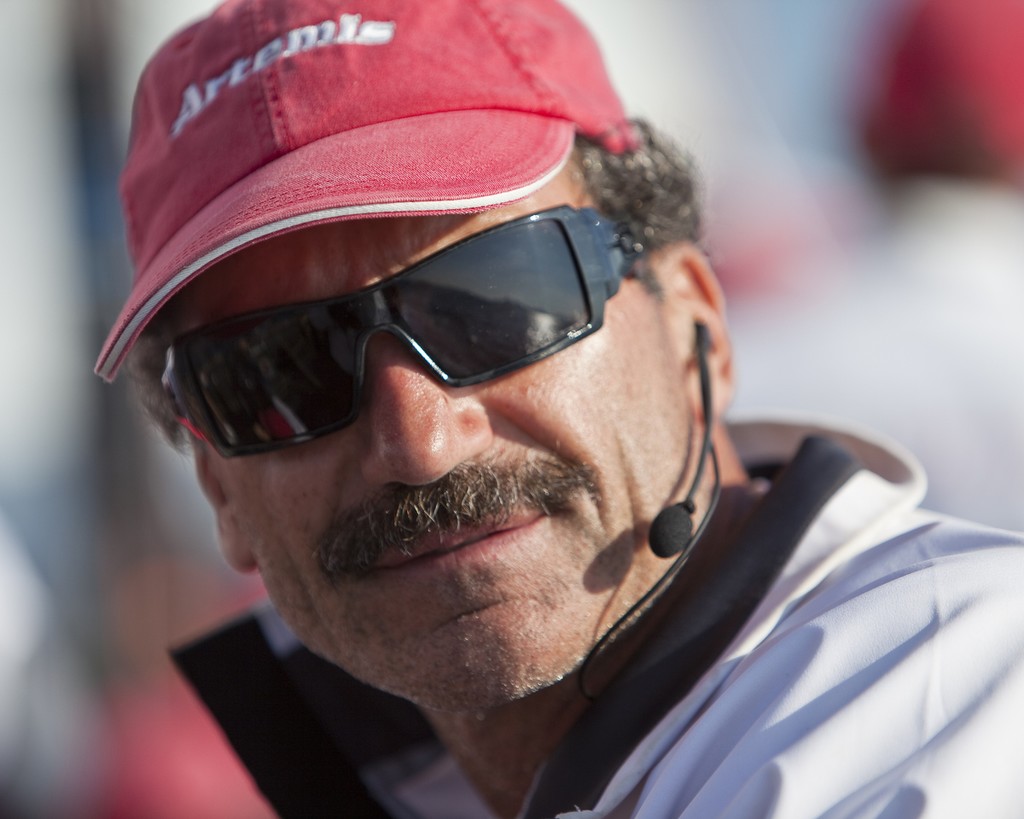
Paul Cayard. Sander van der Borch / Artemis Racing
http://www.sandervanderborch.com
Bob Fisher, one of the world's top international yachting journalists, and certainly the top writer on the America's Cup, is in Naples, Italy for the Fourth round of the America's Cup World Series.
Bob is a multihuller from way back, having competed for Britain in the Little America's Cup and has been covering the America's Cup since 1967.
He writes:
The amazing factor of America’s Cup stories is how exaggeration immerses them. The breaking of the AC-72 wing of Artemis that was being trialled on an ORMA 60 hull platform for example was retold to a degree that defied belief. No sooner had the wing folded than it was in four pieces and with that the rumour mill built so that everything that Artemis Racing had achieved was in the trash-can.
What actually happened was that the wing snapped in two and the whole structure fell on to the boat – 'nothing got wet,' said Paul Cayard, the team supremo. 'One minute after it happened, Terry [Hutchinson] was able to call for a bow tow and 20 minutes later the trimaran and its broken wing were on their way back to the shore.'
'Yes, it’s a set-back,' admitted Cayard, 'but better it happened in May 2012 than in May 2013. We have time on our side now that we wouldn’t have had if this had happened later. We were the first team to have an AC-72 wing up for testing (and we carefully read the Protocol to see if what we proposed doing was within the rules) and in the 12 days of sailing we learned an awful lot. Even the breakage can be construed as part of that learning curve.'
break has been across the main spar, around which the wing elements pivot, and as such requires a great deal of repair work. 'We haven’t even started wing No.2 yet,' said Cayard. He did say that there was 'a pile of work' caused by the breakage, but that it had provided the opportunity for the internal engineering staff and external consultants to add to the requisite technical knowledge before completing the repair and building the next wing. (There would, incidentally, be at least three wings constructed – 'You wouldn’t go to San Francisco Bay with any less.')
It has delayed the Artemis programme. 'Our first aim was to create a team – that was our initial focus. Building the wing and finding, and buying, a suitable platform; preparing for a Protocol protest; made us feel as though Artemis was a fully-formed AC team. Now we can take some satisfaction from the data we have collected in the 12 days of sailing we have had,' said Cayard.
The set-back will probably be of four months duration, but the team can content itself that after July 1st, when the AC-72s are launched, Artemis will be ready to complete the allowed 30 days of sailing. 'We had planned to launch our boat – the platform is ready here in Valencia – on July 1st, and we will be beaten to that punch,' commented Cayard.
We need to stay in touch. What the [general] public doesn’t realise is the complexity of our sport. We’re not playing basketball or soccer – the equipment is complicated and high-tech; we’ve moved from monohulls to multihulls, from sails to wings, and these changes are massive for the design and build teams. The weight limit is quite a challenge. There’s a minimum weight of 1,325 kilos for the wing and an all-up minimum for the hull and rig of 5,700 kilos, with a maximum of 5,900 kilos. Anyone starting in San Francisco at 5,800 kilos will find it practically impossible to stay under the maximum weight limit by the start of the match. Repairs are inevitable and each one will entail added weight.' Cayard speaks with the experience of seven previous America’s Cup campaigns under his belt. 'The critics say that we should have made the wing stronger, but that means heavier.'
He continued: 'No one has ever built one of these wings before, or exploited the possibilities their complexity affords. The C-class guys are using twist, and there is no doubt that twist is a speed-contributing factor of the wing rig. We will be among those who will have twist in our equation, maybe others won’t. The control systems in the AC-72 rig are far more complex than those of the AC-45 rig and we are a step ahead of the opposition in testing those.
'Start early, break early; it’s all part of the development.' Cayard is no stranger to early breakage – he suffered a major structural breakdown on the first day out in the 2005/6 Volvo Ocean race with Black Pearl, his Pirates of the Caribbean entry, missed the rest of the leg while the boat was flown to Cape Town and then finished second overall. 'We are deploying people to San Francisco after the ACWS in Newport as we have two AC-45s and will be two-boat trialling there.'
Artemis had a four month jump on her rivals, even if it has amounted to only 12 days sailing with the AC-72 wing. 'We could be the lucky ones,' said Cayard, 'Others will have set-backs, and it is better to get them out of the way early.' When questioned on the difficulties associated with running a team while not being on board the boat, Cayard said that it boiled down to two items: 'Firstly, I like sailing. Secondly, it is important to have the inside scoop.' To that end he admitted to being on the AC-72 winged ORMA 60 for eight of the twelve days that she sailed.
now, the Artemis design team is working overtime. 'Maybe we would have designed the wing differently if we had intended to race with it.' But high on the list of priorities will be the major structural member, which failed in the practice wing, with a determination that it should not fail again, but also that its weight is not substantially increased. The Artemis AC-72 programme has been delayed until October, but as Cayard pointed out, there are three ACWS regattas before then and he would like the team to retain its lead in the Match Racing Championship, as part of its build-up to the Louis Vuitton Cup.
'Our focus,' he concluded, 'is to be cleverer than our opponents and have the team working together.'
If you want to link to this article then please use this URL: www.sail-world.com/98072