Rio official murdered ten months before the Olympics
by David Biller and Michael Smith on 31 Jul 2016
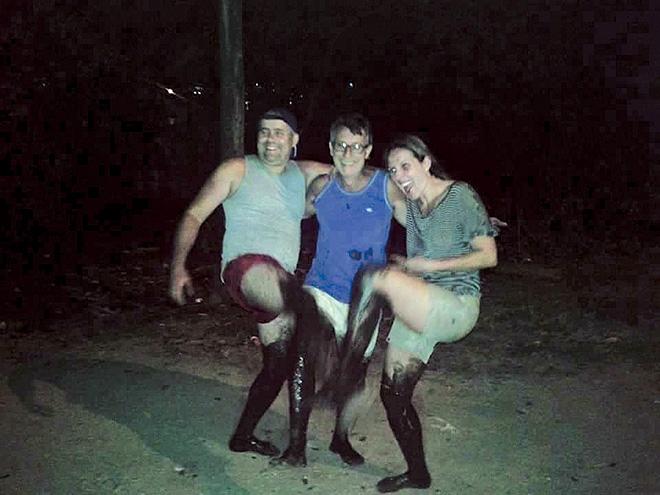
Pereira with her brother, Junior, and their uncle, Carlos Serrano, after emerging from Guanabara. Courtesy of the Pereira family
Does an unsolved murder of an official in Rio in charge of cleaning up Guanabara Bay say a lot about the state of platy in the magical city? Priscilla Pereira was murdered 10 months ago and the thinking is that she was murdered in relation to her work.
Will the cameras peer in more closely? The water those boys are diving into is covered by floating tangles of garbage and sewage. The Museum of Tomorrow—one focus of which is environmental sustainability—is surrounded on three sides by water laced with excrement. And if a camera goes high, it will be appallingly clear that this city is nearly overwhelmed by human feces. Great plumes of it unfurl like storm clouds across the bay’s emerald waters. It emerges from one cove after another, even Marina da Glória, the base for the Olympic sailing and windsurfing competitions that start on Aug. 8. (The state of Rio claims it has fixed the problem in Marina da Glória, but recent aerial photos show little change.)
This 147-square-mile body of water is fed by excrement-filled streams and rivers, including one that pours past a sewage treatment plant built in the 1990s but never connected. It’s a primary reason Rio is regarded as one of the least-prepared host cities in Olympic history.
An essential part of Rio’s bid for the games was a promise to clean the bay, and in 2011 the state secured $452 million in international funding for the effort (that on top of almost $800 million, also from international sources, in the 1990s). But on the eve of the games, at most only half the sewage that flows toward Guanabara is treated. That’s the official estimate from the people who have failed to meet their stated goal of 80 percent. Others scoff and say the real number is more like 20 percent or 30 percent.
In May 2015, Rio hadn’t given up entirely on the bay. That was why Priscila de Goes Pereira, a tough, lively woman, then 37 years old and nothing if not realistic, put aside her reservations about working for the government and took a position with the quasi-governmental agency managing the cleanup, known as PSAM. The work was going nowhere. Some contracts had been signed, but little had been accomplished. Pereira was one of three consultants who scoured PSAM’s books and contracts for signs of mismanagement and corruption. Before long she had a reputation as the boss’s pit bull, willing to get harsh with colleagues and contractors. She was often difficult to work with.
This was all happening while tough times were getting tougher in Brazil. The country had gone from extraordinary economic growth in the mid-2000s to recession; now it was in what would become the worst recession in a century, in part because of a massive corruption scandal at Petrobras, the national oil company. The state of Rio was on the verge of bankruptcy. Political crisis was overwhelming the nation. But there was that $452 million, provided by the Inter-American Development Bank (IDB). The thing was, to get to it, you now had to go through Priscila Pereira.
On Oct. 5, Pereira was shot 13 times while sitting in her car, putting on her makeup. She was at a subway stop in the lower-middle-class neighborhood of Maria da Graça, getting ready to take the train to work. It didn’t look like a robbery. Nothing was taken. Pereira had arrived at her usual time, around 9:30 a.m., and parked her silver Renault sedan in her usual lot near the station. Police say the killer, who fired from outside the car, appeared to be familiar with her routine.
Pereira was raised in a favela, and in a period of hopefulness—even giddiness—for Brazil, she rose to a level of remarkable accomplishment. Then, as her country slowly imploded around her, she was gone.
Pereira was raised in and around Complexo do Alemão, a sprawl of hilltop favelas where drug traffickers strolled openly with guns, and still do. As a teenager she earned money pumping gasoline, preparing finger food for events, and assembling furniture in a factory. “Her dream was to have an independent life, to live alone,” says her aunt, Itaura Serrano. “She didn’t want to be stuck to the family, didn’t want to live in the favela.” Pereira was a university student in 2003, studying geography, when Luiz Inacio Lula da Silva—just Lula to Brazilians—became president, and Pereira was exactly the sort of person the new government wanted to elevate.
Lula’s explicit goal was to vastly increase the size of Brazil’s middle class. The economy quadrupled in size during his eight years in office. Tens of millions rose from poverty. When Rio clinched the Olympics in 2009, euphoria erupted on Copacabana beach and Lula wept, saying Brazil had arrived on the world stage. Pereira was a true child of this new Brazil. She became the first woman in her extended family to graduate from college and, making use of the financial aid that was suddenly so abundant, the first family member of either sex to earn a master’s. In 2007 she took a government job in Brazil’s capital, Brasília, while finishing her graduate degree in urban and regional planning. Her agency, focused on regional development, was in one of the ministries Lula had flooded with money with the goal of creating jobs.
In less than two years, Pereira resigned and returned to Rio. People rarely abandon government jobs in Brazil, but she missed her family and became frustrated with the way the bureaucracy stymied good projects, says her first husband, Celso Leite dos Santos.
She lectured in the geography department at the Federal University of Rio de Janeiro on the shores of Guanabara Bay. In 2009 she took another government job, with Rio state’s public works department. This time she found not only red tape but also corruption. A manager told her to divert public money into her personal bank account and pass it along to him, with a cut for herself. She refused and called her aunt in tears, Serrano says. Again, Pereira quit. By then she was divorced from her second husband, Bruno Palmieri, and had an infant daughter to raise. Still, she vowed that she would never work in government again.
“I used to tell her, ‘You have this thing about speaking the truth, and that’s not always safe’?”
She started on a doctorate while consulting and teaching private classes. She was falling behind financially, but friends could count on seeing her dance to live samba music and drink Stella Artois on weekends at Carioca da Gema, her favorite hangout in Rio’s Lapa bar district. She exuded such self-confidence as she moved that many men were too intimidated to ask her to dance, says Alex Martins, a waiter at the club. “She was always smiling, always dancing,” he says. “She was really classy.”
In spring 2015, Pereira ran into Flavio Silveira, a lifelong bureaucrat she had befriended and impressed at Rio state’s public works department. “She really liked working and had great ability, exceptional intelligence, and very good education,” Silveira says. He urged Pereira to come work for him in his new post as executive coordinator of the Environmental Sanitation Program for the Guanabara Bay Area, or PSAM.
Sewage is as much a part of life in Rio as soccer, samba, and caipirinhas. It puddles on sidewalks and gurgles out of manholes during heavy rains. Rivers of it crisscross the city, its reek as pungent in rich neighborhoods as poor. In the 1990s the IDB and the Japan Bank for International Cooperation financed a plan to treat the fecal flood sluicing daily into Guanabara Bay. Much of the project was managed and executed by the State Company of Water & Sewage, known as Cedae. When the money was gone, Rio and other cities around the bay had a collection of new, barely functioning treatment plants with an unfinished network of underground pipes leading to and from them. A November 2006 IDB report on the project concluded that Cedae’s “institutional weakness affected the execution” of the project.
Nevertheless, Brazil went back to the IDB for money after winning the Olympic bid. At the time, roughly 11 percent of the sewage flowing into the bay was being treated. Rio state officials pledged to increase the amount to 80 percent. Rio’s proposal included the creation of PSAM, operated by three private consulting firms under the aegis of the state’s Environment Secretariat. This time around, Cedae, while helping with design and construction, would be kept at arm’s length on management and financial decisions, according to IDB documents. The plan impressed Yvon Mellinger, the IDB’s former lead sanitation specialist in Brazil. “This was a special time when so many things seemed to be going Brazil’s way,” he says, adding that from the bank’s point of view, the project’s distance from Cedae was essential. In November 2011 the bank committed the money.
Silveira joined PSAM in early 2015 and was appointed executive coordinator in May. Pereira joined that same month. She set aside her misgivings about government jobs, partly because she trusted Silveira and partly because she needed to pay off her debts, family and former colleagues say. Her focus was less on the bay than on making sure the IDB funds were properly spent and accounted for. She and her team acted like gatekeepers for the hundreds of millions the IDB was doling out to contractors, former colleagues say.
Working from PSAM’s ninth-floor office in an art deco tower in the Marvelous Port district, Pereira quickly became known for her aggressiveness in the service of her boss. She yelled. She cursed. She questioned co-workers’ qualifications. According to friends, family, and colleagues, she fired people, at Silveira’s behest. (Silveira says he handled all firing himself.) “I had to come up from the favela to make these people work!” her close friend Luciana Camara recalls her saying.
She said she’d been offered a bribe of 200,000 reais (about $61,000) to ignore some unspecified wrongdoing.
One day a contractor submitted a request to be paid a portion of his fee before getting started on a project. Pereira told her family she visited the site and saw that the work had already been completed—by either this contractor or someone else—and refused to authorize payment for what looked like double-dipping. At another point last summer, she told Camara that she and Silveira had uncovered unspecified “irregularities” in projects, and their efforts to keep them from occurring again were generating “discomfort,” Camara says.
Junior Serrano Pereira, her younger brother, recalls driving with his sister in August 2015 on an expressway near their childhood home. She said she’d been offered a bribe of 200,000 reais (about $61,000) to ignore some unspecified wrongdoing. “?‘That’s not me,’?” he recalls her saying. “?‘I wasn’t raised like that.’?”
One former PSAM executive says Pereira was determined, to a fault, to show that she could defeat the bureaucracy and corruption that sticks to government projects like a leech. Her lack of training in engineering didn’t stop her from challenging seasoned engineers on soil analysis and construction design. She sometimes made slow progress slower.
“It was a naive belief that somehow she could transform government public works in Brazil on her own, when in the end she just didn’t understand how much time these things take in a place like Rio,” says Eloisa Torres, a civil engineer who managed PSAM’s municipal relations department until she lost her job this year. One testy exchange involved work delays on a network of sewage pipes in the poor neighborhood of Penha, says Torres, who witnessed the incident. While digging test holes, engineers stumbled on unexpected pipes and power lines that would slow things down. A veteran PSAM sanitation engineer was explaining the delays when Pereira exploded. She shouted profanities and slammed papers on a table while questioning the engineer’s abilities. He was speechless, Torres recalls.
The job was taking a toll. Pereira would leave the office, pick up her daughter, who was by then five, from school, and then work on her laptop long into the evening in her small apartment. At her friend Camara’s birthday party, she sat in a bikini with her legs dangling into a pool while she banged away on her computer.
In August she and her family went to the bay to fish. “?‘You know, this water was supposed to be clean by now?’?” her brother recalls her saying. That evening, after the ebb tide had beached their rowboat in foul mud, Pereira led Junior and their Uncle Carlos to retrieve it. The smell of sewage was powerful. Still, photographs show them hugging and smiling afterward, with muck up to their knees.
Around the same time, she confided to her therapist, Horacio Ramasine, that she felt like she was working in a “viper pit,” Ramasine said in an interview in March. (He has since died of kidney failure.) “I used to tell her, ‘You have this thing about speaking the truth, and that’s not always safe,’?” he said. “I told her to please watch herself.”
On her 38th birthday, on Sept. 29, she took a call from her ex-husband Celso Leite’s father, Benedito Leite dos Santos. As a long-time employee at Petrobras, her former father-in-law was familiar with the questionable dealings involved in some government projects. Pereira told him she thought she might be killed over something at work, the elder Leite later told his son and Priscila’s family. He declined to answer questions for this story, citing poor health.
“I need to live a long time, because I have to take care of my daughter”
The next evening, Pereira brought up a work matter while Camara was visiting her. Recalling the conversation, Camara says she was struck by how somber her friend seemed. Over leftover pizza, Pereira talked about a dispute she was having with a contractor who wanted his contract structured in a way that she thought was wrong. She told him no, and he demanded a meeting with Silveira. Silveira spoke with him and took Pereira’s side. The contractor was furious, Pereira told her friend.
The next Monday morning, Pereira parked her Renault outside the subway stop on her way to work. She was dead when the police found her. Newspaper photos showed her slumped across the front seats, her hair spilling out of an open door.
Dark clouds of sewage still swirl beneath the surface of Guanabara Bay.
About $59 million of the IDB’s $452 million has been spent; contracts have been signed for an additional $200 million in work. At best, about half the sewage moving into the bay, and also the Atlantic Ocean, from roughly 11 million people is being treated. Recently a team of researchers from Rio’s Federal University found antibiotic-resistant super-bacteria in the bay, of a strain that’s associated with sewage and causes potentially lethal infections. As the Olympics approach, Rio has prepared “eco-boats” to collect flotsam that could interfere with competitions. Olympic sailors and windsurfers have complained—“The sea was really smelling like a toilet, and this was disgusting,” Nico Delle Karth, an Austrian sailor preparing for his fourth Olympics, said last year—but none have pulled out of the competition.
Silveira was recently replaced as executive coordinator of PSAM by a long time executive for Cedae. He’s now with the Environment Secretariat, where he’s negotiating a two-year extension to the IDB funding, which expires next March. He says he doesn’t remember any specific conflicts between Pereira and a contractor shortly before she was killed. It wasn’t her job to sign off on contracts, Silveira says, and she never told him about a bribe offer. Earlier this year, he said he hadn’t found significant corruption in the clean-up effort, but he’d reorganized some procedures that were causing delays.
Cedae proposes adding more sewage to the bay, using money earmarked to clean it for the Olympics.
Cedae is now fully in control of PSAM—the agency formed explicitly to keep Cedae’s hands off the levers. The utility has carte blanche there, says Jorge Briard, a civil engineer and Cedae’s president. He says Cedae was forced to seek IDB cash from PSAM because Rio is broke and expected federal funds haven’t materialized. “I want to get results,” Briard says. Cedae is seeking IDB money for several of its own projects, including the possible installation of a giant underwater pipe near the mouth of Guanabara Bay, beside Rio’s iconic Sugarloaf Mountain. The pipe would spew huge volumes of untreated sewage into the bay, to be flushed out to sea, presuming the tides cooperate. In other words, Cedae proposes adding more sewage to the bay, using money earmarked to clean it for the Olympics. Briard insists that sewage treatment could reach the 80 percent mark in five years—although it would cost a few billion dollars more.
In May, Brazil’s federal police announced an investigation of Cedae for allegedly charging millions of Rio residents for sewage treatment that doesn’t happen. Gustavo Mendez, the IDB’s lead water and sanitation specialist for Brazil, declined to comment on the clean-up or Pereira’s death. A spokesperson for the IDB says the bank has received no allegations of corruption or fraud in the PSAM program.
The police investigation of Pereira’s murder is in its 10th month. Rio city homicide detective Daniel Rosa says police had a suspect in Pereira’s personal life, but recently ruled him out. The inquiry is now focused mainly on “problems stemming from her work relationships,” he says from his precinct desk in the neighbourhood of Barra da Tijuca, a few miles from the Olympic Village. Rosa has interviewed about a dozen PSAM employees. He says it’s not unusual for a murder investigation to last this long, and that he’s “committed to solving this case.”
Pereira’s young daughter lives with her father. Pereira is buried in a grave without a headstone in a cemetery one mile from where a river of sewage still flows into Guanabara Bay.
The original Bloomberg report can be found here
If you want to link to this article then please use this URL: www.sail-world.com/146940