America's Cup- Speculation on Oracle Team USA's foiling system
by Richard Gladwell on 26 Sep 2013
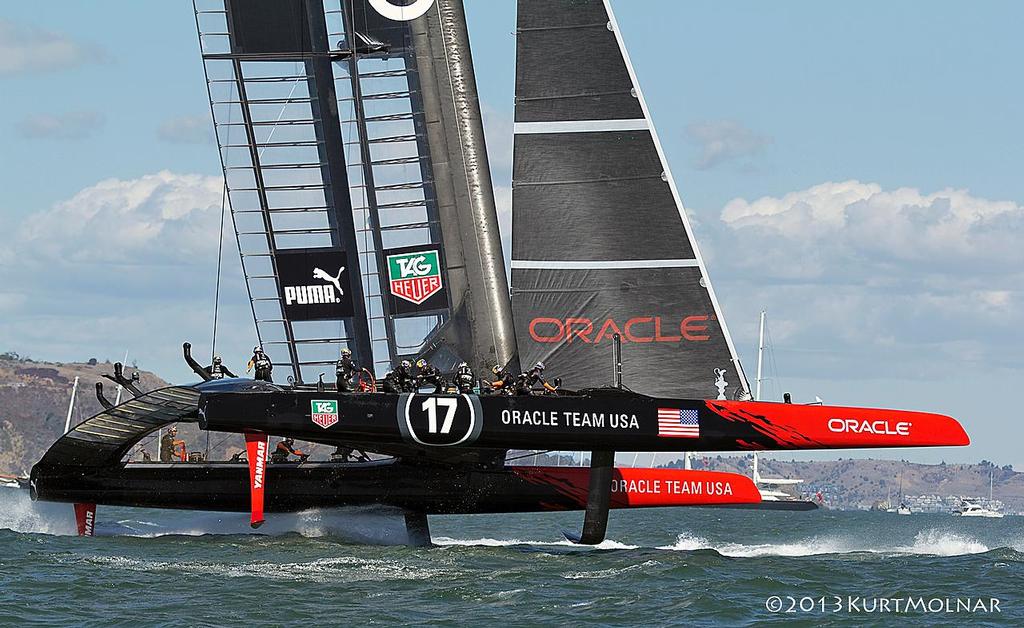
Oracle Team USA foiling - America’s Cup - Day 15 Kurt Molnar
The following notes are circulating in Auckland media circles, as an explanation for Oracle Team USA's improved foiling performance, as time progressed in the 34th America's Cup.
The notes were dated September 23, 2013, but were received by Sail-World mid-morning September 26, after the regatta had finished. But the device was first highlighted by the Television NZ commentary team during their coverage of the vital Race 19, of the 34th America's Cup.
Click here for the full race coverage and NZ commentary including comment on the Oracle Team USA foiling performance.
This afternoon, Tim Smythe, principal of Core Composite Builders, Oracle Team USA's Warkworth (NZ) based building facility, said that the team used the same set of foils through the regatta and that the 'special foil adjuster system, was there before the regatta
Click here for the TV3 report and interview with Tim Symthe.
The matter was taken by Emirates Team NZ to the International Jury on September 3, and a Decision issued on September 6, just one day before the regatta started. It was rejected on the basis on being filed outside the allowable time, but added a rider, that had it been issued inside the time limit, but on the basis of what had been heard, the application would have been unlikely to have been upheld.
Emirates Team NZ's Ray Davies said 'their boat is rock steady up wind, that takes us a lot of effort, and we have been trying to it for a long, long time, and yet they master it in just a few days.
It is well recognised that Oracle was having serious foiling stability difficulties at the outset of the regatta and that their performance could not match that of ETNZ.
Half way through the series it was acknowledged that Oracle had fitted an automatic control to their hydrofoil trim, and that this modification was approved by the measurement authorities.
Since this modification Oracle's performance has almost unbelievably improved. This has been 'explained' by skipper Jimmy Spithill as being due to the superhuman efforts of the crew to improve their handling skills. However, in view of the intensive training Oracle were able to do, prior to the regatta, with their highly skilled team partner, it seems unlikely that only now have they discovered the 'magic bullet' they they clearly have. It is much more likely to be the result of the modifications, possibly enabled by their surprising decision to use their lay day card and the subsequent lucky postponements.
It must be remembered that this is the first time that this contest has been sailed by yachts 'flying ' on Hydrofoils and it is probable that new and different criteria should have been applied.
In the aeronautical world it has long been known that the stability of swept wing aircraft can rapidly be lost by uncontrolled yaw leading to a dangerous situation known as 'Dutch Roll'.
A device known as 'Little Herbie' was developed during the commissioning of the Boeing 747 Jumbo Jets over 40 years ago, to over come this tendency. Little Herbies, or 'Stability Augmentation Systems' (SAS) as these are now designated, are equipped with sensors such as Accelerometers and Gyros which can detect and instigate corrections to stability with a speed and accuracy which exceeds the ability of even experienced airline pilots. They are therefore now installed in virtually all swept-wing aircraft.
The 'legality' of this device has been justified and accepted on the basis that it does not actually 'drive' the trim of the foils.....this is still performed by the muscle power of the crew, via hydraulic linkages. That may be so, but the device, using its sensing and directives, has been described as 'automatic'. This implies that the trim of the foils is determined by what can only be described as 'superhuman' technology. If this technology has been used to overcome the foiling stability difficulties of Oracle it will have enabled the use of higher speed/lower drag foils which the crew would otherwise be unable to manage. This would give a significant speed advantage during foiling. This has been clearly in evidence since the modification. Improvement in stability and speed has been staggering.
The high speed/low drag foils do have a downside in light conditions where, due to their lesser lifting characteristic, foiling is difficult or impossible. This was also clearly seen in the abandoned Race #13 when ETNZ were only 4 minutes from the finish, with a lead of over 1000metres.
Oracle Team USA have not provided any official comment on the system they used.
While it would seem that the actuator device is legal, if it is attached directly to its own power supply, the wider question remains as to whether a boat should be raced with a computer, rather than a human, driving a primary control function.
The Racing Rules on the matter are very clear
RRS42 Propulsion states: A yacht shall compete only by using the wind and water to increase, maintain or decrease her speed. Her crew may adjust the trim of the wing, sails, rudders, daggerboards and hulls, and perform other acts of seamanship.
The vital words are at the opening of the second sentence 'her crew' - meaning that an automated adjustment which works independently of crew intervention is illegal.
Then BMW Oracle Racing did have very sophisticated on-board systems in 2010 in the Deed of Gift Match, which amongst other things they were able to overlay a line image of the optimum wingsail shape against the actual image, enabling the crew to make the adjustment required to get the two shapes into alignment, and achieve the ultimate performance.
That is one step away from having the wingsail shape adjusted by a computer independent of the crew which under RRS42 is illegal. Even under the current America's Cup rules such a system is quite legal, and it is hard not to believe that such systems were not used again in the 2013 America's Cup. The key point being that there must be a crew intervention between the computer and the sail or other control named in RRS42.
Of course computers are not infallible, and any intelligent computer system requires a lot of tweaking and refinement to be operate consistently and at a refined level. It all takes time - and time is the most vital commodity in the America's Cup.
The time for application to the International Jury over such a matter, is long gone. The rules require that a competitor protests or lodges an application to the Jury as soon as they are aware of a measurement issue, not later or at the end of a regatta.
If you want to link to this article then please use this URL: www.sail-world.com/115070