John Rousmaniere looks at America's Cup waterline measurement
by John Rousmaniere on 28 Nov 2009
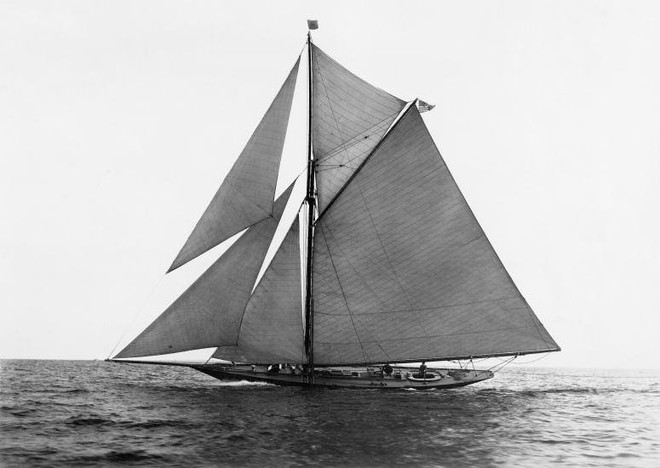
"Gloriana, a good boat but a better rule-beater" SW
Noted America's Cup historian, and correspondent, John Rousmaniere comments on the predilection of America's Cup designers to get around the various measurement rules, and in particular the measurement of Load Waterline Length, which has a particular and current significance.
He writes:
Good on you for addressing the rudder/LWL issue with your characteristic seriousness and clarity (http://www.sail-world.com/NZ/Gladwells-Line:-Americas-Cup---the-Riddle-of-the-Rudders/63750!Click_here to see the original commentary.) I don’t see how this good information leads to the conclusion that the trimaran is too long because, when she heels, the load is put on the leeward ama. Under the rule and in conformity with historical practice (including when George Schuyler introduced the Load Waterline Length dimension in the 1881 America’s Cup Deed of Gift), the boat is measured only when the hull is ready to sail, upright, and at rest.
This is the third time that I know of when the issue of measuring in another way has come up in America's Cup history.
In 1983, one argument against the legality of the winged keel was that it increased the boat's draft beyond the rule limit when the boat was heeled. That was true – but because measurement is done only when the boat is upright, the argument failed.
An earlier instance of creative (and legal) rule exploitation was Captain Nathanael Herreshoff's development of the so-called 'Gloriana bow' in 1891 to exploit a loophole in the dominant measurement rule in the U.S., the Seawanhaka Corinthian Yacht Club rule. Balancing measured LWL against measured sail area, the Seawanhaka Rule was the first effective two-factor measurement rule. Before then, ratings usually were determined solely by displacement or hull volume (the famous 'tonnage').
In a boat with Herreshoff’s distinctive bow, when the boat heeled the short, low-rating waterline for measurement purposes quickly became a long effective sailing length that greatly increased hull speed. After this practice led to boats, like Reliance, with exceedingly lengthy and dangerous overhangs, Herreshoff cut off the loophole that he himself had discovered by writing a new measurement rule for the New York Yacht Club.
Generally called the Universal Rule, the rule tossed out centerline LWL as the key length dimension and replaced it with estimated effective sailing length. The new length was measured parallel to the waterline at a point halfway out to the rail (which was why it was called the 'quarter beam measurement'). Another way to estimate actual sailing length is to multiply LWL by a factor – for example, 104 percent was used in the first Cruising Club of America Rule in the 1930s. In both, the hull was measured when it was at rest, upright, and in sailing trim.
But the Universal and CCA rules don’t apply here. The qualifying measured length under the America’s Cup Deed of Gift is Load Waterline Length– the length of the actual waterline down the centerline of a loaded, upright hull.
There’s only hull that meets that standard in your photos – BOR 90’s center hull, which comes in at under 90 feet.
(Editor;'s Note: The point is that under the SNG measurement is that they use a 'jumped hull' system. In that they look at the BOR90 as a platform, not three separate hulls. So they take the forward measurement point on the platform - the bow of the centre hull where it intersects the waterline is the forward point. The after point is the exit point of the platform with the water, so they jump hulls across to the aft edge of the ama rudder, to establish this measurement point. The separation distance between the two points is the LWL. Of course when BOR90 sails she flops onto her leeward ama, the overhang on that ama becomes immersed, and becomes the effective sailing length of around 110ft from a measured LWL of 90ft or less.)
If you want to link to this article then please use this URL: www.sail-world.com/63802