America's Cup- Designer Mike Drummond looks at foiling and pitchpoling
by Richard Gladwell on 17 Jan 2013
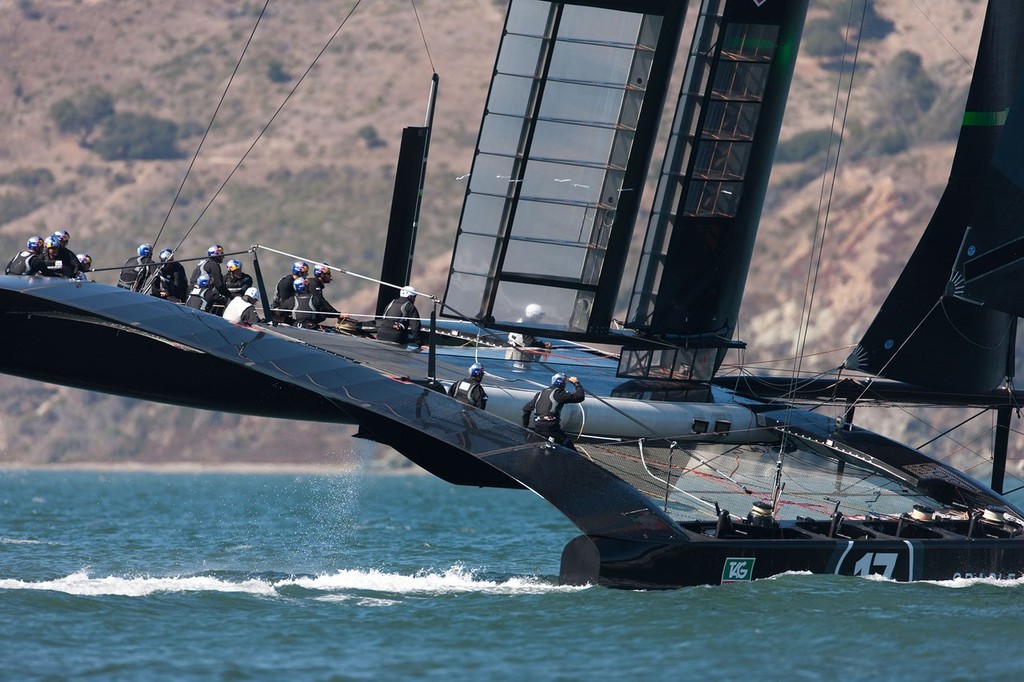
Drummond does not believe the Teams’ second AC72’S will be too different from a design perspective from the first boats ACEA - Photo Gilles Martin-Raget
http://photo.americascup.com/
Mike Drummond has been involved in the design side of four winning America's Cup campaigns, starting with then Team New Zealand in 1987-2003, before joining Alinghi in 2007 and latterly was the Design Director for Oracle Racing in the 2010 America's Cup, and the development of the wingsailed 120ft trimaran USA-17.
[Sorry, this content could not be displayed] In this second part of the interview (http://www.sail-world.com/NZ/Americas-Cup:-Ex-Oracle-design-chief-looks-at-the-Class-of-2013/105594!click_here to read Part 1) the issues of foiling and the trade-offs are discussed, along with the factors that led to the pitchpoling of Oracle's USA-17, and what is expected to be seen in the second generation of AC72 catamarans
While foiling does look spectacular, Drummond points out that it comes at a cost.
'There is a lot of induced drag from the winglet. You have wave drag from your foil, instead of a 72ft long hull going through the water, there is a one metre foil going through the water. These things do trade off against each other, and foiling is not free.
Downwind, especially in strong breeze, foiling will be essential. 'Originally I didn’t expect full foiling to be fast because it also has the risk of instability, but it seems Emirates Team NZ look quite stable and their published speeds are fast.'
'The key thing is to balance your side force and vertical force. The maximum vertical force is the weight of your boat, and the side force is whatever your sails are producing. Once you are flying a hull your righting moment is constant so your maximum side force is constant.
'These guys are doing stuff that hasn't been done before', he observes. 'People are quick to criticize and say that higher is better, or lower is better, but no-one really knows yet. And that is what they are finding out now.
'My guess is that Emirates Team NZ were designed to fully foil with their board further aft.
Oracle have aggressive foils, but further forward. I don’t fully understand the tradeoffs, but perhaps this is a nod to the lighter winds expected in September compared with July/August. Oracle might need larger elevators to achieve stable flight whereas my feeling is Emirates Team NZ have optimized more for downwind than upwind than the other teams. They might be counting on getting to the first mark in front and defending a lead.
Artemis were launched only as a semi-foiler. They are probably pretty good upwind and light airs downwind.
The International Jury decision of October 6, 2012 vindicated the AC72 rules interpretation by Emirates Team NZ, and overturned the view of the Measurement Committee for the 34th America's Cup. Via a complex and complicated class rules route that decision effectively sanctions the larger foils used by Emirates Team New Zealand and also Italian Challenger Luna Rossa.
Both teams are able to foil with ease, enjoying stable flight, in surprising light winds. Emirates Team New Zealand were fully foiling on their fourth day of sailing, Luna Rossa took to the air on their first day of sailing.
Four dimensions of foiling
[Sorry, this content could not be displayed] On the basis of published material Oracle Team USA, do not seem to have enjoyed sustained flight, while Swedish challenger, Artemis Racing have stayed very much in displacement mode.
The whole foiling practice is new science on this size of yacht - they are the largest to foil - with speeds in the high 30's and low 40kts being relatively common.
Does the size, or volume, of the foils currently being used on the four designs tell us why some can foil easily and others cannot?
'By eye, the foils on Oracle look plenty big enough to me', says Drummond. 'Emirates Team NZ's look to be too big, but that is just by eye. Foiling is a function of how much angle you put on your foil, how much camber is designed into the foil, and the area of the foil. Roughly if you double the area you double the lift. If you double the camber you double the lift. If you double the angle, you double the lift.
'Whether an AC72 is designed, or not designed, for foiling is a function of fore and aft location and the foil lift. What none of us see in the photos is the foil camber, or the angle that the foil has been set at.
'Really there is a fourth dimension, which is speed, and that is a critical one, because the speed squared is the effect on the lift, so if you double your speed, you quadruple your lift. And 10% extra speed is 20% extra lift.
'By just looking at photos, none of us can see all those parameters, we just see the area of the foil, which is but one factor.
'From ashore, I have seen Emirates Team NZ foiling in very light winds and at a very bow up angle and they looked quite slow. The point is that if you have a big enough foil at a big enough angle then you will foil fly. '
Drummond adds that the design teams, which generally number about 30 per team for the two boat campaigns, have 'done something like 20 years of development in two years and that never goes smoothly.'
'The science is relatively well known, but the application of it is new on any scale of boat. People have been foiling for 40 years, but they have all had control systems like wands to regulate the ride height. This is the first time in 30-40 years that anyone has tried to do this without a control system.'
Moving onto the events of October 16, when Oracle Team USA capsized their AC72 on just the eighth day of sailing, the highly experienced multihull designer and sailor has only a simplistic answer - 'they started to put their bow in, which started to slow the boat down, which increased the apparent windspeed on the rig. Once you get to a certain pitch angle it is an unstable, runaway situation.
'Every multihull can be pitchpoled - you just need a strong enough breeze,' Drummond adds.
'The only reason monohulls don't pitchpole is because they lose control at some point. But a multihull will track very straight with both her bows submerged.
'If you start to look deeper and ask why they dug their bow in, those answers are way more complex.
'People have sailed Hobie 16's and Tornados for decades and still pitchpole them unexpectedly. I don't think the physics and changing dynamics are well understood. Every team is trying to figure it out.'
'In summary I think Oracle would have analysed a lot about that capsize and what led to it.
'They need to look at it in 100th/sec scale because at one point they thought they were OK, and at another they clearly weren't. How to identify when to bail out is critical. You don't have any options when your bows are under and your rudders are out. You have to make decisions before you have lost control.
Significant benefit from just eight days of sailing
Perhaps surprisingly, from a design and development perspective, Drummond believes that Oracle Team USA would have got a huge benefit from just the eight days of sailing they managed in USA-17, which would be valuable input into their second AC72, expected to be launched in March or April.
'Every day of sailing is valuable whether you are looking at systems, board up and down systems, pitch control systems, wingsail systems. Oracle would have checked in with rudder angles, leeway angles, sail shapes, jib sag. There is a massive amount of information they should have gathered.
'They would have got a lot out of those eight days and I'm sure they will be poring over that data.
'The question is how much did they learn that will change what they are doing on their second boat. We don't know what any of the teams are doing for their second boat, and therefore we don't know how much they are changing it based on their first boat results.
In terms of what we can expect to see in Oracle Team USA’s second boat, Drummond is expecting to see a different approach from their first. The changes may include putting more volume into the bow, and modifying their structure to be less prone to twisting. But he quickly adds that it is hard for teams to radically change their design path especially since there is very little overlap between sailing boat 1 and starting to build boat 2.
For practical reasons he doesn't expect to see major concept changes between boat 1 and 2 for all the teams. For instance for Emirates Team NZ or Oracle Team USA to change course completely between pod and Y structure means discarding many hours of design work and starting again. This would have a major effect on construction schedule and budget.
He points out that the scope for a change in the design approach, by any team, and also any modifications depends on how much weight they have to play with for the second boat.
'A lot depends on how much weight they have up their sleeve - my guess is that USA-17, for example would have been underweight – perhaps up to 200kg – and that determines how much laminate they can add to the boat.
'If they decide to reduce the torsion - if they can put 50kg of torsion laminate into the beams - that will make a massive difference. We don't know that information and it is hard to predict where they would go with their second design.'
'Oracle would certainly have known that boat was going to twist, that is for sure. Whether it twists more than they anticipated, I don't know. I guess the actual sailing behavior with the twist has been harder to manage than expected – for example, the windward bow touching might be unsettling in steering.' he adds.
Emirates Team NZ generally shows flying at zero heel with the windward rudder elevator immersed, and this is probably one contribution to their stable flight. For Oracle Team USA's first boat, a low heel angle puts her windward bow closer to the water and waves because of the platform twist and this would be harder to sail steadily. It may be just a matter of the crew needing more time in the boat to get used to in sailing USA-17, Drummond says.
Oracle's foiling test platform
Oracle Team USA did their initial foil development on AC45s which are relatively stiffer platform in torsion, so any effects of the windward bow touching the water would not have shown up there, he adds.
One of the options to catch up time for Oracle Team USA could have been to speed up the building program, but Drummond’s response saying that everyone wants to do that in an America’s Cup program, so the designers can leave their options open for as long as possible, and the sailors want to sail it as early as possible.
'It is close to impossible to speed up a building program. Even if you hire more builders and work 24 hours a day, you have to wait for laminates to cure, paint and filler to dry. And there is a physical limitation as to how many builders you can have per sq metre in a boat building shop. I have been through it many times having overseen the construction of about 15 AC boats, it is incredibly expensive to pull even a few days out of a program. You have to put a massive effort in and get very little in return.
'I don't think there is really a lot that Oracle can do to shorten up their programmed building times.
'Part of what the America's Cup is about is how you manage your timelines, and manage your risks. It is an 'everything' contest. It is how you set your priorities for your designers, builders and sailors. Every team has some setbacks along the way, and how they react to it is very important in determining whether you win or not.
[Sorry, this content could not be displayed] 'What we are seeing now with the various teams, and their issues, is just a really graphic example of what happens in every Cup.
Despite the setback of the capsize, Drummond believes his former team is still in with a chance of defending the America’s Cup.
'Oracle can still win the Cup, for sure. Their chances have certainly taken a dive, but they are not down to zero or anything like that. They will have six months with two boats, and you can be sure that the program will be tightly focused on performance.
'In many respects, from that incident, Oracle will end up with better data about the limits than other teams. I don't discount that as being insignificant.
'Right now they aren't learning about exactly how high to fly or what angle the boards should be or sail shapes, but their capsize won't be a complete waste of time.'
If you want to link to this article then please use this URL: www.sail-world.com/105592