Dave Ullman - yachting's elder Statesman (Pt.II).
by John Curnow on 24 Sep 2010
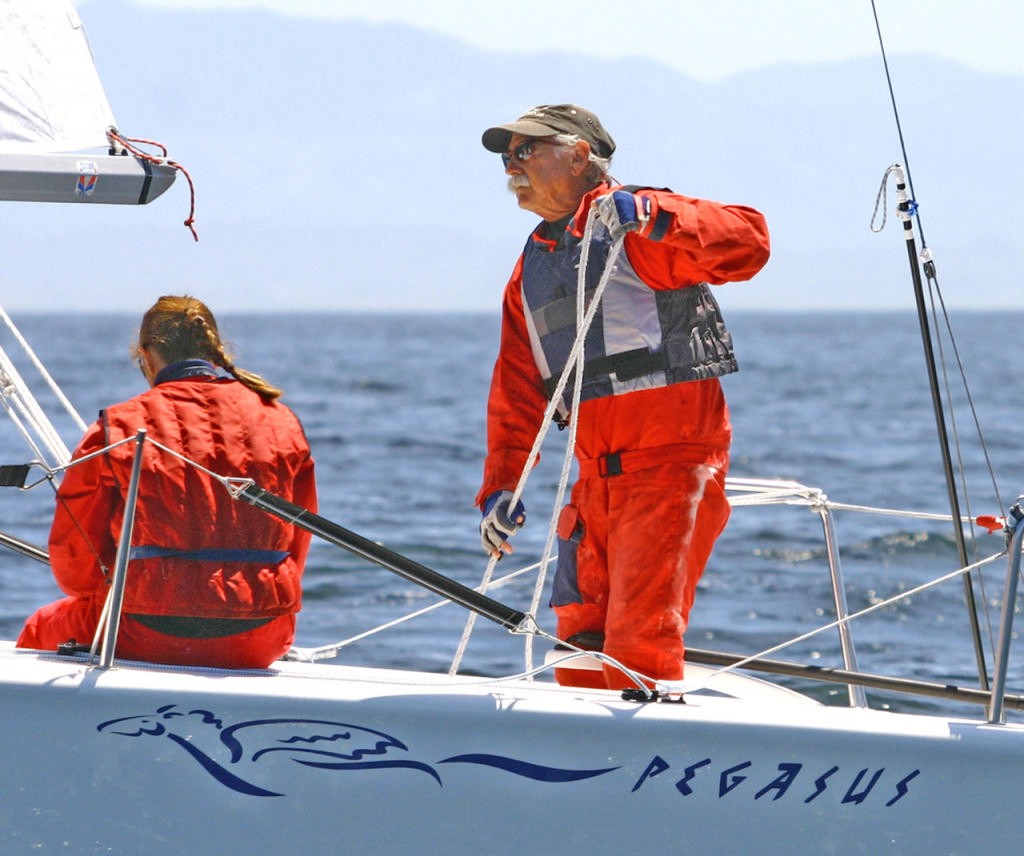
Veteran Dave Ullman wins the 2007 Melges 24 Worlds Rich Roberts
http://www.UnderTheSunPhotos.com
In Part I of Dave Ullman – yachting's elder Statesman, we looked at how Dave got into the sport he's somewhat synonymous with. We also learned some of his thoughts on the business of sailing, which he's been working in for over 50 years.
Now here in Part II, our focus turns squarely to the future, including a look at the sport's top levels of competition. When younger people want to progress to the top of their game and consider making a living from sailing, they could take a few notes from Dave. Dave has certainly seen it all transpire and continues to help young sailors start their sailing careers.
One of his observations is that the current generation of 470 sailors commonly sail as tacticians on bigger boats and there are often Olympic sailors in the sort of fleets that a large regatta can bring together. ‘I've been doing tactics on big boats since the mid to late sixties. I think dinghy sailors make very good tacticians. They have much more of a feel for it, as there's often no one else to blame when you're sailing dinghies. Justifiably, they are very much in demand and quite skilled.'
‘Today, the kids have to decide whether they're professionals or not. Right now most of them have money put into their Olympic funds and then draw down on that. This is more common in say Australia than the USA, where the sailors don't try to funnel it into some kind of liquid campaign.'
‘I think Australia's Olympic program is the second best program in the world behind the Brits. There is much more government support here for the Olympic classes. Ours is yielding pretty well for one that's not funded. The truth is that I think we have the best sailors in the world in terms of numbers and always have.
The US Olympic program lacks funds and it shows in the results today, whereas 20 years ago we dominated the results. If you look at the LA and Canada Olympic Games, we dominated the results and then we started losing funding. We've got talent, all right, but if the funding were properly arranged, we'd be on par with anybody. It takes money! Trying to earn a living and do a full Olympic campaign is not easy', Dave then added.
‘Here in Australia, you've got Tom Slingsby, the Laser and 470 teams. You won two gold medals back-to-back, I think. That's pretty good. Your coach, Victor Kovalenko, whom I've known since the 70s, is very, very good.
Eight Golds in a row or something like that for him, I understand', said Dave, showing his understanding of the global scene. ‘I like Nathan Outteridge. He's a good kid and a great sailor.
All these guys have been Moth sailing. The foiling Moth is very special. They choose to be involved with the Moth in addition to their regular craft, because just to go sailing is such a blast!'
So then we ask Dave which vessels should be the Olympic classes and which should have gone out? ‘The Women's Match Racing scene was an interesting choice. I thought that Men's Match Racing would have been in before the Women's event.'
‘The Finns are good. Sure they're old world, but they are very physical. Maybe the Finn and Laser should not both be in, but you can't kick the Laser out because of the representation and I do think there is a place for the Finns.
As a result, I think maybe the Stars should go out and the 18s or something like that to come in. There's certainly room for more skiffs. It doesn't matter what type, just more skiffs. It'll probably be the 29er, given that the women already sail them. This means that the Women's 470 has to go and I hate to say it, but the Men's 470 has to go, too. The argument is that they're for light people, but this doesn't make sense. Downhill skiing doesn't have a class for small people. A sport's a sport!'
Certainly weight and athletes of all types is an ongoing discussion. One of the Australian Men's teams looked painfully reduced in weight and it didn't seem healthy. Dave saw that as well, ‘I weighed 125 pounds when I sailed 470s. That 125 pounds represented about 11 years of struggle weight-wise, all the time. One of the biggest factors in this type of sailing is weight, which may be wrong.' Incidentally, Dave does not have a massive frame, so he's kind of qualified to speak on the matter.
Reviewing the last Olympic Games, Dave commented that ‘Qingdao may have been the windiest Tornado regatta, but it was also the windiest regatta across the board. The Lasers had some wind; they didn't have no wind for their racing days. The sea breeze helped to make it a better regatta. If you'd watched them drifting around on TV you'd think to yourself, that's a stupid sport.'
‘Of course the last 49er race had heaps of wind and as a result, was watched a lot, certainly on playback.' So where does mass media and television fit into sailing? Should the fun element of sailing be the focus or is the funding element really important at Olympic level?
‘At Olympic level I think mass media should have nothing to do with it and I don't think mass media makes any difference. The popularity of the sport does not grow because of mass media watching. It's not exciting enough to watch sailing on TV and say 'I'm going to do that.' Even with the relative carnage of that Gold Medal 49er race, Dave does not feel that the sport of sailing grows because of the coverage.
Moving on to whether a class of boat is advantaged or disadvantaged by being an Olympic class, Dave has some very clear and valid points. ‘If you're looking for growth, it's a disadvantage. If you want a class that has size to it, you don't want it to be an Olympic class. You look at every one of the Olympic classes, besides Lasers, and they exist in very small numbers. You find ten Olympic sailors in a country and that's it. However, if you then look at say Etchells, which is not an Olympic class, and it is just huge. Well… if you want health in a class, it should not be Olympic.'
Actually the Etchells is an interesting point as Dave elaborates on it for us. ‘If the Etchells had actually been an Olympic class, they would have gone the way of Solings. There really isn't much difference between them as a type of craft.
'In fact, the Soling is a better boat and yet it is non-existent. You just can't put that much expertise into a class and expect the middle of the class to survive and enjoy it; it's just not going to happen. The distance between the Olympic guys and the middle guys is just too much. Everyone has an ego and nobody likes to lose by a leg. If that happened, you would hope they would go to another class and not just quit sailing altogether.'
Asked what he would do if he was in charge of the US Olympic sailing team, Dave says ‘You're not going to get government money in the United States, even in the best of times. It's just not going to happen. You need to go look for a really good sponsor and it's not like the Olympic Committee hasn't been doing that. I was on the sailing part of it at one point and there was never a real conviction to go looking at money.
The sentiment was, ‘Yeah we'll go get a sponsor, but we're not going to do what it really what it takes to get a good sponsor. But if somebody wants to give us money…' I think it's changed now. They're working hard. They're a long way behind and it's a lot of work to catch up. It's simply a terrible time to be looking for sponsorship money.'
‘The crux of the problem is money - pure and simple. It might take four to eight years to raise enough money to get back on the map. We have top quality programs; we just don't have the funding. In the past we've had people spending their own money. I did three Olympic campaigns with strictly my own money. I did some fundraising, but there was no money from the government or the Olympic program'.
By way of demonstrating just how tough it all is, Dave elaborated on his four-year Olympic cycles and his own 470 campaigns with crew Tom Linskey. ‘From '72 to ‘76 we worked hard, but didn't win the trials. From '77 to '80, which was unfortunately the boycott year, we won three out of the four World Championships, so we would have probably won a medal in Moscow. We did not do super well in '83 and '84 and ended up second in the trials.
From '77 to ‘80 we sailed five afternoons a week during that whole period. We worked very, very hard. As with anything, when you fall behind, finding the ladder again is close to impossible because everyone else is working hard too. You get behind by not participating for a while and then you can't get enough time arranged to get back to where you were. That was a very good lesson. It's also important to remember why you were good. It wasn't because you were good; it was because you worked hard.'
‘I've been around to observe a lot of changes in sailing. There are more and more young professionals in the sport these days. Right now it's not a good time for professional sailing, due to the economy. The America's Cup is interesting. Jimmy Spithill's got a helmsman position for instance, but not many others. In a year or two it will all be back, one way or another. They said the same thing about '88 recession; it didn't make any long-term difference, just took a little while to come back. There's certainly more avenues now for professional sailing than there has been in the past.'
Talking about the America's Cup and observing the fancy media boat that was in Geelong, which is about the only thing that can keep up with the new breed of Cup boat (just), Dave said, ‘One thing you can say about all this, is that those last two boats have shot development on like nothing else in a very long time; the Oracle boat is just amazing. The whole thing is pretty absurd in a way. Both sides are pretty absurd. I think it's fascinating though. It's not particularly good for sailing, in a way, but I've got friends on both sides and that they can dream this stuff up is just amazing.'
Coming back to talk about things more based on the water, Dave loves the fact that the AC teams have got helmets on. ‘Wearing crash helmets every day is like a whole different ballgame. Sure it is old hat for the French. They're used to just going sailing and have crossed oceans in these sorts of boats.' However, the Oracle programme that he saw a lot of in the USA ‘is just dominated by regular, one-design sailors and to them this is a huge deal! The French may have a significant attrition rate with the big multihulls and in a way, this event is not even big for them.'
Given all of the above, it is little wonder that when discussing what we consider to be an interesting life, Dave simply comments with a smile, ‘Yeah. I'm really enjoying it.'
Dave Ullman, yachting's elder Statesman sure can sail and he knows a thing or two about the business of sailing as well. One would do well not to underestimate his skills and powers, whether competing against him on the water or in the sailmaking business. There is every chance that he might just be able to offer some you some invaluable advice for your own sailing career, no matter whether it's on or off the water.
If you want to link to this article then please use this URL: www.sail-world.com/75025