Container Ships and the Cruising Sailor - Part 4
by Sail-World Cruising on 7 Apr 2006
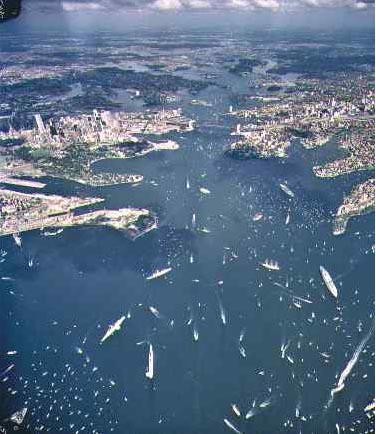
Busy Harbour SW
A very experienced Ship’s Captain, Capt Jim Mort, tells the story:
I well remember a French yacht in a very narrow passage in the Great Barrier Reef on the Australian coast in daylight. This fellow was right in the middle of the deep-water route, which caused me to have to move to starboard. The ship I was in was around 120,000tonnes. As I moved over, the yacht also altered its course, not to avoid us, but to get closer. This required me to mover over still further, until I was only about 150 feet from the reef and could go no further. The yacht had tons of room. Due to the entrained water between the reef and the ship I could not get the ship away from the reef after passing the yacht until I had passed the end of the reef. It required a change of underpants for me.
Later on Thursday Island, a Frenchman came to the pilot house to buy charts, and I found out it was the same yacht’s owner, who was quite surprised at the trouble he had caused. He said that he only wanted to be friendly and get close enough to wave to us on the ship.
In this article, we discuss the situation of yachts and ships in enclosed waters, a ship’s ‘close proximity’ effects on a yacht, How to tell you’re on a collision course, the meaning of horn blasts from a ship, and suggest two great gadgets that may help.
ENCLOSED WATERS
There can be a very real danger of collision when in enclosed waters, because of the increased lack of manoeuvrability of ships, particularly those with very deep drafts. In these places yacht should be very wary of passing too close to large vessels. Should it be necessary to remain in a channel, such as a narrow river, then stay to the starboard side of it as close to the bank as possible, but do not forget the wash that a large ship makes in confined water under these conditions.
In a river, the ship pushes water ahead of her onto the bank, but as it passes this water runs off the shallow back into the channel quite rapidly, and this is then followed by a pretty hefty quarter wave which rolls over the exposed flats and returns the water to its original level. This movement of water can make life interesting for small craft.
Large ships navigating near sheer walls or coral reefs on one side or passing another large vessel close-to can have problems manoeuvring due to the effect of the entrained water between the reef and the ship. The water pushed aside by the bow has to go somewhere. It cannot escape to the side where it is blocked by the reef, so it has to speed up to get between the reef and the ship, causing a large reduction of pressure on one side. This can make steering extremely difficult.
WINDWARD AND LEEWARD EFFECTS IN CLOSE PROXIMITY:
There is another factor that the cruising sailor needs to keep in mind about the danger of finding yourself in close proximity to a large ship. Obviously, if the yacht is in the lee of the ship it will find itself deprived of a reasonable wind, and will have to rely on its motor to manoeuvre. This may be okay unless something goes wrong with your engine at the same time. However, the same effect can occur when the yacht is on the windward side of the ship – particularly if the ship is high sided, such as a container ship with a full load, a passenger ship or a bulk carrier.
What happens here is that the wind hitting the side of the ship causes an area of high pressure, and an area of still or erratic air. The mainstream of wind then blows over the top of the ship. So the unfortunate yacht may find itself in this area of erratic air not be able to sail. It can then be sucked against the side of the ship because of the interaction of the water between the two.
SHIP’S HORN IN CLOSE PROXIMITY:
In close proximity, here are the meanings of the Ship’s Horn:
One short blast means 'I am changing course to starboard.'
Two short blasts mean 'I am changing course to port.'
Three short blasts mean 'I am operating astern.'
Two prolonged blasts followed by one short blast to mean 'I intend to overtake you on your starboard side';
Two prolonged blasts followed by two short blasts to mean 'I intend to over-take you on your port side.'
A long blast every two minutes is used when operating in fog.
ARE WE ON A COLLISION COURSE?:
How can you tell? Easy! (Method is valid regardless of the distance between the boats). Say you see a boat seemingly coming towards yours at an angle, and you see it just forward of your starboard stay (If you have a hand compass, and you want to impress your neophyte crew, you can also take a bearing of the other boat.) Check again 2 to 3 minutes later. Three things can have happened:
The other boat is now much more forward of your starboard stay. In other words, the bearing of the other boat has moved forward. Result: If both boats maintain speed, the other boat will pass yours ahead of your bow. No risk of collision. If the boat is very far, re-check every 5 minutes.
The boat is now much more aft of your starboard stay. In other words, the bearing of the other boat has moved aft. Result: If both boats maintain speed, the other boat will pass yours behind of your stern. No risk of collision. If the boat is very far, re-check every 5 minutes.
The boat is still at the same place relative to your starboard stay. In other words, the bearing of the other boat has not changed. Result: If both boats maintain speed, there is a probable risk of collision.
CLOSING SPEEDS:
Finally, let’s look at how long you have between the appearance of a ship on the horizon and the moment of collision.
Let us assume that the practical distance that you can see is 7 miles. Let us assume that the ship is travelling at 15 knots, a not unreasonable speed. Let us further assume that the yacht is travelling at 6 knots, a reasonable speed for most cruising yachts. This means, in the worst case of a head on collision, the closing speed is 21 knots. These are quite conservative estimates, as both yachts and ships frequently travel at much higher speeds. Nevertheless, this means that from the moment of sighting the first tiny speck on the horizon to the point of collision is just 20 minutes. Any yacht that puts its ‘time between required horizon checks’ at more than 15 minutes is taking a risk all the time they are sailing. (We put ours at ten minutes)
THE FINAL WORD ON RIGHT OF WAY:
Finally, just in case you, as a sailing boat, think that you have right of way (as in the story of Windhoven and Blackwattle in Part 1 of this series) over the container ship, Rule 18 (b) of the
International Rules for the Avoidance of Collision at Sea states that
‘A sailing vessel under way shall keep out of the way of a vessel restricted in her ability to manoeuvre’
– which applies to all large ships at sea
GADGETS WHICH HELP:
Today there are two great gadgets that will make keeping a watch for ships at sea a lot
The Watch Commander:
This simple gadget, once set, cannot be turned off unless you actually disconnect the power. It is designed to preset the time between horizon checks. Once set for the number of minutes that you stipulate, it sounds a soft alarm which will not wake sleeping crew at the end of the period. The crew on watch merely has to hit the button and the time period starts all over again. If the crew has fallen asleep or whatever, after 45 seconds, the soft alarm turns into a shrieking siren that will even scare away nearby fish. The Comar AIS Receiver, which not only shows, but IDENTIFIES all ships in your vicinity, thus enabling you to call them by name.
There are two types – first is an interface box to plug into your laptop:
The RadarPlus SL161R includes dual AIS receivers in a rugged water resistant aluminum enclosure. When attached to a VHF antenna optimized at 162Mhz, the RadarPlus serial data output will drive most popular marine charting software packages available today. The output provides the location of all AIS transponders within receiving range. Other interface options, such as USB, Ethernet, and RS-422 are available to increase the overall flexibility of the RadarPlus SL161R.
Information gathered by the RadarPlus SL161R is more detailed than radar and provides the everyday boater with the same information afforded to commercial vessels. Now you can see what's coming on your PC or chart-plotter long before it is in your line of sight.
The second type is the stand-alone which comes with its own screen:
The SLR-200 will receive, decode and output the name of the vessel, call sign, type of vessel, destination, speed, course, heading, rate of turn, position, navigation status, vessel dimensions and MMSI
If you want to link to this article then please use this URL: www.sail-world.com/22840