Volvo Ocean Race- Barkow and Lush - from the Olympics to the Volvo
by Steve Rosenberg on 25 Feb 2015
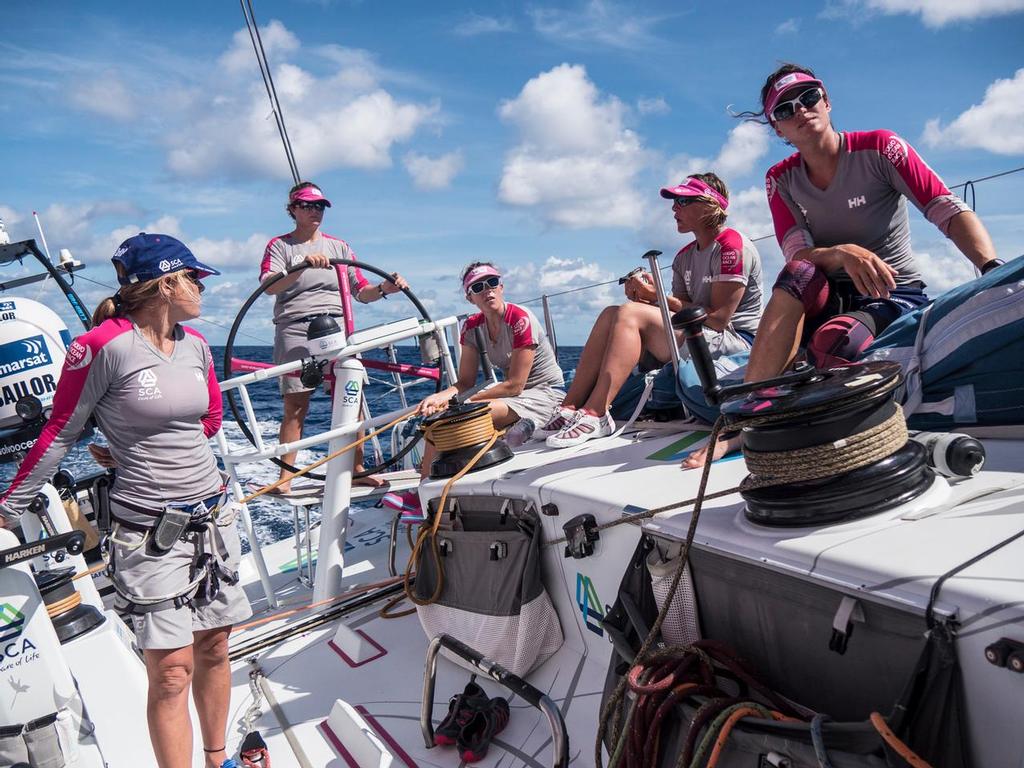
Team SCA - Annie Lush in traditional Doldrums clothing - Volvo Ocean Race 2014-15 Anna-Lena Elled/Team SCA
Kaenon's Steve Rosenberg talks with Team SCA crew members Sally Barkow and Annie Lush before the start of Leg 4 of the Volvo Ocean Race. Both are former Olympic match racers, who have switched to ocean racing. Both are wearing the new prescription Kaenon sunglasses in the 40,000nm race around the world.
Steve Rosenberg talks first with Sally Barkow on how she had found the preceding Leg 3, what lay ahead for Leg 4 and the various strategies they employ in the first womens crew in ten years to compete in a round the world race.
A skilled match racer, Barkow has been on and off the Olympic circuit for the past 10 years. She represented the USA in the Beijing Olympics in 2008, skippering in the Yngling Womens keelboat event. She was US Rolex Yachtswomen of the Year in 2005 and 2007.
Leg 3 from Abu Dhabi to Sanya is a very tactical and treacherous leg . After sitting out Leg 2, what was your mindset the morning of the start of Leg 3?
The day started like any other in Abu Dhabi - usually light winds dying off then rebuilding in the afternoon.
However, the morning of the start was extra foggy. Usually we look out from our hotel room on the 39th floor onto the race course to have an idea of the day, but we were stuck in the clouds. Even though I was not onboard for Leg 2 there is a routine in place for leg start day and it is usually a pretty relaxed morning.
First, I get the latest weather update to have an idea of what kind of day it will be tactically. Then I get on the water, reassess the conditions, and try to make the best decisions possible. Leaving day is usually long; it is actually a relief to get on the race track, settle into our watches, focus on the boat speed and determine the best course to take.
While the result on paper was not what you or the team wanted, it appears the boat was well sailed and more competitive than the result indicates. How would you describe the result?
We stuck with the pack for 16 of the 24 days – which was much longer than we had in previous legs. This was a huge improvement for us even though we ended up in the back of the pack. We really made some solid strides sailing the boat, but more importantly working as a team and I hope we can continue on this path.
Team SCA entered the race with the strategy that crew rotations are advantageous. What’s the thinking behind this strategy? How have the women onboard adapted as a team?
The philosophy with the crew rotations is to keep people fresh, strong and to have the best crew combination onboard for each leg. I think this is extremely hard to get right all the time and it has slowed the team development process quite a bit. The well-known fact that we don't have as much experience as the other teams, motivates us to always strive to build experience. This process takes us a lot longer, but I’m not sure there is an easy way to shorten the process.
Has your role onboard changed or evolved? If so, how?
Yes, close to the start of the race I moved into the role of inshore Tactician and added to my offshore role of Trimmer/Driver. We are all gaining experience in the boat so the details of who is best in what conditions are constantly being assessed.
The various Straits and Oceans in Leg 3 proved to be a danger-filled obstacle course to navigate. When racing through the Malacca Straits, your team had to avoid a broad spectrum of challenges such as extreme maritime traffic, local unmarked fishing boats, trash, flotsam and jetsam. How did your team approach and handle this type of obstacle course – especially at night?
The only thing we could do was keep our eyes peeled! It was hit or miss sometimes and pure luck others. We get a feel for the surrounding waters in the daylight then do as best as we can at night. We did catch a few fishing nets and came extremely close to other traffic, but I thought we managed the situation the best we could without having to alter course too drastically.
What was your overall impression of the sea and sea life in that region of the world?
It was a very cool to come through the Straits of Hormez from AbuDhabi, then rejoin land through the Malice Straits in such a different part of the world. I enjoy racing near land especially after so many days at sea and I really enjoy the challenges it brought. The most unique thing we saw was off the coast of Vietnam. Scattered amongst these 20 ft fishing boats were these 'salad bowls'. One person in a round bowl-looking tub or boat, basically floating around…I think they were fishing...needless to say when we came screaming past them at 15 knots their eyes were HUGE and I hope we did not toss their bowl too far!
Are you surprised by what you’re seeing in the ocean and how our planet is being treated? Do you have any concerns?
We did see a small but fairly steady stream of plastic bottles mainly off the coast of Sri Lanka up until the Malacca Straits. It makes you never want to drink water from a plastic bottle again.
Leg 4 will take the race from Asia to the iconic sailing port of Auckland, NZ – where sailing is part of the local lexicon. Weather conditions should be more extreme than the previous leg. Do you prepare a different game plan for Leg 4?
The game plan is not too much different. We just prepare the best we can for the conditions we might get. Leaving Sanya should be fairly rough and pretty windy upwind, which was just the opposite to the start of Leg 3.
Annie Lush (GBR) is an Olympic match racer who competed at the London Games in the Elliott 6m class.
Lush has been Women’s Match Race champion three times (2004, 2005, 2010) and topped the ISAF World Ranking in 2010. She competed in the World Match Race Tour, as well as racing on professional circuits.
How are you preparing yourself mentally, emotionally and physically for Leg 4?
We just try to get as much rest as possible during the stopover, have a little fun and do a little physical maintenance in the form of stretching and light cardio. I think we did a lot of the mental prep before the race start so I think most of us have a switch that we flip on start day and get into race mode!
What are you finding to be the most rewarding elements of onboard life on Team SCA? Conversely, what elements are you finding to be most challenging and difficult?
When I started the race and the long legs I thought the biggest challenge would be the physical challenges of life onboard at 25 degrees of heel, not sleeping enough, living on freeze dried food, being wet all the time etc. But for me the biggest challenge in these long legs is just like any sail boat race - it's the mental part. Constantly looking for any gain possible, trying to get that extra 1%, fighting for days on end to gain a few miles and then having to deal with the loss. When the losses come they often happen fast, a bad cloud or shift or tide, and you know it's going to take you hours, days, nights more work trimming, driving, grinding, stacking to make the miles back.
In comparison to inshore racing, you get to mentally throw that race away, maybe discard the bad race from your series score and if you do it well, you can go back out there and win the next race. But offshore there's no discards, you just have to slowly grind your way back into the race.
The most rewarding part is when you fight back as a team and the hard work pays off. We all have different skills which we need to combine to keep the boat working and sailing as fast as possible. It's a unique feeling when you go off watch and know that even while you sleep your team is pushing and working the boat in your absence. It takes a lot of teamwork and respect for each other, to perform in conditions where people are not at their best - we’re usually tired, cold and hungry. The sense of achievement when the team works together is very rewarding.
You’ve known a few of the women on Team SCA prior to the start of the Volvo Ocean Race, such as Sally Barkow. What’s been most pleasurable about adapting to a team of new personalities? Did anything stand out as a positive surprise?
I knew of most of the women, but only raced with Sally and Stacey in prior competitions. We all come from very different sailing backgrounds and cultures so there has been challenges, but mainly I have loved it!
On our first Atlantic crossing training run, we were in a big storm and a part of our boat started to break off. We had to fix it quickly in big waves and wind.
Suddenly, a lot of the girls began showing incredible skills such as boatbuilding, engines, hydraulics, and safety which I personally have no idea about. My job was to keep the boat sailing as well as possible while they did the fix. I remember watching in awe and being incredibly proud of our team. Some of the women are mums, some have sailed around the world multiple times, while others are just at the start of their sailing career. There’s definitely a lot we learn from each other.
We also have a tradition of bringing traditional treats from our home country. We have Swiss bring back chocolate, Dutch waffles and the Swedish liquorish is good to take onboard!
Are you seeing more defined similarities and differences between offshore racing and Olympic style racing (preparation, approach, decision making, team dynamics, etc)?
There are definitely a lot of similarities. One thesis is at the end of the day it's all about speed - you just have to be as fast as you can. You also need to try to go the right way, get your strategy and tactics right, but as with any sailing race, speed is king. In offshore, 1% faster is not meters but adds up to many miles over a long leg. In two days you'll no longer be in sight of a boat going 1% faster.
The biggest difference I find is that you're trying to perform your best in offshore racing and push for that extra 1% in conditions that are far from optimal.
On an average day before a race at the Olympics, I would wake up well rested from eight hours of sleep in a decent bed, eat a specially prepared breakfast, and take a urine test to ensure I was hydrated to the right level.
Then I warm up, stretch, have a full weather briefing for the day and set aside some mental prep time. After the race we would debrief, warm down, sip protein drinks, sit in ice baths and get Physio treatment. For the rest of the day we rest and eat well to get ready for the next day.
Offshore you only have about two minutes to get from your bunk, into your kit to help stack or do a very physically demanding maneuver. If you're very lucky you might have had two hours of sleep in a block but that’s rare. You have no real food, and there is no time or space to stretch or prepare in anyway. It's often dark and your kit is usually still soaking wet & salty from your last watch. Imagine trying to perform, communicate, and take in a lot of information when you're at you're worst. People often say it'd be like racing at the Olympics while simultaneously looking after a new born child!
What are you looking forward to most about Leg 4?
I'm looking forward to getting back out there and getting another chance to improve. We made big changes to the structure of the team before Leg 3 and we made good gains in some areas in terms of speed, but we still have a lot to work on. I hope we can continue to improve quickly. If we can stay in contact with the guys and push them for the entire leg this would be a big step.
If you want to link to this article then please use this URL: www.sail-world.com/131864