The Necessary Sextant and How to Choose It
by Rob Landis/Sail-World Cruising on 16 Jun 2006
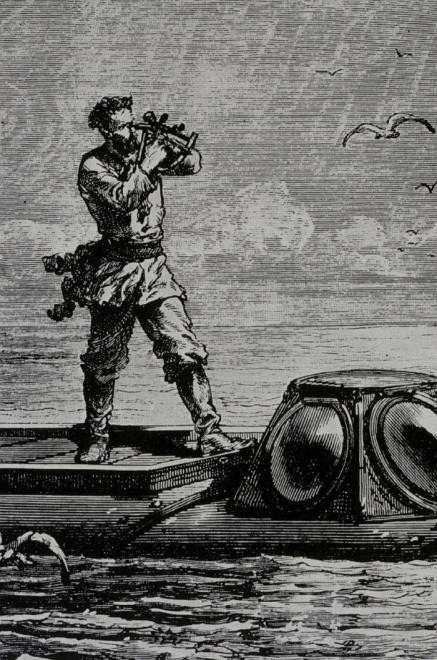
Captain Nemo taking a star sight SW
GPS’s have sneaked under the guard of ancient mariners, making their wonderful navigation skills almost a thing of the past. Sailors set out on journeys across the world with no skills but how to read the GPS and Cmap. Where once the ocean mariner used vigilance and good seamanship to weather storms and miss the rocky bits, now satellite telephones and helicopters give the hesitant sailor the confidence to go where no bad seafarer should be.
However, what happens when your computer crashes at sea? Or worse, seawater fouls the instruments? Or what about the possibility of lightning strikes? – leaving you without any electronics at all?
(The two cruising boats we have spoken to who have been hit by lightning in the last couple of years have been adamant that no lightning protection would have protected their boat from the lightning that struck them in the ocean. Both had all instruments fried, even though they had disconnected all gear. One did have lightning protection, the other not, but each agreed that in the event it would not have mattered.)
This makes the knowledge of how to use a sextant, and the carrying of the appropriate tables, one of the most excellent safety measures any cruising boat can have. If you are convinced to carry a sextant – or didn’t need convincing - the following is some sound advice that comes from Rob Landis of Celestaire , a company which specialises in navigation equipment, on how to choose the best sextant for your purpose – and budget.
Selecting a Marine Sextant
OVERVIEW
The first choice to make is between plastic or metal construction. Today's low cost metal sextants offer high accuracy and ease of use. These reward the beginner's efforts, and satisfy the professional's demands. Plastic models are perfect for lifeboat provisioning, and for restricted budgets. They are also acceptable to some experts who don't mind making frequent adjustments. The following characteristics of sextants should be considered.
NEW OR USED?
Older sextants tend to have smaller mirrors and scopes which make them harder to use. Spare parts and maintenance are also more uncertain. Avoid discontinued models (ie. those not shown in this catalog), and those greatly out of date. Purchase only from someone you know and trust, or a reputable dealer. You will find that today's low cost metal sextants are very competitive with expensive used ones.
ACCURACY
For all practical purposes, metal sextants are error free when compared to the many uncontrollable errors which may exist from such things as refraction, oblateness of the earth, and data tabulation. Generally, a minute of arc (one mile) is about the best anyone can hope to achieve. For these reasons, undue emphasis should not be placed on extreme accuracy guarantees. Plastic sextants commonly exhibit errors in excess of 5 minutes, even when great care is exercised. Although this is sufficient to make landfalls; precision navigation is difficult, and student progress may be retarded.
MIRRORSIZE
The size of the mirrors on a sextant generally vary directly with the quality of the instrument. Large index and horizon mirrors are desirable because larger mirrors admit more light, making it easier to obtain sights in marginal conditions. Larger mirrors also lessen the possibility of losing the image as the body is brought down to the horizon.
WEIGHT
Sextants are available with their major metal parts made of either aluminium or brass. The alloys of each metal are both suitable for use at sea. Some people feel that the heavier weight of a brass sextant provides greater steadiness and hence more accurate readings, especially if it is windy. Others find that the lightweight models are less tiring to their wrist and arm and that the reduced fatigue gives better results. As the observer develops proficiency and speed in sight taking, fatigue becomes less of a factor. Lightweight plastic models can be difficult to use facing into a stiff wind because they tend to 'flutter'.
SCOPES
A 3.5 (or 4) x 40 scope is a good choice for stars. The large objective 40mm lens admits a great deal of light. The 3.5 to 4 power magnification helps you find and maintain stars in view in both calm or pitching seaways. A 6x30 or 7x35 monocular of greater magnification is well suited for sun sights, or the greater heights of eye associated with large ships.The increased magnification allows the sun's diameter to appear larger, and better defines a more distant horizon. This helps the navigator determine the point of tangency of the sun's limb and the horizon. The increased magnification however makes finding and holding sights more difficult on a moving deck. A Sight Tube of zero magnification affords a wider field of view for rough weather, horizontal angles, and finding stars. If your sextant is to have only one scope, a 3.5x or 4x would be the logical choice for yacht sized vessels.
HORIZON MIRROR
Many sextants have an option of either the traditional (half-silvered) horizon mirror or what is called a 'whole horizon mirror'. With the traditional mirror, the horizon glass is divided vertically into two halves producing a 'split image.' The half nearest the frame is a silvered mirror and the other half is clear glass. In some cases this clear glass is eliminated. A later development in sextant technology is the whole horizon mirror. Using specially coated optics, the whole horizon mirror superimposes both the horizon and the celestial body on the entire mirror with no split image. This greatly simplifies 'bringing down' the celestial body and makes it easier to hold the body in view. A draw back to this system is a very slight reduction in light transmission and reflection which may affect marginally lighted observations. Some feel these two aspects are a 'trade off; that is, one can more quickly take observations with the whole horizon mirror, and be finished before marginal conditions occur. In general, people on stable platforms such as large ships tend to favor the traditional horizon mirror while those on yachts tend to favor the whole horizon mirror.
ILLUMINATION
Sextant lighting is the least needed feature on a sextant, since a flashlight should normally be available in any event for recording observations.
VALUE
Contrary to the adage that you get what you pay for; global exchange rates, tariffs, and labour costs have combined to produce variations in value. In this monetary respect only, we would rate the ASTRA IIIB sextant highest, and the Tamaya sextants lowest in value for the metal sextants. The Davis Mark 15 is the best in value for the plastic models.
THE ASTRA IIIB SEXTANT $795
The Astra IIIB has somewhat revolutionized celestial navigation. Never before has such a high quality, accurate metal sextant been available at such a low price. Over 18,000 sextants of this model have been sold in the US alone in the past 20 years; far more than any other serious sextant. Its popularity has spread throughout the rest of the world as well, making it the the most recognized (and supported) sextant worldwide.
Its low price, excellent optics, and choice of horizon mirrors and other accessories makes it the perfect selection for beginners. Yet, we know several professional navigators who prefer the ASTRA IIIB merely because they can leave their expensive models at home without sacrificing noticeable accuracy. The Astra IIIB is made by the Changzhou Celestaire Instrument Co. in China, with whom Celestaire is joint-ventured, and it is produced in accordance with our specific quality guidelines.
Construction Details
The frame is made from lightweight aluminum alloy which resists corrosion. Aluminum alloy is not new to sextant construction. It has long been used by m
If you want to link to this article then please use this URL: www.sail-world.com/24879