Team GBR on the Road to Rio (Part One)
by Rob Kothe and the Sail-World team on 24 Apr 2014
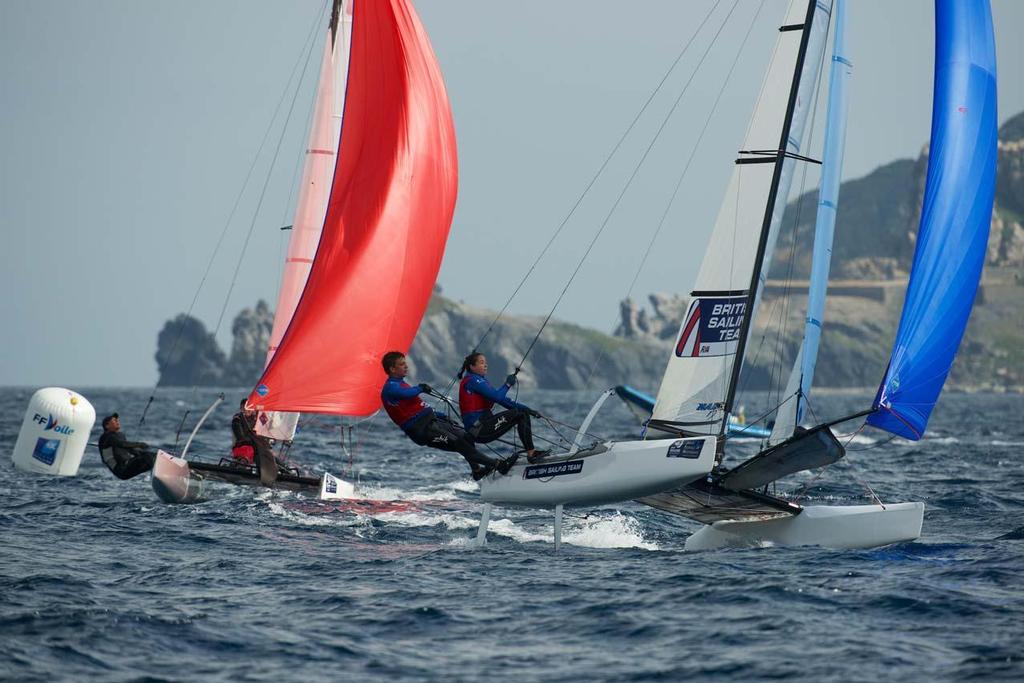
GBR60 Ben Saxton and Hannah Diamond, Nacra 17 - 2014 ISAF Sailing World Cup Hyeres Franck Socha / ISAF Sailing World Cup Hyeres
http://swc.ffvoile.fr/
GBR Team Manager Stephen Park has led Great Britain’s Sailing Team in the Olympic and Paralympic Classes – to unrivalled success on the world stage since 2001.
Great Britain is now the most successful Olympic classes sailing nation and sailing has been one of the nation’s consistently high performing sports at the past three Olympic Games.
Stephen, known as ‘Sparky’ amongst those in the sailing community has steered the team towards some outstanding performances from Team GB’s sailors at the Athens 2004 Games, where they won five medals, then Beijing Games where Britain’s sailors won six medals, including four Golds, and achieved their best Olympic medal haul in 100 years.
While Australia won three Gold Medals and One Silver media at London 2012, the overall British medal count was one Gold and four Silver.
Since then Britain has continued to lead the overall medal count at the European World Cup events and they remain the bench mark squad as sailors campaign towards Rio.
Sail-World talked to Sparky today and we will run this interview two parts…
As you’d expect Australia as the top performing sailing nation at London 2012was rewarded in funding term. Team GBR also received a funding increase?
Our funding agency UK Sport has got a funding model and we try pretty hard to get what we can out of them to give our sailors the best possible chance and so we have done reasonably well funding wise for this four year cycle.
People would say that there was a lift but it was less than the rate of inflation over the four year period so in terms of buying power a little bit less than the last four year cycle.
We have got quite a sizeable number of people about 100 sailors on the program in total. About 40 in our top group and then 60 on the potential group. When you divide the money you have got between that numbers of people obviously it doesn’t go quite as thickly as you might like.
I suppose that is part of the challenge that all the nations have got. To try and be as effective as you can with the resources that you have available.
One of the challenges that we have is that we have good depth in pretty much all of the fleets so you then get a situation where you are saying where do you want to draw the line. Top six in the world, top eight in the world, top ten in the world.
If we go the top ten in the world in most classes then we are talking about two or three boats.
Yes so you quite quickly knock up the athletes. 15 athletes in a full team so if you have two boats in each class that’s 30 sailors before you start. As you say we have got a couple of classes like the 49er, like the Finn where we have got more than two. Again it doesn’t take a genius to work out why you end up with 40 funded sailors at that top level.
Some of the programs are more expensive than others. The 49er is one of them but recently in this last 12 months the Nacra of course has got itself pretty well up there with the number of changes they have had on the kit and some of the equipment.
Those programs are expensive and that means you need to be careful on how you are going to spend the resource and which events you can afford to go to and where you can afford to train.
For GBR, Santander is a major cut off in terms of total squad being supported towards Rio?
Yes. In terms of games selection our sailors know what they have got to do but ultimately I suppose like all top nations we are just trying to get ourselves in a position where we can send the people that we think are going to be most capable of winning medals in Rio to Rio itself.
The world championships always remain our key result orientated event in terms of funding levels and that sort of thing. Santander event will be a big event and of course it is the country qualification so therefore although we would like to think that country qualification in any of the classes is not a drama for us you can’t take any of those things for granted so it is important for us to make sure we get country qualification sooner rather than later.
Again just as with all the top teams Santander will be a huge event. Probably be the biggest event of this four year cycle both in terms of numbers, in terms of countries determining which athletes they are then going to support for the two years running up to the games and it is no different for us.
The problem Team GBR had running into London was some late selections, not one sailor dominant and that meant that you had to keep delaying selection. Anything you can do about that?
You could select early I suppose. How early do you want to back your horse? When you have got one sailor who is dominant in a given class then clearly selection one would hope would be relatively simple. For a number of countries that’s a lot easier than it is in the UK.
From a Great Britain perspective we want to try and give the sailors the opportunity to prove that they are the best sailor and the sailor that should be selected to go to the games so if we don’t have somebody that is dominating then in the last cycle it has run on a bit.
Can you do something about it? Yes you could pick early and you could choose to support some more than others at an early stage and that would probably result in somebody getting a bit of a head start but again you are then getting into whether the system and the processes are altering the outcome rather than the sailing.
We are certainly pretty keen to do whatever we can to insure it is the sailor’s performances that determine what level of support they get and what position they are in in the run in to selection.
I suppose that as we look at the 2016 selection it will probably be fairly similar. We will have some classes where we will probably have some people who will stand out a little bit earlier and they may well end up being selected a little earlier and I suspect we will also have some classes where that will run on and of course I am always conscious that we have got some new classes this time with the FX and the Nacra.
As we have seen over the recent world cup events both the UK and the world people are learning pretty fast in those classes and things are changing still fairly fast. You would have to think carefully if you are going to have an early selection that you were confident that they were still going to be the best sailor 12 months down the line.
If you have only got one sailor then it is relatively easy to choose your horse. If you have got a number then maybe you need to give them the opportunity to prove who is the best.
My belief is that when you get to the top end of any of the Olympic fleets the equipment almost doesn’t matter. The top sailors will all be super competitive. They will all be highly skilled. It will be the decision making, the tactics and the strategy that they choose to deploy on a given day that will determine whether they will a medal or not.
Certainly we hold in huge respect all the sailors that are battling out at that top end and there are a lot of sailors from a lot of countries now who on their day could win a race, could win a regatta and it is certainly more competitive across all the Olympic classes now than it has ever been.
I suppose that means that it is less likely we are going to see people having the level of domination perhaps either in a class or across a number of classes on a country basis than perhaps we have seen in the past. There are still one or two people doing a good job of that.
The Australia 470 men have been doing a pretty good job of that until the last couple of regattas for sure. They won 18 regattas on the run. They are doing well but then equally they know they only need to make one or two mistakes and suddenly there are plenty of people queuing up to pounce. It is incredibly competitive which is a great thing about our sport. It is highly competitive across a number of nations and not all the Olympic sports can say that.
The Nacra 17 with a mixed crew is quite a breath of fresh air?
It has been an interesting journey so far for both the sailors and for the boats and the equipment.
This time last year we went to the Sailing World Cup in Palma and the top three boats where all helmed by women and then we came here to Hyeres three weeks later and the top three boats where all helmed by men.
Just seeing those different skill sets come together and indeed a lot of sailors from outside the multihull world who have perhaps been sailing in other Olympic classes coming together either single handed sailors stepping in or 470 or 49er sailors coming in and having a go in the Nacra has certainly made it very interesting.
It’s certainly exciting and it has got plenty of people interested. This year they have maxed out on the entry limits which is pretty good for a new class. They have clearly generated lots of interest from around the world which is great. The racing is good, its competitive, it’s exciting, its fast, it’s colourful. So far so good in that class.
One or two challenges from an equipment perspective which is often the case with new Olympic equipment. You see fairly regularly that new suppliers are underestimating the challenges that they face and the pressure that the boats are going to be put under and the difference between a weekend sailor and the amount of sailing that a normal weekend sailor would do in their boat compared to the sailing that an Olympic class sailor would do in their boat.
That’s presented a challenged and certainly they have got some challenge along that road in the Nacra 17 and I am sure we will see a few more changes there over the next couple of years before it is all done.
If you want to link to this article then please use this URL: www.sail-world.com/121421