Polar research- Six priorities for Antarctic science
by Mahlon C. Kennicutt II and colleagues on 17 Aug 2014
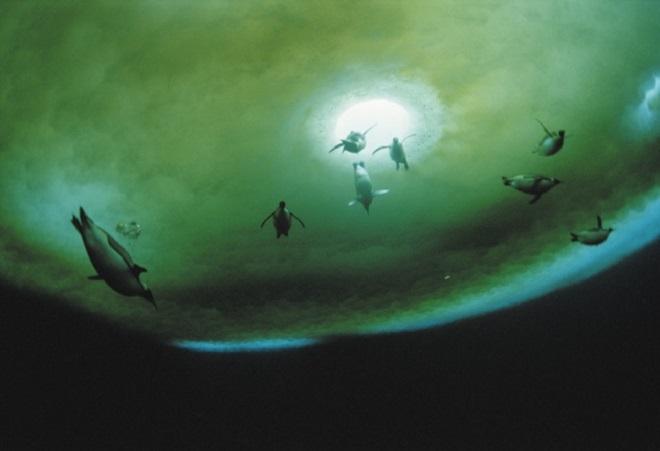
Emperor penguins dive under a breathing hole in the Antarctic sea ice, which provides a platform for marine life. Maria Stenzel/National Geographic Creative
Antarctica, the word conjures up images of mountains draped with glaciers, ferocious seas dotted with icebergs and iconic species found nowhere else. The continent includes about one-tenth of the planet's land surface, nearly 90% of Earth's ice and about 70% of its fresh water. Its encircling ocean supports Patagonian toothfish and krill fisheries, and is crucial for regulating climate and the uptake of carbon dioxide by sea water.
Antarctic scientists are unlocking the secrets of Earth's climate, revealing lakes and mountains beneath the ice, exploring the deep sea and contemplating the origins of life and the Universe. Once seen as a desolate place frozen in time, Antarctica is now known to be experiencing relentless change. Local transformations such as the loss of ice, changes in ocean circulation and recovery of atmospheric ozone have global consequences — for climate, sea level, biodiversity and society.
In April 2014, the Scientific Committee on Antarctic Research (SCAR) convened 75 scientists and policy-makers from 22 countries to agree on the priorities for Antarctic research for the next two decades and beyond. This is the first time that the international Antarctic community has formulated a collective vision, through discussions, debate and voting. The SCAR Antarctic and Southern Ocean Science Horizon Scan narrowed a list of hundreds of scientific questions to the 80 most pressing ones (see Supplementary Information). A full report will be published in August.
Here we summarize the overarching scientific themes, and outline steps that researchers and governments must take to make this vision a reality. Securing funding, as well as access to and protection for the region, will make greater international collaboration a necessity.
Six scientific priorities
The questions identified fall broadly into six themes. To realize the full potential of Antarctic science we need to do the following.
Define the global reach of the Antarctic atmosphere and Southern Ocean. Changes in Antarctica's atmosphere alter the planet's energy budgets, temperature gradients, and air chemistry and circulation. Too little is known about the underlying processes. How do interactions between the atmosphere, ocean and ice control the rate of climate change? How does climate change at the pole influence tropical oceans and monsoons? How will the recovering ozone hole and rising greenhouse-gas concentrations affect regional and global atmospheric circulation and climate?
The Southern Ocean has important roles in the Earth system. It connects the world's oceans to form a global system of currents that transfers heat and CO2 from the atmosphere to the deep ocean. Nutrients carried north support the base of the ocean's food web. The ocean is becoming more acidic as CO2 dissolves in sea water, and cold southern waters will be the first to exhibit impacts. How will climate change alter the ocean's ability to absorb heat and CO2 and to support ocean productivity? Will changes in the Southern Ocean result in feedbacks that accelerate or slow the pace of climate change? Why have the deepest waters of the Southern Ocean become warmer and fresher in the past four decades?
Sea ice reflects and filters sunlight. It modulates how heat, momentum and gases exchange between the ocean and atmosphere. Sea-ice formation and melt dictate the salt content of surface waters, affecting their density and freezing point. What factors control Antarctic sea-ice seasonality, distribution and volume? We need to know.
Understand how, where and why ice sheets lose mass. The Antarctic ice sheet contains about 26.5 million cubic kilometres of ice, enough to raise global sea levels by 60 metres if it returned to the ocean.
Having been stable for several thousand years, the Antarctic ice sheet is now losing ice at an accelerating pace. What controls this rate and the effect on sea level? Are there thresholds in atmospheric CO2 concentrations beyond which ice sheets collapse and the seas rise dramatically? How do effects at the base of the ice sheet influence its flow, form and response to warming? Water bodies beneath the thick ice sheet have barely been sampled, and their effect on ice flow is unknown.
Reveal Antarctica's history. Glimpses of the past from rock records collected around the continent's margins suggest that Antarctica might look markedly different in a warmer world. But rocks from the heart of the continent and the surrounding oceans have been only sparsely probed. Responses of the crust to, and the effects of volcanism and heat from Earth's interior on, overlying ice are largely undescribed.
We know little about the structure of the Antarctic crust and mantle and how it influenced the creation and break-up of super-continents. Ancient landscapes beneath ice reveal the history of interactions between ice and the solid Earth. Geological signatures of past relative sea level will show when and where planetary ice has been gained or lost. We need more ice, rock and sediment records to know whether past climate states are fated to be repeated.
Learn how Antarctic life evolved and survived. Antarctic ecosystems were long thought of as young, simple, species-poor and isolated. In the past decade a different picture has emerged. Some taxa, such as marine worms (polychaetes) and crustaceans (isopods and amphipods) are highly diverse, and connections between species on the continent, neighbouring islands and the deep sea are greater than thought. Molecular studies reveal that nematodes, mites, midges and freshwater crustaceans survived past glaciations.
To forecast responses to environmental change we need to learn how past events have driven diversifications and extinctions. What are the genomic, molecular and cellular bases of adaptation? How do rates of evolution in the Antarctic compare with elsewhere? Are there irreversible environmental thresholds? And which species respond first?
Observe space and the Universe. The dry, cold and stable Antarctic atmosphere creates some of the best conditions on Earth for observing space. Lakes beneath Antarctic glaciers mimic conditions on Jupiter and Saturn's icy moons, and meteorites collected on the continent reveal how the Solar System formed and inform astrobiology.
We have limited understanding of high-energy particles from solar flares that are funnelled to the poles along the Earth's magnetic field lines. What is the risk of solar events disrupting global communications and power systems? Can we prepare for them and are they predictable?
Recognize and mitigate human influences. Forecasts of human activities and their impacts on the region are required for effective Antarctic governance and regulation. Natural and human impacts must be disentangled. How effective are current regulations in controlling access? How do global policies affect people's motivations to visit the region? How will humans and pathogens affect and adapt to Antarctic environments? What is the current and potential value of Antarctic ecosystem services and how can they be preserved?
Challenging environment
Answering these many questions will require sustained and stable funding; access to all of Antarctica throughout the year; application of emerging technologies; strengthened protection of the region; growth in international cooperation; and improved communication among all interested parties.
Antarctic programmes are sensitive to budget uncertainties and disruptions. In the past year, US projects were deferred, delayed or reduced in scale because of the US government shutdown in October 2013. Other national programmes suffered budget cuts stemming from the economic slowdown. High fuel prices and diversions for a major search and rescue mission hindered some. Decades-long projects are difficult to sustain given short grant cycles.
Postponed projects and lost field seasons leave gaps — a missing year of data for an ice-sheet study or biodiversity monitoring is irreplaceable. Faced with such uncertainties and hurdles, and with laboratories and students to support, some Antarctic researchers choose to leave the field. This also jeopardizes the recruitment and retention of the next generation of researchers.
Access to locations needed for science is limiting. Much of the continent and the Southern Ocean remain unexplored, and most scientists visit for only few months each year. Researchers will need to develop autonomous vehicles and observatories that can reach remote locations such as beneath ice shelves, the deep sea and under ice sheets. Miniaturized sensors deployable on floats, animals and ice tethers must be able to acquire or transmit data for months or years.
A wider range of satellite-borne sensors is needed to continuously observe the entire region. Expanded aircraft-based geophysical surveys are needed to access the continental interior and ice margins. Advanced biogeochemical and biological sensors will be crucial for establishing regional patterns. Databases and repositories that can handle vast quantities of genomic and biodiversity information will be essential.
Future data sets will require high-speed and high-volume communications over great distances. Reliable sources of energy to power remote observatories and better ways to store and uplink data will be needed. Improved computer models are essential for portraying the highly interconnected Antarctic and Earth system if we are to improve forecasts.
Antarctica's environmental-protection measures must be strengthened. More scientists will need to visit, and tourist numbers have almost tripled in the past decade to more than 34,000 a year plus support personnel. This growth increases the risk of introducing non-indigenous species and the likelihood of fuel spills that we are ill-equipped to respond to effectively.
The Antarctic Treaty System, which is responsible for governance of the region, is being tested by mounting environmental pressures and economic interests. The establishment of marine protected areas, international regulation of tourism, assessing financial penalties for environmental damage and regulating bioprospecting have proved difficult to resolve. An integrated strategy for Antarctic environmental management is essential.
Antarctica is seen as a place to assert national interests. In the past decade, countries including Belgium, China, the Czech Republic, India and South Korea have established new stations; Germany, the United Kingdom, the United States and others have replaced ageing ones; and Japan, South Korea and South Africa have built or replaced ice-capable ships.
Yet scientists from many other nations lack access to Antarctica. Twenty-nine countries participate in decision-making and another twenty-one have agreed to abide by the Antarctic Treaty. Although this represents about two-thirds of the world population, it comprises less than one-sixth of the 193 member states of the United Nations — countries in Africa and the Middle East are notably under-represented.
Work together
Maximizing scientific return while minimizing the human footprint should be the goal. Coordinated international efforts that engage diverse stakeholders will be crucial.
It is time for nations involved in southern polar research to embrace a renewed spirit of cooperation as espoused by the founders of the Antarctic Treaty — in actions not just words. Wider international partnerships, more coordination of science and infrastructure funding and expanded knowledge-sharing are essential.
As an interdisciplinary scientific body, but not a funder of research, SCAR should assist with and encourage coordination and planning of joint projects, sharing of data and dissemination of knowledge to policy-makers and the public. SCAR should repeat the Horizon Scan exercise every four to six years and provide the outcomes to emerging integrated science, conservation and policy efforts (see www.environments.aq).
We urge the Antarctic Treaty and its Committee for Environmental Protection to expand use of scientific evidence in its decision-making and to apply state-of-the-art conservation measures judged on measurable outcomes.
Communicating the global importance of Antarctica to the public is a priority. Narratives must better explain how the region affects and is influenced by our daily lives. Antarctic success stories, such as signs of ozone recovery, engender confidence in the power of changes in behaviour.
Antarctic science is globally important. The southern polar community must act together if it is to address some of the most pressing issues facing For more information
If you want to link to this article then please use this URL: www.sail-world.com/125684