Fitting out a new cruising boat - Part Two, power generation
by Peter Salisbury/Sail-World Cruising on 30 Mar 2009
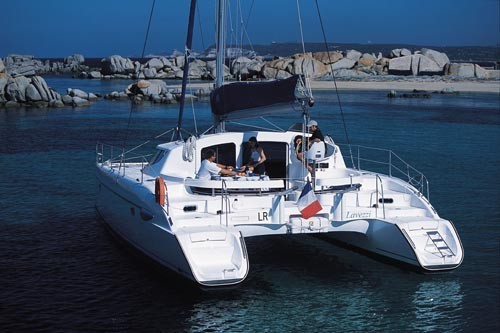
Lavezzi - the question of power generation Multihull Solutions
http://www.multihullsolutions.com.au/
So, after much research, many discussions and a reasonable amount of anguish, you have bought the new cruising boat, and now you have to fit it out.
Peter Salisbury here gives the new owner a starting check list of how to decide what to do next, and this week he considers the question of power generation on the yacht, in all its forms.
This is Part Two of the series. For Part 1, click here
Power generation
What you get
The new boat will be most often equipped with a 12 volt (occasionally 24 volt) electrical system. This will consist of two battery banks, one for motor starting and the other to supply all the other electrical equipment. Both batteries will be charged by alternators mounted on the engines. The boat may also be fitted with a shore power connection for use with mains power in the marina.
How much power do you need?
The power requirements of cruising boats vary widely. A boat connected to shore power all week and used for overnight trips on the weekend will probably be fine with the standard equipment. Boats that spend long periods away from shore need a well designed power management system.
The starting point in determining power requirements is to think about how the boat will be used.
Some possible scenarios to consider are:
• Anchoring out overnight with several guest on board
• Sailing day and night on long ocean passages
• Living aboard and anchoring out every night for weeks on end
• Running the engines for several hours each day while moving from place to place
You need to carefully consider what equipment you are likely to use in each situation and how long you are likely to use it.
Some items that use a lot of power are:
Fridge or freezer – perhaps 50 AmpHours (AH) per 24 hours
Standard anchor light – 20 AH per night (unless you use a LED light)
Household microwave 10 minutes – 20 AH
(An AmpHour is a current of 1 Amp supplied for one hour.)
Air conditioning for a few hours each day - at least 100 AH and very likely much more.
The design of your system involves deciding what types of equipment you intend to use and estimating haw long they are likely to be used for on average each day. The consumption figures of all equipment are then added up to determine your likely total power usage.
As an example a conservatively run 12 metre live aboard cruising boat might use 100 – 120 AH per day. Add a watermaker and a few other bits and pieces and this could easily reach 200 – 250 AH per day. Adding a washing machine, extra refrigeration or even air conditioning will push the power requirement
up even further.
For owners not conversant with electricity it is well worthwhile to think about planned usage and then work through the power requirement calculations with an experienced person.
Keeping track of usage
In any situation that involves the boat being away from shore power for more than a few days at a time it is important to install a good quality battery monitor (that measures the total AH into and out of the batteries) so that the skipper can readily check the state of charge of the battery. A car’s fuel gauge is a good analogy.
Where will you get the power from?
In practice the power requirements will come from a range of sources. All have benefits and disadvantages and none should be relied upon in isolation.
Shore power
Shore power is the most reliable and largest capacity source, but you cannot be away from it for more than a few days. It is ideal for a boat that spends its week days at the marina or on a private pontoon and then cruises for one or two days each weekend.
When the boat is used this way it only needs a moderately sized battery charger. It must, however be a three stage charger to avoid over charging the battery. An automotive charger is never sufficient. The charger should have a minimum amp rating about one twentieth the amp hour capacity of the battery. Ie a 400 AH battery should have a minimum of a 20 Amp charger.
Main motors
The main motors are fitted as standard with reasonably sized alternators that will supply your power needs while they are running.
There are a couple of problems with the standard alternators. The first arises because the voltage regulators fitted are not particularly sophisticated and will not charge at maximum rate for very long. For example a 70 Amp alternator might only deliver a maximum of 50 Amps for ten minutes or so and then gradually decline to 15 Amps even though the batteries are nowhere near charged. This means the motors end up running for a long time at low load, and consequently:
• A diesel’s life expectancy is compromised if it is run for long hours at low load
• Engine hours will build quickly
• There will be excessive fuel usage
• They are noisy while running, particularly in an anchorage
The second problem arises if you do not run the motors for long enough each day to completely recharge the batteries. In this instance the batteries will gradually decline over many days or weeks, to the point where they are permanently damaged.
Because of these limitations, if the main motors are to be used as the primary power generation source they should be fitted with larger alternators and a three stage regulator specifically designed for battery charging. This is relatively expensive and does not solve all of the problems.
Solar
Solar panels are reasonably expensive to install, but they cost nothing to run, are silent and will last for a long time – in excess of 20 years. The amount of power they produce depends on:
• The area of panel installed
• The amount of time the panel is exposed to the sun with no shade on any part of it. (A shadow from the boom (or even a rope) can reduce the output by 90%
• The number of hours of full sunlight per day
• The latitude and orientation of the panels
Very roughly. 100W of solar panel might produce 40 – 50 AH on a clear spring day in any really sunny climate - probably a little over half that on average.
A conservatively run cruising boat can get nearly all of its power requirements from 200 – 300 watts of solar in good weather. It is quite feasible to set up a boat to leave on a mooring with a smaller solar array to keep the basic systems in operation and the battery fully charged.
The main disadvantage with solar for a live aboard boat is that a backup power source is required to cover the inevitable cloudy week.
Wind
Wind generators can contribute a useful amount of power in windy weather. The amount of power is basically related to the blade diameter, but most generators need 5 – 7 knots of wind before they produce any power. Given that most cruisers select anchorages protected from the wind, they are unlikely to produce anything like their rated output for most of the time.
There are two other problems with wind generators. In strong wind they spin to a high speed before they cut out and so some are quite noisy, even in a marina if the owner does not turn them off. This means asking around and choosing a wind generator that is reputedly not excessively noisy. If you have already obtained one that is extremely noisy, some relief without much loss of power has been obtained by cruisers who 'trim' the blades. Do not underestimate this issue.
Secondly they have to be rigidly mounted in a position where the blades cannot possibly strike anything, particularly crew members in any wind direction. They are probably at their best on a sailing boat on extended ocean passages.
Trailing generator
This simple and inexpensive mechanism provides excellent power fo
If you want to link to this article then please use this URL: www.sail-world.com/55274