Fast foils-a conversation with Paul Bieker, part two
by David Schmidt, Sail-World USA Editor on 8 Mar 2014
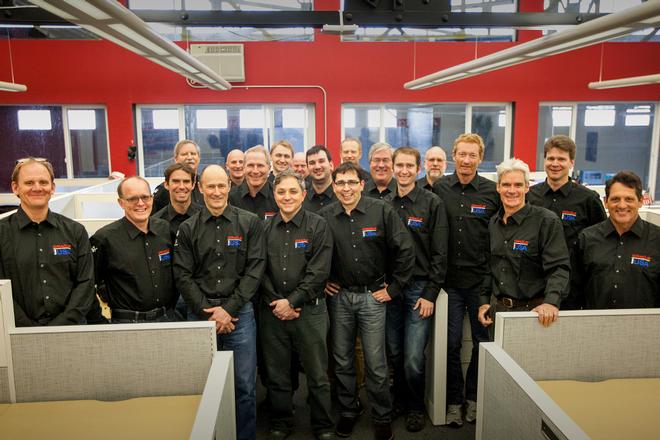
Oracle Design Team - America’s Cup 35. Paul Bieker is standing in the front row, second from the left Amory Ross
http://www.amoryross.com
Few people in the sailing world are sharper than Paul Bieker, a soft-spoken Seattle-based naval architect who has spent his career designing a wide variety of sailing vessels, from super-quick I-14s and his one-off line of 'Riptide' racer/cruisers, to America’s Cup yachts. Bieker is one of the core designers credited with 'super-charging' Oracle Team USA’s 'USA 17' last September, changes that helped the American-flagged team to successfully pull-off one of sports history’s greatest comebacks to defend the 34th America’s Cup. Yet pull up a seat on the rail next to Bieker-as I’ve been fortunate enough to do on many occasions aboard our mutual friend’s Riptide 44-and it quickly becomes obvious that Bieker’s horizons extends far beyond racecourse designs.
Take, for example, the day that he brought our crew lunch. Each sandwich was individually wrapped in brown recycled paper and was hand-tied with a bit of hemp twine in an effort to reduce landfill fodder.
Or then there’s Bieker’s insistence that his Riptide designs offer their owners a huge amount of value and utility, irrespective of whether the agenda involves racing, savoring 25-knot kite rides or extended cruising. Bieker is widely regarded as one of the world’s foremost foil-design experts, and while he wisely tries to dodge the limelight, Oracle Team USA has again tapped Bieker for AC35, this time in the role of lead designer.
I recently caught up with Bieker at a local Ballard (our mutual Seattle neighborhood) pub for part two of this two-part interview to get his thoughts on how AC34 was won, his design role for AC35, as well as his thoughts on the future of America’s Cup Racing.
The wind limits where certainly a big factor in AC34.
Yes. By the end of AC34 it was pretty clear that we could have sailed in a lot more breeze, and so the wind limits will go back up in AC35.
When Artemis flipped over, everybody looked at the reality of their sailing and how the boats felt, and how they could control them. We came up with the wind limits probably four or five months before the Cup. By then we had the boat pretty dialed, it was scary but it was pretty controllable. If you look at that boat going around the course in the last race, it was beautiful.
Did you take a deep breath during that last windward bear-away maneuver? They flew that hull a little high.
Usually, the highest load the foil ever takes is the high fly on a bear-away. The only other time when we saw higher loads than that was on a reach when the boat launches out and does a side-slip before going back in the water. When the boat comes back into the water, you can see the strains in the boards spike up as the flow hooks back up-around 1.5x the maximum steady state loads. You can learn pretty quickly when you have the ability to tunnel in to every bit of the sailing data and look at little moments in detail.
You mentioned that you’ve been down in Los Angeles with Morelli and Melvin, talking to those guys about the AC35 design rule. Does Team Australia also have a designer that’s your counterpart or is it just a meeting with you and those guys?
Basically at this stage Morelli and Melvin talk through the issues with the Defender. The Defender drives the process, but the Challenger of Record basically has right of refusal, so you keep them in the loop and try to come up with something that works reasonably well for them.
There has been a lot of buzz of AC35 with smaller catamarans and maybe a semi One Design element to it. Do you think that these One Design elements will actually reduce cost or will teams just find the loop hole and spend it on that?
There has been a ton of discussion about that and I think basically where it’s going to go is that the new design rule will constrain the parts of the boats that aren’t as likely to produce big performance gains so that we don't spend too much design time on them.
The hull platform for instance?
That one has gone. You get liability problems when you spell out the design and engineering of major structural components. I think they will constrain the boat in the places that they think a team could spend money unproductively. I think that they will constrain the rule such that certain parts of the boat might as well be One Design, but not make them One Design per se, so that you could have multiple builders. If you could have competition amongst builders, you’ll probably get better value.
You just used the word ‘value’ in relation to the America’s Cup…
They are technological boats. You will always be able to spend a shit load of money on them.
In the last Little America’s Cup, 'Groupama' used a boat that was built using Southern Spars’ Thin Ply Technology 'printed' hulls. Could we see a scaled-up version of this technology in AC35?
That stuff is kind of a nightmare to work with but there are some things it is great for. I was exposed that technology in 'Artemis' when I was there. It’s super expensive and it’s hard to handle.
Do you reckon foil design will be less important or more important in the next America’s Cup?
I think it will be as important or more so. It was pretty important in the last Cup. It will be as or more important in this next Cup.
If you had to guess, do you think they will take away the ‘no-moveable-flaps-on-the-rudders rule’ and eliminate the articulating daggerboard cassettes that we saw on the AC72s?
I don’t know how it will go. I think the rudders will be left pretty open. The best way to figure out how to control hull trim is is to let the best designers in the world work away at it and then it will be obvious three years from now… How the rudders adjust lift, I think, that will be left open.
As a designer, how to you feel about a semi One Design AC35?
At first I appreciated the idea of a partial One Design concept. If we really wanted to minimize cost and maximize innovation, you would make the wing, the hulls and the platform One Design, and you would open up the appendage design and let everyone spend their efforts on that and we would really learn something but that’s not really the America’s Cup. We’re not there yet anyway… The economy isn’t that dire!
Any insight into the relationship between Oracle Team USA and Team Australia? And, from your perspective, are things progressing smoothly between the Challenger of Record and the Defender?
It seems like a natural relationship to me. I see a separation-I don’t feel like we’re in the same bed. I don’t think they’re just a rubber stamp for what Oracle wants to do or a handbrake. I think they have a distinct vision of where the Cup should go, and Oracle does as well, and they aren’t the same so they have to sort through it. That seems pretty healthy to me.
Do you feel like there was a danger that AC34 was over-hyperbolized? All the talk about the world’s fastest boats and the best technology-how do you follow up on something like that?’
I think it’s pretty obvious that if anything, the yacht designers overshot the mark. Like they aimed too high with the boats. They were huge challenges. The fact that we got two boats that could go out there…we raced 20 races in San Francisco Bay during the America’s Cup without a major mishap…without a gear failure. Sometimes going over 30 knots upwind, match racing, having passing happening multiple times on a race, you’re sort of in awe that it worked out like that because you would have thought that aiming that high, something is going to go wrong.
So I think the thing that what we achieved in AC34 was understanding the boat and figuring out how to manually fly a winged catamaran downwind and upwind. Hopefully we can build on the foiling upwind in AC35, but really more than anything else create an environment where other challengers can get into the game at a semi-reasonable amount of money…something that isn’t horrendous. You’re never going to get that many groups of people that could mount an America’s Cup challenge like AC34 so the next Cup is going to be about trying to make it more accessible. And it is not like we’re killing the evolution-there’s still a ton to learn! I came out of the last Cup feeling like we were just scratching the surface.
As a designer, do you feel that there’s some pressure to create yachts for AC35 that are as fast, or faster, than the AC72s, even though the new boats will likely be smaller LOA?
Not really. One of the issues is that speed wise, we were right up against the limit with the AC72s downwind. Their foils were cavitating a lot of the time, so they were totally on the ragged edge and that’s just the physical limit. There are little things you can do about cavitation, but it is kind of a physical limit.
Does that mean then that 45-50 knots is kind of the fastest speed a hydrofoil-borne sailboat can go?
Yes, until you go to the super cavitating foil shapes, but then the super cavitating foils do really poorly at lower speeds.
As a longtime designer, what presents a more interesting problem to you-monohulls, foil borne multihulls, or cruising yachts?
All boats are interesting, and in all boats you end up with tradeoffs. But for sure, right now the foilers are the most challenging because you are touching into new speed ranges.
You have obviously made a really strong name for yourself designing everything from International 14s to your Riptides to AC72s. What element of the design game holds the most appeal to you intellectually and fun-wise?
That’s a pretty good question. I’m a little bit ADHD and my head is all over the place a lot of times, so I find that part of my day I’m thinking about foiling powerboats, and another part of my day I’m thinking about high-performance cruising catamarans and sport boats. Another project that I’m working on right now is a kite boat, a foiling 45-foot kite boat.
So is this one of those things that will fly a big kite a few hundred feet in the air?
It’s for this guy Don Montague who is one of the key guys that invented kiteboarding. There’s just a ton of interesting stuff going on. What’s exciting is when you see the relationships between the projects. The best thing about working on a variety of boats is that you make connections. I think that the best way to become a good designer is to work on a real variety of boats. This allows you to understand why they are different-it gives you a deeper understanding of boats in general.
You say there are a lot of interesting projects right now—is this the result of being a winning designer in the AC34?
I don’t know. I think that I showed some instinct around the base and I think that would have made some impression, so I’m probably doing this 52-foot cat because of the America’s Cup. I also would love to do more [monohulls], like the Riptide 41, 'Blue'.
'Blue' is a truly awesome boat...
Yes. So hopefully we will do more of those. There have been surprisingly few calls on those boats but I think that people don't fully understand them yet.
Are you getting a lot of calls from multi-hull guys to design custom foiling packages?
I haven’t yet, although right now I’m working on some Moth foils. I think there is going to be a lot of interesting stuff in the foiling boats.
As a longtime and accomplished sailor, what aspects of sailing personally turn on your lights?
Probably my favorite is sailing International-14s off of Shileshole Bay Marine [in Ballard/Seattle] on Thursday nights. Just out there during the middle of the week, with seven or eight boats, and the Olympic Mountains [in full view to the West], with 12 – 15 knots of breeze. Sailing with a small enough group of people so that it’s not big-fleet intense, but still enough that you get good competition-but really deep down you’re just [sailing] to blow the cobwebs out and to just go ripping around-for sure that’s been the best sailing of my life.
Anything you want to add?
When I first got out of school, I worked with guys [here in Seattle] that had been part of the design for the Boeing military hydrofoil boats and they had learned a lot about hydrofoiling. Those hydrofoil projects were a long time ago…the 1960s or maybe the early ‘70s-but I remember guys telling me about having control problems and vibration above 40 knots and how they learned to use super-cavitating foils. I never dreamed that 25 years later I would be in the same territory on a sailboat!
It’s a little bit of an aside but I think there’s definitely potential for hydrofoiling powerboats that would be somewhere in the order of magnitude more efficient than a lot of the runabouts and high-speed power cruisers that are out there right now. One of my hopes is that this stuff with the hydrofoiling sailboats is going to trickle back down to the powerboats. When those old hydrofoil powerboats were designed gas was cheap. So back then the performance challenge just drove you towards just putting a bigger engine and bigger fuel tanks.
So you would be interested in the challenge of trying to find a more efficient way of moving powerboats?
Yes, I think there’s a whole world to that part. I’m not sure when it will come, but it will.
Many thanks to Paul Bieker for his help with this interview.
If you want to link to this article then please use this URL: www.sail-world.com/119902