America's Cup Preview - The Points of Difference
by Richard Gladwell, Sail-World.com/NZ on 16 Jun 2017
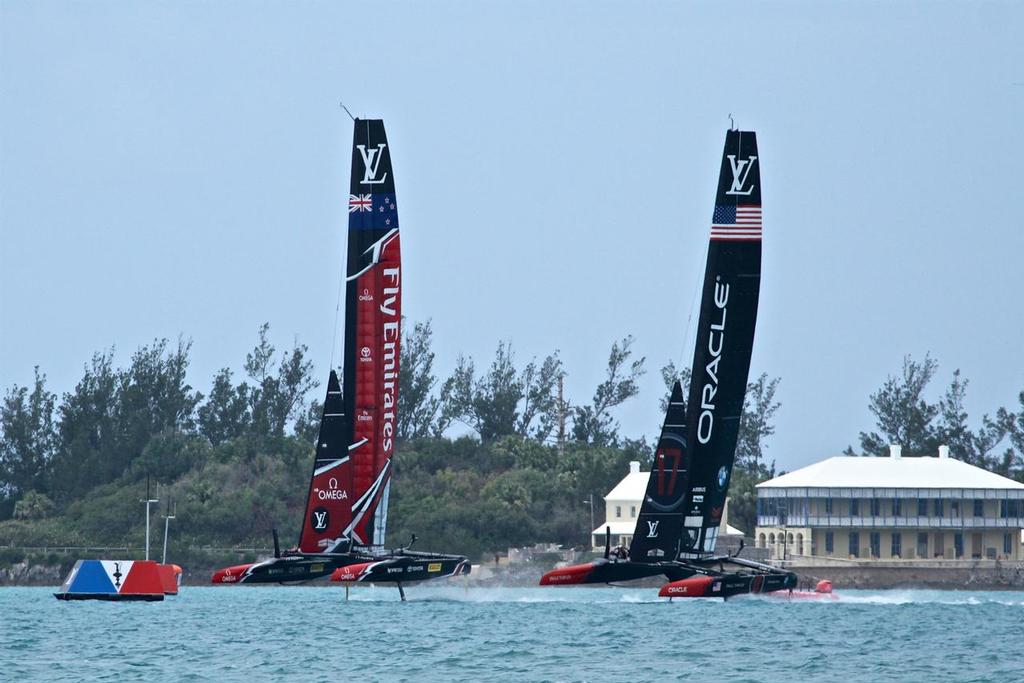
Start - Oracle Team USA and Emirates Team NZ - Round Robin 2, Day 8 - 35th America's Cup - Bermuda June 3, 2017 Richard Gladwell
www.photosport.co.nz
After 17 days of very intense competition, Emirates Team New Zealand won the right to Challenge for the America's Cup for the 35th Match.
It is a position New Zealand has been in only three times in its 30-year history.
In 1987 and 1992, Team New Zealand made the Challenger Finals, and it took three attempts to win the right to Challenge (1988 Supreme Court decisions aside).
Since losing the America's Cup in 2003, Emirates Team New Zealand has been the Challenger in the America's Cup Match in 2007, 2013 and now 2017.
That is a very remarkable achievement but is the standard by which the New Zealand public and media measure their America's Cup team.
This is a very unique America's Cup.
It is stadium racing - and many are struggling to accept that a race in an America's Cup Match could be just 17 or 18 minutes long.
And even more difficult to understand that Emirates Team New Zealand will start the America's Cup competition having to win eight races to the Defender's seven.
That is a quirk of the system where the Defender if they won the Qualifiers, took a point into the America's Cup Match.
For a Challenger to get the same point, they had to win the Qualifiers AND the Challenger Final.
Officially Emirates Team New Zealand will start the Match on negative points.
Oracle Team USA skipper, Jimmy Spithill, claimed at the end of Qualifiers media conference that having the Defender in the Challenger Selection Series added something to the contest and put a harder edge on it.
While few would have disagreed with him at the time, in hindsight the Defender added very little.
They were beaten twice by Artemis Racing, who in turn were beaten five times by Emirates Team New Zealand in the Challenger Final, and the Defender beat the eventual Challenger in both their Matches.
What does that tell us? Very little.
The competition level in the Semi-Finals and Finals was very intense, and the Round Robin phase looked tame in comparison.
For Emirates Team New Zealand the Semi-Finals and Finals, in particular, put a real edge on their racing technique and strategy.
The team now looks race sharp which has only just been the case. In the previous series, ETNZ looked like they were still feeling their way rather than using their boat speed as a weapon.
From what could be seen on the water (and you don't get to see on television) the team now seems to have settled on a Plan A and Plan B as their racing strategy.
Plan A is to win the start, or rather be ahead at Mark 1, and certainly at Mark 2 at the bottom of the course.
In this scenario, they can expect to build their lead and can keep a tight or loose cover on their opposition depending on the situation.
Plan B kicks in if they are behind at the start or get penalised. The damage control strategy seems to be to stay in contact by Mark 2 and then attack on the beat.
Their opposition has one of two options, They can either put a tight classic match racing cover and risk Emirates Team New Zealand initiating a tacking duel - which the Kiwis will always win because with their cycle power they are generating more hydraulic pressure than the arm-grinder systems.
The cyclors can just wear their opposition down.
Even if their opponent does stay in front at the end of the first beat, they are in for more of the same in the second beat - except this time their grinders will be tired.
In short, it is like racing a bike against a motorcycle - the outcome is always the same - just a matter of when.
The only way for a competitor to win is to nail the start - preferably by forcing a penalty or premature start on ETNZ. Then put on a very sharp cover to keep the Kiwis pinned down in dirty air, or wing-wash, upwind and then stay in front downwind.
The passing lanes are very limited on the short courses with legs usually around 1.2nm long. There is no opportunity for a long beat to windward, which in the days of yore developed into a speed test as one boat ground away at another until one had ascendancy.
Emirates Team New Zealand are beatable, but it does require pin-point accuracy with tactics and boat positioning. Of the other five teams Oracle Team USA are the best placed in this regard, having good consistent boat speed, and an afterguard who is very sharp tactically.
Emirates Team New Zealand doesn't seem to have any real advantage downwind - so their competition just has to work out a short-term strategy to get through the beats.
And of course, upwind and down there are big gains to be made in picking wind-shifts and wind-pressure.
Another point of difference is that Oracle Team USA skipper is one of the old school of the America's Cup. Neither of the two Challenger Finalists competed in the IACC class used from 1992 to 2007.
The two eliminated two semi-finalists Ben Ainslie, and Dean Barker both came to the AC50's from monohulls, as does Spithill.
For sure Spithill and Barker have a long experience in America's Cup multihulls but didn't grow up on apparent wind sailing to the extent of Outteridge and Burling.
Emirates Team New Zealand is a very young crew with only one America's Cup under their belts. They mostly come from an Olympic background and bring this discipline and attitude towards their America's Cup sailing. So there isn't the usual mix of chemistry and backgrounds. The Kiwis are there for their country. They seem to be very tight and focussed.
Offset that against the Defender's much more experienced Cup team, with their afterguard having all been part of the afterguard in 2013 win.
They are all Australians, as are several of the top echelon in the Oracle Team USA team - so there is some commonality of background and thinking. Plus they are used to working together in a tight spot and are comfortable with having to make a Comeback - as they have done it before.
The America's Cup will be a contest of youth and flair versus experience.
Helmsman Peter Burling has grown in stature and confidence over this series.
At the opening media conference, he looked a little in awe of his surroundings, but as racing has progressed has realised that his competitors pull their pants on one leg at a time, same as he does.
His sailing style looks infuriatingly relaxed, and there is not a lot said on the boat.
Not that there has to be - his 49er crew, Blair Tuke has sailed with Burling since 2008 to win four world championships and two Olympic medals. All three sailed in the A-class Worlds in New Zealand - taking the top three slots and with Tuke beating his 49er skipper. Burling won the foiling Moth Worlds sailed in Australia in 2015.
Tuke sailed in the same regatta, finishing sixth overall even though he had never raced a foiling moth before and had three months. Oracle's Slingsby and Kyle Lanford also competed.
At both regattas, other members of Emirates Team NZ competed. In itself that doesn't mean much but it is significant in terms of shared experience and working together.
In their first encounter, Emirates New Zealand came close to beating Oracle Team USA. In the second the Kiwis gave it away with a string of unforced errors including sailing outside the boundary. If the New Zealanders eliminated those errors from their second encounter with Spithill and friends, then the OTUSA vs. ETNZ win equation might be a little different.
Light winds are expected for the first two days of the regatta, Saturday and Sunday. Then there are five days off with the March resuming on Saturday, June 24, until it ends.
Emirates Team New Zealand only raced on one day when there were winds close to the bottom end of the limit (6kts) allowed for racing. They left Artemis for dead winning by just under a minute.
Oracle Team USA's Jimmy Spithill claimed that a team of boatbuilders had flown up from Auckland and would be working 24x7 on Oracle's AC50. The Defender has been out sailing most days initially against Softbank Team Japan, and since June 12, alone.
It was claimed that there was a lot of development work to be done on the Oracle Team USA AC50. Maybe that has happened.
Even though Spithill claims their hybrid grinding system is a step forward - and looks to be - sailing downwind. Where the other teams have come apart in the Semi's and Finals against Emirates Team NZ is upwind. And by then tactician Tom Slingsby is usually back in his forward grinding position and not contributing the extra pedal power.
The other downside of the Oracle BMX system is that it puts Slingsby up higher in the boat with a resultant increase in drag.
Emirates Team NZ's cyclors are packed well down and present a lower profile and produce less parasitic drag than the arm-grinders or the Oracle hybrid system.
The most likely area of development has been for Oracle Team USA to come up with a system to develop more energy or be more efficient with the hydraulic pressure they do have.
However, at this stage of the game, it is small changes adding up to a more substantial overall gain, rather than a single development proving to a game breaker.
One thing that has come very clear since the start of the regatta has been that reliability will play a big part.
With two races per day, a break down in the first often costs the second - as Land Rover BAR found when they broke a cross arm in their wingsail.
Now the shore crews are almost more crucial than the sailors - without a boat, you can't win races. And the shore crews are called upon almost daily to deal with some issue which has to be running for racing next day, on what has been a very tight schedule.
The stage is set for a very interesting America's Cup Match.
If you want to link to this article then please use this URL: www.sail-world.com/154668