Debbie says the 8thP with Insurance is Patience (Pt.II)
by John Curnow on 25 Apr 2017
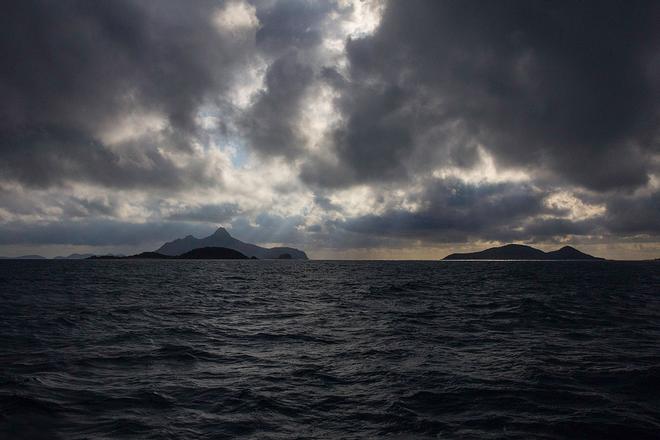
Dramatic - Shaw Island on the right, with Lindeman Island and then Maher Island behind. John Curnow
We’re back to keep exploring the nature of TC Debbie and how she came to tell us about the eighth P of insurance. We looked at what it was like to come into a disaster zone and now we see the evidence of those that did the right thing, and how the area is already on the road to recovery. You can go back and read Part One at any stage. The original thread in 7Ps is also available for you to read.
It’s called seamanship, even when you’re not out to sea
Jaime MacPhail from Pantaenius Sail and Motor Yacht Insurance, talking about the Formosa that ended up on at Shingley Beach added, “It broke its lines under the additional load of the headsails filling up in 120 knots of breeze, and so she ended up on the beach. Here’s another situation that clearly identifies, amongst all the other video/social media evidence that we’ve seen, that the biggest cause of damage in this cyclone, in marina’s like Abell Point absolutely goes straight towards negligence of some owners. Also, and very notably, in a lot of cases professional yachties or managers who look after these boats for the owners also did not go anywhere near far enough to prepare their owners boats for an event that was incredibly well forecast and publicised.”
“It was promoted through multiple media outlets, including the marinas themselves, who sent emails to every client. Our warning emails were sent out four days before the storm, and yet in speaking with people, interestingly some of them still think it was okay to leave their Bimini top and the clears in place with a cyclone approaching, because they thought the cyclone might go past Townsville and not affect Airlie Beach.”
“Well the evidence and the information out there clearly indicates that this was a negligent position for those owners to take. We saw very few boats that had left Biminis and clears up that didn’t sustain quite significant damage. At least losing the canopies and covers, but more often than not doing other damage, where ropes tore out of cleats on the wharf, where the fingers of the wharf were damaged or even pulled away from the main walkways, all because of the additional load created through a significant size sail unfurling in conditions that you wouldn’t even put storm sails up in!”
“That would be the closest analogy I could draw, for what was very clear was where you had a marina arm where a few people had got together and taken all their roller furler headsails off, canopies and so on, strapped or taped the stainless steel work with duct tape, they faired significantly better. In every single case that we saw this occur with either our clients, or other insurers clients, the boats were pretty much undamaged. They just didn’t take cleats off the wharf, and didn’t do damage to the boats next door, none of that.”
“Those boats survived well because they were properly prepared. Curiously, we’ve had people talk to us as if this is the first cyclone to ever hit the Australian coast, and it just surprises me that people can take that attitude. You can’t leave your boat in North Queensland and not be aware that it’s a cyclone prone area, they hit the coast frequently, the data available from the Bureau of Meteorology shows you that something like 130 cyclones have hit the North Queensland coast sometime in the last 65 or 70 years. Yes they had varying degrees of force, but it just escapes me that people think somehow you can leave a Bimini top and clears up in 120 knots of breeze. I really do not know how they can possibly come to that decision.”
The other disparate areas of assumptions revolve around people from yachts and powerboats that thought they could just leave the tender on the davits. “They were still on the davits and those davits were twisted and bent, the duckies were damaged and the outboard engines had fallen in the water, and it just strikes me as a crazy thing to do. One couple we saw on the docks said, ‘I’ve lost my outboard, I hope it’s covered.’ You ask them where it was, and they say, ‘Oh it was on the dinghy bouncing around on the davits in 120 knots of breeze.’ So you say I’m not sure if that was a really good place to leave your outboard…”
Just sink it!
“By way of contrast, we had other people in the marina insured by us and others who had taken their dinghies off their davits and sunk it, after taking the outboard off, of course, and putting it in the cabin or in a well on the boat. Long-term cruisers know that’s the safest place for the dinghy. They tie it on and they sink it right next to the boat in the berth with a couple of solid ropes. It’s perfectly safe and secure underwater. And when the cyclone goes through you pull it up, pump the water out and the dinghy’s brand new.”
“There were quite a few people who did that and it was pretty pleasing to see. Often the older wiser owners did this. Again, no rhyme or reason, but often it was the older couples in their 70s, that spent the time to take their sails down and properly secure their boats. They went up the rig in Bosun’s chairs to cut halyards that were seized, because they couldn’t get the roller furler down. They sank their dinghies and other prudent activities. Then we’ve got other couples or family or people in their 30s, 40s or 50s that just said, ‘Oh, it was just too hard. I didn’t have time. I couldn’t get there.’ The complacency in the attitude of some people, it just amazes me to think they feel it’s okay. Well it’s not ok.”
Some of these better-prepared boats had extra, properly sized fenders and additional mooring lines attaching the boat to keep it safe. MacPhail highlighted, “Yes, it was clearly obvious. We saw people who had gone out and put brand new fenders on and got a piece of carpet for the finger, and put brand new, oversized ropes on the dock. Then there were other people that did nothing and had a fender that would be suitable for a 15-foot tinny trying to safeguard and protect a 48-foot yacht on a concrete dock. Then they wonder why their boat’s all scratched up. You’ve got a fender that’s maybe six inches in diameter or less, and looks like it’s 30 years old, with a bit of string on it that you wouldn’t use as a jib sheet on a Manly Junior. They wonder why it’s frayed and broken, and the fender fell away. They say, ‘I lost my fenders in the storm, sir. I can’t imagine why.’ You look at the size of the rope that was holding the fender and you go oh my God, are you serious?”
“In some cases you’re going to argue that these people are inexperienced, but having said that they’ve got a onus of care, they need to look after their boat and there’s no shortage of data and information available online, in articles, such as this. We as insurers educate our clients. We’re out there writing articles, promoting safe boating, safe boating practice, and all these sort of things. There’s so much information available in the media, whether it’s in print or online that these people had available to them, and yet some people did nothing. Above and beyond that it is pleasing to see a lot of people did educate themselves on what to do and took action, followed a good procedure, read articles, even people that were inexperienced, a lot of them did read up, so hopefully the message will get through for next time!”
Waiter! Can I have the bill, please?
Now some industry pundits were talking about $25 million worth of damage in the area at the time. Is this still the case? “Certainly if you limit that to pleasure craft it would be a fair estimation. However, in terms of commercial or charter craft it will be far greater, and I would not like to hazard a guess as to the total cost for the marine industry. For instance, I’m led to believe over 40 yachts and cats of the bareboat charter fleet in Shute Harbour have been destroyed.”
“Most of them were left on moorings, and of course they all ended up on the rocks, on the beach, or on the coral, and in many cases unrecognizable as a boat. They’re just pieces and fibreglass and engines all strewn over the beach.”
“In the past we’ve heard people say that Shute Harbour is a cyclone safe harbour. I just can’t imagine anybody believing that to be the case. It’s basically a valley that opens up into a bay, and the valley’s a deep valley and any breeze coming out of the South east will accelerate going into that valley.”
“Conway National Park to the Western side of the bay is very high, it would just channel breeze in there. I believe, from some locals, they had wind readings in there that were well over 300 km/hour because of these factors. So the damage done there was extreme. And I don’t think anybody could argue with the photographic evidence that’s out there now shows that the very worst area hit was Shute Harbour.”
“To think that you could leave your boat there on what some people deem to be cyclone safe moorings is beyond me. I cannot fathom how they could believe that. Sure the moorings are still there, for in a lot of cases they have got blocks the size of a motorcar on the bottom, and some say they are actually cars down there, but it is what’s happening up top that counts.”
“Even if you’re going to attach your boat with 25mm chain to some sort of solid attachment at the front of your boat, and that is bolted with the strongest bolts you can possibly find in the world, well you’ll probably find that you have pulled the prow clean off, leaving a hole, so it would have sunk or blown up on the rocks. Every one of those boats would have left their moorings because of chains, ropes and attachments between the boat and the mooring failing!”
The area has a big heart
Looking to the future we have Hamilton Island indicating they will be fully back up by the end of July ready for race week. Airlie Beach Race Week is also on, and of course Pantaenius is a sponsor there. “Sure there is damage there, but they’ve got commitment by club members, and their insurers to get the thing up and running. Even when we were there, there were teams of people running around, picking up debris, and cleaning stuff up. The clubhouse is water damaged and they probably did not know the full extent of it at that time, but undoubtedly they’ll be up and running and they made it clear they will be.”
“No one could question the resolve of the Oatley family and Glenn Bourke to turn Hamilton Island around as quickly as possible. When we got there on the Saturday, the fifth day after the storm went through, he had already had teams of people out with rakes and whatever they could to clean all the grass. The roads were all passable, and there were huge piles of broken trees, timber and refuse already being picked up by trucks and taken away.”
“They were well on the way to recovery. They had teams already painting some of the hospitality areas down in the Quayside area where there had been water damage, and by day five it was already dry because of course a lot of the windows were broken. There’s plenty of breeze going through. The roofs were dry, the water damage was evident, but they had guys in there with rollers painting open rooms and reception areas.”
“Hamilton Island was already open for business in a limited way that week, and even had got a couple of groups staying in some of the areas that were not badly damaged. But by the end of July they’re saying the resort en masse is going to open for business, which is definitely in time for race week, and there’s no way in the world they’ll miss it!”
“In all, it will be a lot easier than Daydream which has now brought forward a $50 million redevelopment, slated for completion by the end of 2018. “We did a full circumnavigation of Daydream on the ferry and I took a lot of photos. I can only imagine that it resembles what parts of Vietnam looked like after carpet-bombing by B52s. It actually looked that bad. Daydream was more damaged than any other facility that I had seen.”
“Every part of the island was damaged. There would’ve been very few buildings with any glass left in the windows, and every one of them would be water damaged, with a lot of structures that were buildings just washed away. They had grey water across most of the island for almost the entire storm, which hovered there for 15 to 18 hours. Daydream had better than 110 knots of breeze solidly for over 15 hours.”
OK. We have more about the eighth P of insurance, but that will have to wait for Part Three, so make sure you stay tuned for that. It will be with you soon enough!
If you want to link to this article then please use this URL: www.sail-world.com/153240