Seeing - truly is believing with FLIR (forward looking infra-red)
by John Curnow on 8 Apr 2012
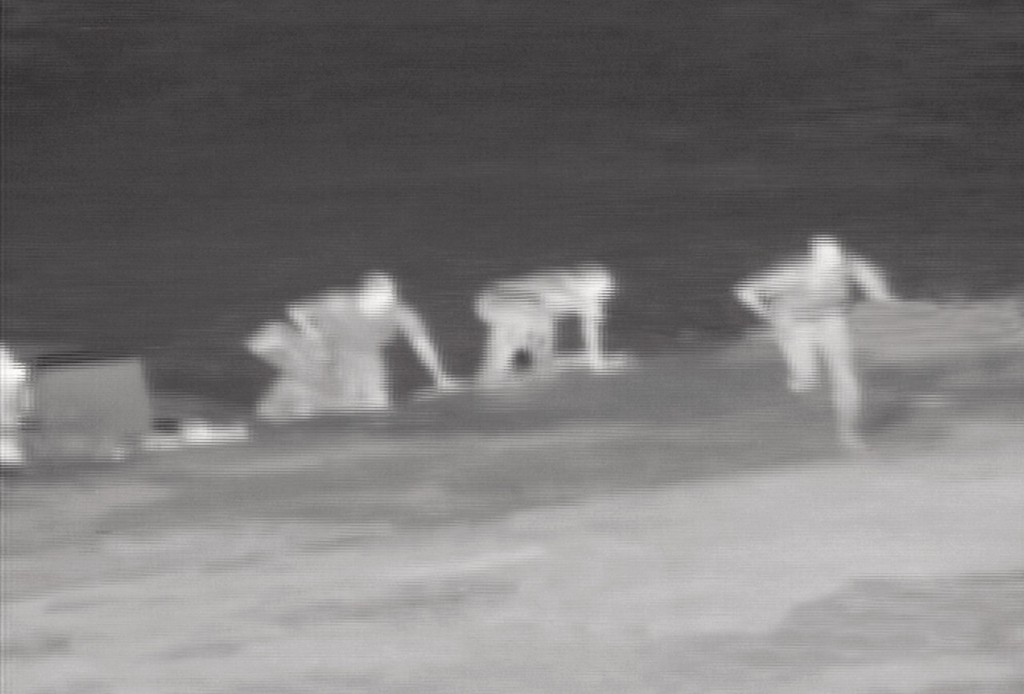
People on ship - Powerful new M-Series night vision camera from FLIR FLIR
http://www.flir.com/cvs/apac/en/maritime/
Going back not all that far in time, the beam from the Police helicopter’s spotlight as it flew overhead at night, used to make you think there was a lunar eclipse going on right there in your backyard.
A breakthrough came when infrared technology was applied and relatively small, gimballed units could be mounted to the fuselage. They offered a greater range and could supply better visual information to the crew than had ever been imagined. One of the world’s leading suppliers of this technology is FLIR Systems Inc, who takes their name from the acronym for Forward Looking Infra-red
Today, the military detection and surveillance division is still not only the largest component of FLIR, the corporation, it also provides many of new technological breakthroughs that will one day soon see your mobile phone offer IR capabilities.
One of the most amazing and incredibly beneficial of these, has been the recent introduction of the latest image processing chips, microbolometers. This one development alone has seen a massive reduction in the size of the units, the overall price of them and ultimately, a huge increase in the sheer volume of applications and gear into which it can be deployed.
By moving from elaborate cameras that required gas cooling, which in itself not only added size and weight, but also required high-tech maintenance, to microbolometer sensor arrays, you could now have IR equipment literally in your hand.
You still need to use the gas-cooled cameras for long distance viewing, say up to five kilometres, which is great for border protection and certain military uses, but when you appreciate the number of applications requiring the technology on a much shorter range, the microbolometer is a breakthrough of massive proportion.
Many acquisitions over the last 15 years have seen FLIR Systems now leading the charge for uses in the electrical, mechanical, building, medical, robotics/automation, security and automotive arenas.
One of FLIR’s more recent corporate purchases was Raymarine, as the company sought to find ways to introduce the maritime world to the wonders of its technology. It does not matter whether you are a superyacht, local hobbyist fisherman, round the world cruiser or serious offshore racer, as there is a FLIR product to not only match the size of your vessel, but your needs and applications as well.
If you’re an offshore racer, you could see the requirement to keep a handheld version strapped to the pedestal and be as important overall to the boat as the ship’s knife. Think of a MOB situation or actually determining the finish line marks in the dark. Perhaps you’re close to rocks and there, a FLIR product would add more than a little comfort to the equation.
As a round the world cruiser, you could consider it as essential as AIS. With most cruisers also going short-handed, it adds a safety element that is nearly unsurpassed and its use to firstly find a port at night and then to provide a clear path to shore as you row the dinghy in, is literally self-explanatory.
The same goes for the fisherman, returning to port a bit later than expected and needing help locating the launch ramp in the dark.
Superyachts and commercial vessels can utilise larger units to not only assist with entering ports and docking, but also locating tiny craft like rowing shells and kayaks.
Having this information on the chartplotter or the Navigator’s tablet, in the case of a racing yacht, is virtually unprecedented.
No doubt, this is exactly why both Sydney’s harbour and Brisbane’s river ferries have readily adopted the use of the technology.
To get a better understanding of all the FLIR is up to and capable of, Peter De Ieso, the Distribution Manager for FLIR in Australia, was able to shed some light, so to speak.
‘FLIR Australia utilises the three corporate areas of operation too. You have the one for Government work and then there is thermography.
The latter is more about condition monitoring or preventative maintenance, especially in the electrical industry. It is this area that can do things like see where there is insulation or not in houses, check for moisture leaks and investigate switchboards to see which circuits are running a lot hotter than others and where you could potentially have a problem. The newest division is called Commercial Vision Systems and it was created specifically for the newer markets that FLIR was beginning to operate in. Things like maritime, security and transportation industries. This is the division that will drive the volume up, the prices down and create all the new applications’, said Peter.
Around seven years ago, the automotive industry was one of the first to adopt the technology. In high-end brands like BMW, Audi and Rolls Royce FLIR cameras help to detect pedestrians at night, which is when most of those specific types of accident occur.
In Australia, you would not have to look to far to see the same principle also apply to the beloved Kangaroo.
‘Your headlights work to between 100 and 200 metres, but pathfindIR (FLIR’s automotive product line) can see up to 800 metres in front of you, so it ‘outsees’ your headlights quite easily. You couldn’t see this with a visible live camera. With a thermal imaging camera, everything within the image is very high contrast (sensitive to 0.05 degrees Celsius), so things stand out and that’s what you want as an operator of the vehicle, as you will not be caught staring at the screen for ages and losing concentration on the task at hand - driving. You want to be able to quickly notice something there, so you can react to it very quickly and that’s why they have chosen us. We see it as a bit like an airbag safety type feature for the automotive industry’, Peter explained.
Maritime uses first started to appear around 2006 as well, and FLIR have produced three generations since then, as the technology marches forward. Radar struggles to pick up some of these smaller objects and it also takes a fair bit of skill to be able to operate it proficiently enough to get that sort of detail.
Also, it takes a lot of time to study the screen and figure out what you are seeing, whereas it’s a very natural thing to be able to look at actual vision and pilot the boat forward. There is no real training there, because we have all been exposed to television and GPS/Chartplotters, so the extension is not that great.
At night time, it is near impossible to find someone in the water. As a test, draw a face on a balloon and throw it overboard. You’ll be lucky to make ten as you count up, with you moving and the waves making it more and more obscure. Marine thermal imaging just makes a lot of sense for man overboard alone!
A thermal camera works by producing an image that displays the variations in heat. To understand that, you have to even think of an ice cube as ‘hot’, because it is way above absolute zero. Similarly, different materials on the planet firstly absorb and then omit heat at different rates.
Peter explains for us, ‘If you take one of our FLIR Maritime products, you can even tell the difference between oil on the water’s surface because they are omitting their stored heat at different rates. Your new FLIR product can see differences in temperature to 0.05 degrees Celsius and then has 256 shades between black and white to display them.
We are all in the physical world. As an example, try wearing a wetsuit. The mask shields the heat from your body, but our product will still see the wetsuit. If you held up a sheet of glass, we’d see the glass and then your two hands on the sides holding it up.’
With five distinct model groups on offer, there is definitely a FLIR product to suit both your needs and budget. The HM Series allows for a video feed and also has a 2x Extender available for the lens, to increase its range. It can record live footage for up to two minutes, as well. As a battery powered model, it is more suitable for land-based activities, which is why mobile surveillance units choose one of the HM range.
The First Mate is rugged, lightweight and easy to use. It has an in-built Lithium Ion battery, and so as long as it’s charged, you won’t have to worry about spare batteries. It powers up virtually instantaneously and with just the three buttons, it is exceptionally easy to use. Being both small and light, the First Mate is ideal for sailors and trailer boats.
The Navigator II is an extremely affordable thermal imaging package and ideally suited to fixed mount, forward looking only applications on larger, displacement hull types of powered vessels, as it does not have shock resistance, such as the pounding of a planning hull landing after jumping waves. If the latter is you, the award-winning M Series is far more suitable.
The M Series won the prestigious Design Award, Marine Equipment Trade Show in the electronics category and was also the overall winner.
Little wonder, really. The M Series is able to handle higher G force rates, has a user-friendly interface to control it and switch between white-hot and black-hot vision, along with a sleek modern design incorporating both tilt and pan functionality. You can choose the resolution/range you require and whether or not you need a low light CCTV camera as well. ‘Rivieras, Maritmos and those sorts of craft are very much suited to this sort of equipment. Today the M Series range would have to be our main selling maritime camera’, said Peter.
The Voyager II is at the ultimate end of the microbolometer series of FLIR products. It offers the longest range – able to detect a MOB at 1.4nm - and it’s gyro-stabilised, so the on-screen image remains steady. There are two thermal imaging cameras for both wide and narrow angle vision, as well as a low-light camera and importantly, it can link in to your radar to track targets. You can also push the video to compatible devices, so that the vision can be seen in multiple locations. Control of the Voyager II is achieved via a Joystick and the panel also incorporates all controls for switching between cameras. Importantly, you can also access the Voyager via TCP/IP, meaning you can see the imagery from any Internet capable network, the world over.
‘FLIR does spend a lot of its revenue on Research and Design. We are either doing that or acquiring other companies, as there is always road map of new products. FLIR Systems’ goal is to have Infra-red everywhere. We see this technology as being as ubiquitous as GPS now is. GPS is in our phones, cars and boats. It is everywhere and thermal imaging has taken the same track. I predict that in the next few years we will have thermal imaging cameras in our mobile phones’, said Peter.
So no matter what the weather is doing, whether it is light fog or just plain black, the moon is down, it’s all gone a little sideways on you or you have been into that port a thousand times before, there is a FLIR product to help with your situational awareness. After all, everything on this planet is above zero degrees Kelvin (-270 degrees Celsius), and accordingly, it leaves a heat signature.
See and believe for yourself contact FLIR +61 3 9550 2800 or visit FLIR Systems website to begin your journey in to the world of Infra-red.
If you want to link to this article then please use this URL: www.sail-world.com/95811